You should build your closet around the storage type that matches most of your wardrobe. Start by laying out every garment and sorting them into hangables and foldables. If you own more delicate fabrics, formal wear, and structured pieces, prioritize hanging space. If your wardrobe leans toward casual knits, t-shirts, and heavy sweaters, focus on folding storage first. Understanding your specific inventory ratio will help you create a layout that works for your daily routine.
Hanging or Folding: Which Storage Type Comes First?
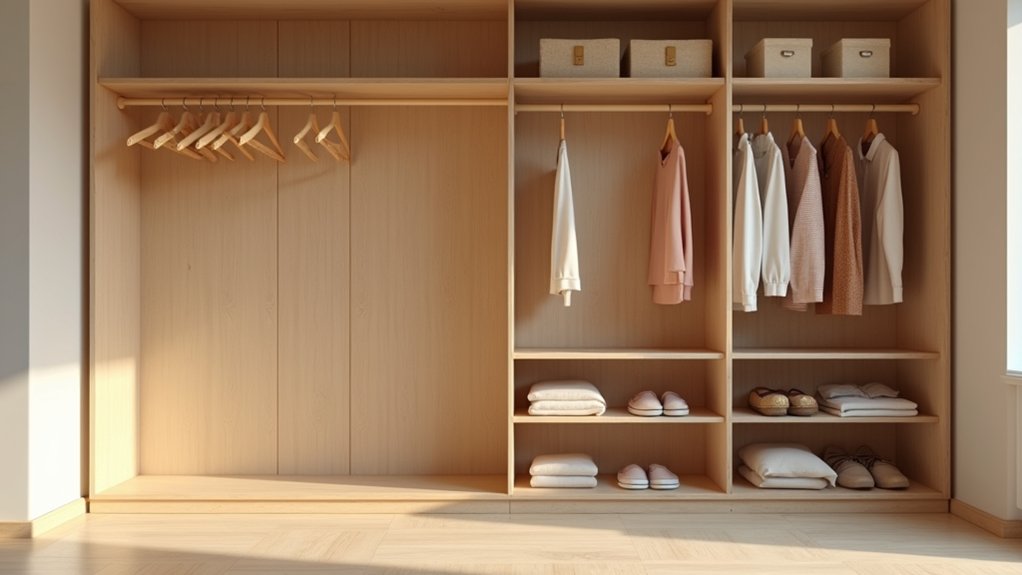
Everyone approaches closet organization differently, but the hang-versus-fold decision ultimately comes down to three factors: your available space, your fabric types, and your garment weights.
Start by examining your closet’s configuration. If you’ve got limited drawer space, you’ll want to prioritize hanging foldable items like pants and sweatshirts. Conversely, abundant drawer space means you can file T-shirts for easy visibility. Since folding is an excellent way to maximize closet space, this approach works especially well for smaller wardrobes.
Your closet’s layout dictates your strategy, limited drawers mean more hanging, while ample storage opens up folding options.
Next, evaluate your garment characteristics. Linen and silk require hanging to prevent creasing, while heavy knits like cashmere need folding to avoid stretching. Your fabric inventory directly shapes your storage needs. For items like jackets and blazers, always use padded hangers to maintain their shape and structure.
Finally, consider weight. Chunky sweaters fold best, but lightweight slacks hang well on clip hangers. By analyzing these three elements systematically, you’ll establish a foundation for overall closet organization that works specifically for your wardrobe. When shopping for new pieces, perform a quick “crush test” in the dressing room to determine whether a garment will wrinkle easily and require hanging space.
Count Your Hangables vs. Foldables Before You Plan
Before you reconfigure a single shelf, you’ll need to lay out every garment and sort them into hangables and foldables based on fabric type and structure. This inventory determines your space allocation ratios, whether you need more rod length for dress shirts and coats or additional drawer space for knits and casual wear. Since folding is more space-efficient than hanging, you may find that dedicating more square footage to drawers and shelves allows you to store a larger wardrobe in a compact closet. Once you’ve tallied each category, measure your closet’s vertical clearance and shelf dimensions to match your actual storage needs. When planning your hanging rod length, allow 1 inch per hanging item plus a 20% buffer to prevent cramped rods and wrinkled clothing. Keep in mind that a standard 36-inch-wide reach-in closet with an 8-ft ceiling provides 11 linear feet of hanging space, which helps you calculate whether your hangable inventory will fit.
Inventory Your Wardrobe First
How can you design the perfect closet layout if you don’t know what you’re actually storing? Start by laying all garments on a flat surface for visual assessment. Your garment care considerations determine which items need hanging versus folding.
Categorize everything using these criteria:
- Hangables: silk, satin, formal wear, pleated items, and embellished garments
- Foldables: jersey knit, cotton t-shirts, knitwear, and casual apparel
- Fabric type: delicate materials hang; stretchy fabrics fold
- Shape preservation: structured pieces require hangers
- Wear frequency: prioritize accessible placement for daily items
Record your totals in a spreadsheet or tracking app. This data drives your space utilization approach and reveals actual storage needs. You’ll discover whether hanging rails or folding shelves deserve priority, eliminating guesswork from your closet design decisions. If your inventory reveals more foldables than hangables, consider that foldable closet organizers and storage bins have the highest sales volume among portable wardrobe solutions, reflecting their effectiveness for most consumers’ storage needs. Keep in mind that folded items take up less space, allowing you to fit more garments in compact areas when rail space is limited. Once you’ve completed this inventory, audit your garments every 90 days and donate or sell anything unworn for six months or longer to prevent closet overcrowding.
Categorize by Storage Method
Why does counting your hangables versus foldables matter so much? This count directly determines how many linear feet of rod space you’ll need versus shelf quantity. Most adults own 75 to 150 hanging garments, and you’ll want to plan 1 inch per item plus a 20% buffer for growth.
Start by evaluating garment fiber resilience. Cotton dress shirts, linen trousers, and silk blouses demand hanging to prevent wrinkles and distortion. Sweaters, t-shirts, and jeans fold efficiently on shelves. Beaded items should always be hung to prevent snagging against other fabrics in your drawers or on shelves.
For hanging space optimization, separate items into short-hang (36-42 inches) for shirts and jackets, and long-hang (60-66 inches) for dresses and coats. Consider double-hang systems to maximize vertical space for shorter pieces while reserving dedicated zones for full-length garments. Modular, adjustable organizers allow you to reconfigure your hanging and folding ratios as your wardrobe evolves over time.
Measure Available Space Options
Every closet makeover starts with hard numbers, not guesswork. Before selecting appropriate hanging systems, you’ll need a complete inventory of your wardrobe. Count your hanging garments separately from folded items to determine which storage method dominates your needs.
Start with these measurements:
- Tally hanging pieces (most adults own 75, 150 items requiring rod space)
- Count folded items like T-shirts and jeans (typically 20, 40 pieces)
- Measure shoe collection (25, 50 pairs) and accessories
- Calculate available floorspace requirements for reach-in (24″ deep × 4, 8′ wide) or walk-in layouts
- Plan 1 inch of rod space per garment plus 20% buffer
Your inventory data directly dictates how many linear feet of hanging space, shelf quantity, and drawer count you’ll need. This systematic approach prevents cramped rods and wasted vertical space. Consider your personal habits and whether your wardrobe leans more casual versus formal, as this significantly impacts which storage method should take priority in your design. To maintain accuracy over time, review your closet inventory quarterly and adjust your organization system as your wardrobe evolves.
When to Build Your Closet Around Hanging Space
When your wardrobe consists primarily of delicate fabrics, professional attire, or beaded garments, you’ll want to design your closet with hanging space as the foundation. Garment fragility dictates storage method, silk wrinkles when folded, and beaded pieces snag against each other in drawers.
Your structured garment needs determine rod allocation. Plan 1 inch per blouse, 1.25 inches for pants and skirts, and 2-3 inches for suits and dresses. Most adults own 75-150 hanging items, so measure your current collection and add 20% buffer space.
Consider double-hang configurations if you have 84 inches of vertical clearance. Position upper rods for shirts and folded pants while reserving lower rods for skirts and cropped jackets. This maximizes accessibility and keeps daily essentials within the prime 30-60 inch zone. For double-rod installations, ensure your closet maintains a minimum height of 84 inches to accommodate both hanging levels comfortably.
When Folding Storage Should Take Priority
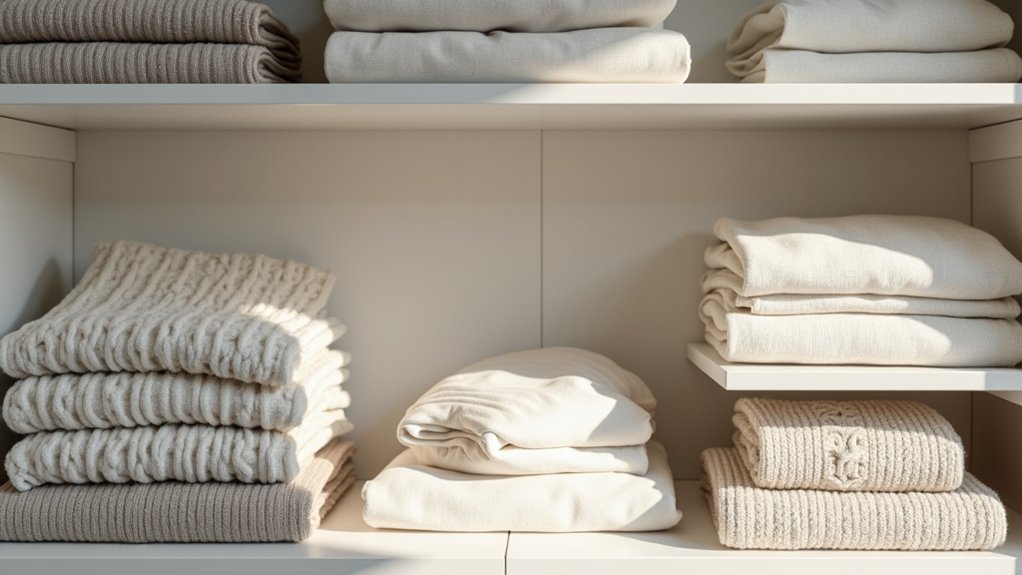
If your wardrobe consists primarily of t-shirts, jeans, sweaters, and casual knits, you’ll benefit more from drawer and shelf space than hanging rods. Limited closet rod space shouldn’t force you to cram items together, instead, shift your storage strategy toward folding solutions that maximize every available inch. Pull-out bins and baskets work especially well for this approach, providing easy access to smaller items like socks, underwear, and accessories that would otherwise get lost in drawers. Stretchable fabrics like cotton knits and synthetic blends actually maintain their shape better when folded properly rather than hung, making drawer-heavy organization the smarter choice for your specific clothing collection. Folding t-shirts in a way that displays each one also provides easy accessibility, allowing you to quickly select what you need without disrupting the entire stack.
Drawer-Heavy Wardrobe Contents
How do you know when your closet needs more drawers than hanging rods? Your wardrobe composition tells the story. If you own more foldable items than hangable pieces, prioritize concealed storage compartments over rod space.
Consider drawer-focused design when your wardrobe includes:
- Extensive athletic wear requiring folded organization
- Large accessory collections like scarves, belts, and jewelry
- Bulky knitwear that stretches on hangers
- Undergarments and socks needing categorized storage
- Seasonal items you rotate throughout the year
Ergonomic drawer configurations maximize accessibility in compact urban spaces where every inch matters. With shelving units holding 64.1% market share in closet organizers, the industry confirms drawer-heavy systems meet modern storage demands. You’ll find modular drawers particularly effective for managing the 300,000 items found in average American homes.
Limited Hanging Rod Space
Before purchasing additional hanging rods, audit your wardrobe to determine whether folded storage actually serves you better. Count your long items requiring over 50 inches of vertical space, most people overestimate this need. If you own 60 short items versus 10 long pieces, strategic folding organization delivers superior results.
Maximizing double hang capacity transforms limited rod space dramatically. Double-hang configurations store 16-20 pieces per linear foot compared to 8-10 for single rods. Position your top rod at 80-84 inches and bottom rod at 40-42 inches to prevent overlap.
For closets five feet wide or less, dedicate one side to hanging and the opposite to shelves. Use 24-inch wide drawers that accommodate two folded stacks side-by-side, maintaining a functional center walkway throughout your space.
Stretchable Fabric Dominance
While maximizing your hanging rod space solves one storage challenge, your fabric composition often dictates whether hanging actually makes sense at all. Your fabric composition considerations should guide every storage decision you make.
When knits, cotton jerseys, and stretch blends dominate your wardrobe, prioritize folding infrastructure:
- Knitwear protection: Hanging stretches knit loops vertically, degrading elasticity within 3 wear cycles
- Cotton preservation: Gravity elongates shoulder seams by up to 1.2 cm annually on hangers
- Merino investment: Folded sweaters retain loft for 5+ years; hung versions flatten within 12 months
- Activewear care: Compartmentalized dividers with breathable materials prevent moisture retention
- Storage containers: Canvas boxes containerize garments without excessive weight loading
These fiber longevity strategies extend garment life by 3, 5 years through proper folding techniques.
How to Balance Hanging and Folding in a Small Closet
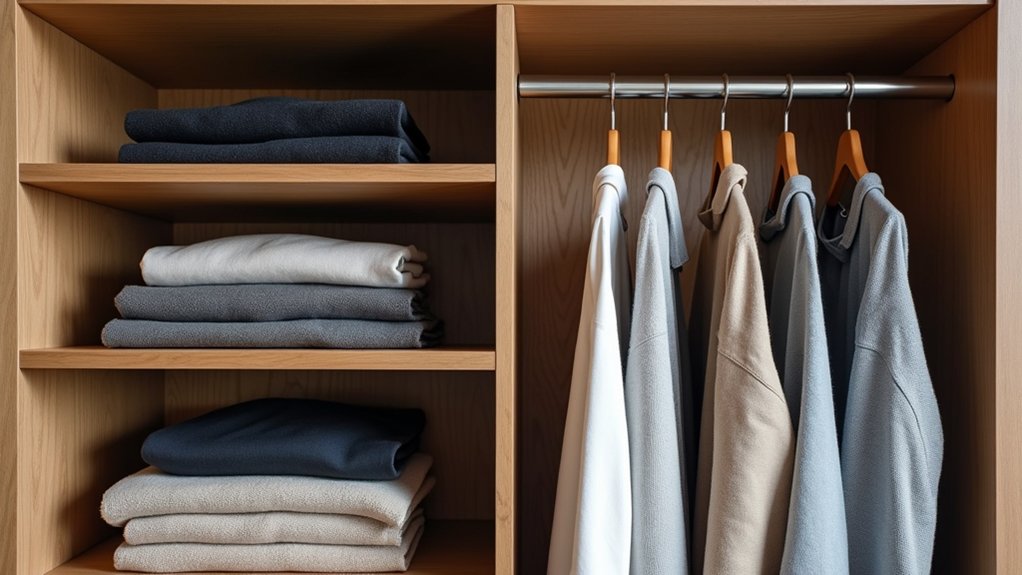
Balancing hanging and folding in a small closet comes down to one key ratio: allocate 70-75 percent of your space to hanging and reserve 25-30 percent for shelving or folded storage. Within your hanging section, dedicate 85 percent to double hang and 15 percent to long hang for dresses or coats.
When considering season-specific needs, you’ll likely require only 4-6 long hang items at any time. Double hang stores 16-20 pieces per foot, nearly doubling your capacity compared to single rods.
For optimizing vertical storage, install shelves to the ceiling with 10-14 inch spacing, closer for shoes, wider for sweaters. Slim velvet hangers add 20-30 percent more capacity. This systematic approach maximizes every square foot while keeping essentials accessible.
Choose a Layout Based on What You Wear Most Often
Your closet layout should mirror your actual wardrobe habits, not an idealized version of how you dress. Data shows black walking shoes get worn 100+ times annually, while parkas and jackets see 41-75 wears. Prioritize accessible space for these high-frequency items.
Consider these usage patterns when designing your layout:
- Outerwear priority: Jackets and parkas rank among most-worn items, deserving prime hanging real estate
- Seasonality considerations: Rotate storage based on current weather demands
- Footwear placement: Position frequently worn shoes at eye level or within easy reach
- Jeans and pants: Items worn 14-33 times monthly benefit from folded stacks or pull-out drawers
- Knitwear storage: Sweaters worn 21-53 times should be folded to prevent shoulder stretching
Track your actual wear frequency before committing to permanent storage solutions.
Frequently Asked Questions
What Hanger Types Work Best for Heavy Winter Coats and Suits?
For heavy winter coats and suits, you’ll want wooden hangers with thick, curved shoulders that maintain garment shape and prevent shoulder deformation. Grade A beech wood construction handles substantial weight without bending. For suits with silky linings, velvet hangers provide non-slip surfaces that prevent sliding. Consider wide-shoulder options measuring 19 inches to distribute weight evenly across heavier pieces. Composite hangers with wire reinforcement also work well for bulky winterwear.
How Do I Prevent Sweaters From Stretching When Storage Space Is Limited?
You’ll protect your sweaters by rolling sweaters from the thickest area, which prevents unraveling and maintains shape. Avoid packing sweaters tightly in vacuum bags, this causes distortion. Instead, use breathable cotton bags or acid-free bins lined with tissue paper. Store them in cool, dry spaces and layer tissue between each piece. Periodically unpack and air your knitwear to maintain structure and prevent moisture damage.
Can File Folding Damage Delicate Fabrics Over Time?
Yes, file folding can damage delicate fabrics over time. The tight, upright stacking creates sharp creases that weaken fibers, especially in silk, cashmere, and lace. You’ll notice stress points where tears develop in brittle materials. For better fabric preservation, you should pad folds with acid-free tissue paper, which also aids moisture absorption. Alternatively, store delicates flat or roll them loosely to eliminate crease damage entirely while maximizing your limited space.
What Drawer Depth Is Ideal for Folded Jeans and T-Shirts?
For ideal folded garment storage, you’ll want drawers measuring 18 inches deep. This drawer depth for folded items accommodates both jeans and t-shirts without compression or cramping. While t-shirts fit comfortably in 12 to 14-inch depths, jeans require the extra space that 18-inch drawers provide. Pair this depth with 6-inch drawer heights for t-shirts and 8-inch heights for bulkier denim to maximize your storage efficiency.
Should Seasonal Clothing Rotation Affect My Closet Layout Decisions?
Yes, seasonal clothing rotation should directly influence your closet layout decisions. When you plan for seasonal storage needs upfront, you’ll create dedicated zones for active items while reserving upper shelves or under-bed areas for off-season pieces. Your rotating wardrobe considerations should include keeping year-round essentials accessible and designing primary closet space around current-season dominance. This systematic approach guarantees you’re reaching for weather-appropriate clothing without daily decision fatigue.