For 2026, TFL (thermally fused laminate) and melamine rank as your most durable closet materials, offering superior moisture resistance, scratch protection, and sag prevention at spans up to 36 inches. Solid wood handles longer spans up to 48 inches but struggles with humidity. MDF falls to the bottom, requiring support every 24 inches and failing faster in real-home conditions. Your climate, budget, and storage loads will determine which material performs best in your specific situation.
2026 Closet Material Rankings: Best to Worst for Durability
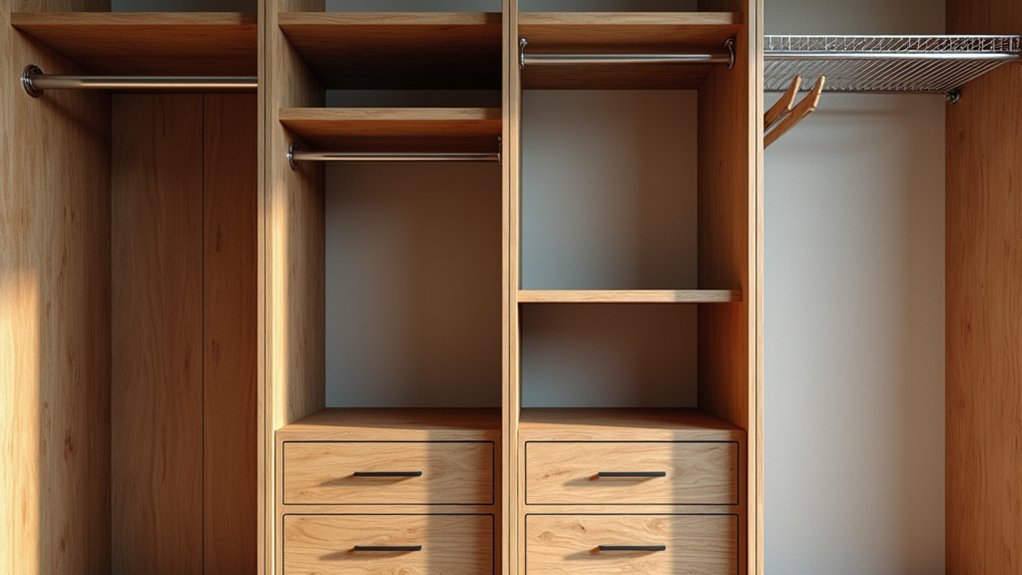
When you’re selecting materials for a custom closet, durability should drive your decision, not just aesthetics or upfront cost.
Durability beats beauty every time, choose closet materials that last, not just ones that look good today.
Rankings from Best to Worst:
- Solid Wood, Unmatched longevity, superior hardware holding, resists wear for decades. The natural grain patterns and rich stains also enhance any décor style.
- Melamine, Best balance of durability and value; resists moisture, mold, and warping. Melamine surfaces can be wiped with a damp cloth and mild soap, making no-fuss cleaning a practical advantage for busy households.
- Plywood, Handles heavy loads well, though it requires edge finishing and periodic sealing.
- Metal, Industrial strength for walk-ins, but limited residential appeal.
- Laminate, Sleek designs with easier installation challenges, yet less robust long-term.
- MDF, Budget-friendly with excellent paint adhesion, but weakens under humidity and heavy use.
You’ll notice composites like melamine outperform MDF in real homes because they handle moisture without swelling. A full custom melamine wardrobe typically costs between $1,500 and $5,000, making it a cost-effective choice for homeowners seeking long-term value. For maximum durability, prioritize materials matching your closet’s specific load and humidity conditions.
The 4 Factors That Determine Closet Material Lifespan
Four critical factors separate closet materials that last decades from those that fail within years, and understanding each one helps you make smarter investment decisions.
- Moisture resistance, Climatic demands on materials vary considerably. Humid environments require edge sealing and moisture-resistant cores, while MDF warps without proper finishes. MDF should be avoided in bathrooms or other areas prone to dampness and high humidity.
- Weight load capacity, Solid wood and plywood resist bending under heavy items, whereas low-cost pressboard sags with sustained weight. Reinforced shelving and hanging systems can handle heavy items without damage, ensuring your closet maintains perfect alignment even under significant loads.
- Installation quality, Built-in systems with solid anchoring last 20-30+ years compared to modular options requiring frequent maintenance. Plywood cores with laminate finishes outlast particleboard cores significantly, making them worth the added investment.
- Hardware and edgebanding durability, Furniture-grade components endure thousands of cycles, preventing loosening and chipping.
Realistic budget considerations should balance upfront costs against replacement frequency. You’ll save money long-term by prioritizing these factors over initial price tags.
Span Limits and Sag Resistance: A Material Comparison
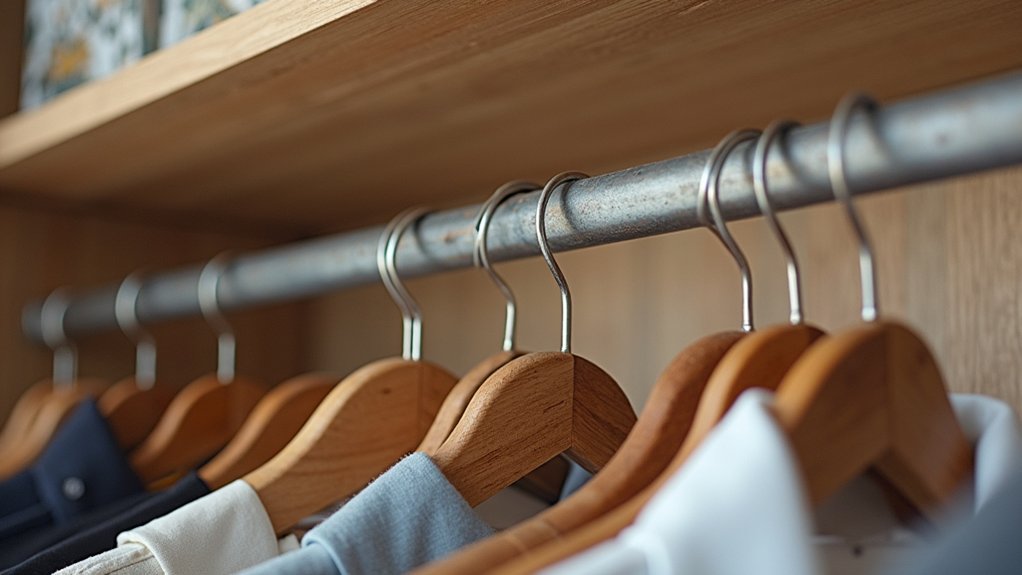
When you’re planning your closet shelving, understanding each material’s span limits helps you avoid frustrating sag problems down the road. You’ll find that solid wood handles spans up to 48 inches under heavy loads, while plywood performs well at 36 inches, and MDF struggles beyond 24 inches even with lighter items. Knowing these weight load thresholds and long-term sag prevention strategies lets you choose materials that’ll maintain their structural integrity for years. Keep in mind that shelves can experience an additional 50% sag over time, so building in extra stiffness from the start pays off in long-term performance. For linen shelves holding bedding and folded clothing, you should limit spans to 32 inches to prevent sagging regardless of material choice. For heavy-duty applications, consider that hollow steel shapes provide excellent strength without adding excessive weight to your closet system.
Maximum Span Capabilities
Understanding how far a shelf can stretch without sagging directly impacts your closet’s functionality and long-term performance. Span variability differs considerably across materials, making material selection factors critical for your project’s success.
- Solid wood supports spans up to 48 inches with minimal bracketing needed
- Plywood handles up to 36 inches while maintaining structural integrity
- Melamine matches plywood at 36 inches thanks to its laminated construction
- MDF requires support every 24 inches to prevent sagging
You’ll notice that shelves exceeding 36 inches demand additional reinforcement regardless of material choice. Standard closet depths of 24 inches influence your effective span planning, while reach-in configurations ranging from 36 to 96 inches require careful bracket placement to maintain long-term stability. For walk-in closets, the standard size of approximately 6.5 feet by 10 feet provides more flexibility for incorporating longer spans with strategic support systems. When planning shelving for folded items, keep in mind that optimal shelf depth ranges from 12 to 16 inches, which affects how much weight distribution occurs across your chosen span length. Plywood’s cross-grain layered construction gives it excellent resistance to warping, making it particularly reliable for larger storage components that need to maintain their shape over extended periods.
Weight Load Performance
Because your closet shelves must support everything from lightweight linens to heavy storage bins, understanding each material’s weight load performance helps you avoid costly failures down the road.
| Material | Load Capacity | Humidity Tolerance |
|---|---|---|
| TFL Panels | 250, 300 lbs/32″ shelf | Excellent |
| Wire Systems | 100 lbs/linear foot | High |
| Solid Hardwood | 35, 50 lbs/linear foot | Moderate |
| MDF/Particleboard | 50, 100 lbs/shelf | Poor |
TFL panels deliver 2, 3 times the strength of particleboard, making them your top performer for heavy loads. Wire systems handle moisture challenges effectively with vinyl-coated steel that resists corrosion for 10, 15 years. Solid hardwood offers superior scratch resistance but remains vulnerable to humidity swings causing thickness changes. Hard maple stands out among hardwoods with a Janka rating of 1,450 lbf, supporting over 50 pounds per linear foot, ideal for storing heavy winter coats. MDF requires edge finishing due to low moisture resistance. Budget closet systems often use traditional HPL bonded to cheaper cores, which is why TFL’s superior construction requires diamond-tipped saw blades to cut, a testament to its exceptional density and durability. For closet poles specifically, metal options like stainless steel or aluminum prove most durable and can support heavier clothing items without sagging over time.
Long-Term Sag Prevention
Everything you place on a closet shelf exerts constant downward pressure, and selecting the right material for your span length determines whether that shelf stays flat for decades or develops an unsightly bow within months.
Here’s how materials rank for span performance:
- Solid wood handles spans up to 48 inches with superior hardware holding strength
- Melamine maintains sag-proof stability up to 36 inches under daily use
- Plywood offers reliable performance up to 36 inches with domestic-core varieties
- MDF requires supporting wall mounts every 24 inches to prevent collapse
You’ll want customized reinforcement options for any material exceeding recommended spans. Particleboard and MDF absorb humidity, losing strength over time. For durability-focused applications, melamine and solid wood deliver the structural stability your closet demands long-term. Most closet components should use ¾ inch thick material, which provides the perfect strength-to-weight ratio and is considered the industry standard for closet shelving.
Why Melamine Outperforms in High-Humidity Homes
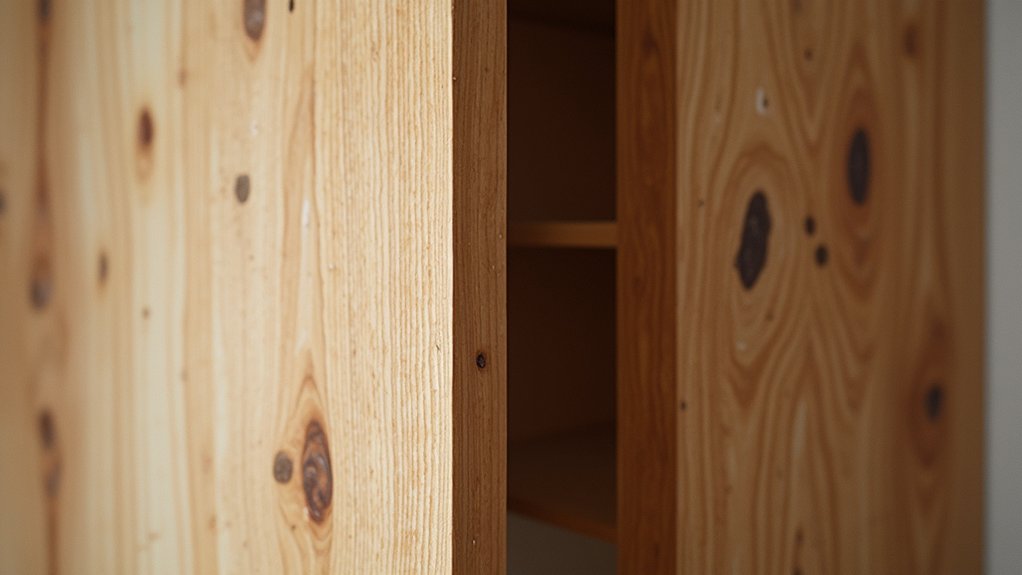
| Feature | Melamine | Solid Wood |
|---|---|---|
| Moisture Resistance | Excellent | Poor |
| Mold/Mildew Risk | Low | High |
| Shelf Stability | Maintains Level | Warps Over Time |
Your closet shelves remain level and functional because the laminate coating creates a protective barrier against water infiltration. This resistance to mold and mildew means you won’t face costly replacements in high-use, humid environments.
TFL: The Engineered Closet Material Most People Overlook
When you’re evaluating closet materials, TFL delivers the superior strength and durability that high-traffic spaces demand without the premium price tag of solid wood. You’ll appreciate how its moisture and scratch resistance protects your investment against daily wear, humidity, and the inevitable bumps from hangers and storage bins. The realistic wood grain textures give you the aesthetic you want while the engineered construction provides the performance your closet actually needs.
Superior Strength And Durability
Three key properties separate premium closet materials from budget options that fail within years: resistance to warping, load-bearing capacity, and dimensional stability under varying conditions. TFL’s microscopic structure creates a uniform surface that resists cracking better than grainy alternatives.
Here’s what you’ll notice with TFL’s material uniformity:
- Warping resistance – Engineered as a single unit rather than stacked layers, eliminating weak points
- Moisture protection – Laminate coating shields against humidity damage common in closet environments
- Load consistency – Maintains structural integrity under heavy use without developing wear patterns
- Temperature stability – Won’t expand or contract like solid wood during seasonal changes
You’re getting engineered strength that outperforms both MDF and standard wood options for long-term closet applications.
Moisture And Scratch Resistance
Because closets face constant humidity fluctuations and daily contact with clothing hardware, hangers, and accessories, your material choice directly determines how long shelves and panels maintain their appearance.
In any moisture resistance comparison, TFL outperforms standard MDF and particleboard considerably. The thermally fused laminate surface prevents water absorption and swelling, making it ideal for humid climates like South Florida. When you seal edges properly, TFL blocks moisture infiltration entirely.
For comparative scratch resilience, TFL again leads the pack. The high-pressure fusion process creates a tough surface that withstands everyday scuffs, dents, and abrasion without peeling or chipping. You’ll notice shelves maintain their finish under daily use.
Melamine offers solid performance in both categories at a lower price point, though TFL delivers superior long-term durability.
Realistic Wood Grain Textures
While TFL excels at moisture and scratch resistance, its ability to replicate authentic wood grain textures makes it the engineered closet material most people overlook. The wood replication quality you’ll find in today’s TFL rivals solid hardwood at a fraction of the cost.
Consider these texture options for your closet design:
- Light birch patterns deliver clean, modern aesthetics
- Rich walnut finishes add warmth and sophistication
- Chocolate pear laminates mimic exotic hardwood character
- Oak natural grain brings classic depth and interest
The acrylic wood grain performance in premium lines features texture-matched surfaces that feel authentic to the touch. You’re getting furniture-grade quality with organic patterns and deep reveals that emulate real wood, without the maintenance demands or environmental impact of harvesting hardwood trees.
When Plywood Is the Right Closet Material Choice
When your closet project demands a balance of performance and value, plywood emerges as the ideal material choice. You’ll appreciate when plywood offers attractive wood aesthetics without the premium price tag of solid hardwood, saving 30-50% on material costs while delivering superior durability.
Its cross-laminated core provides space saving versatility, allowing longer shelf spans without sagging under heavy loads. You can maximize storage capacity while maintaining structural integrity throughout your closet system.
Plywood excels in moisture-prone areas near laundry rooms, resisting warping and swelling where solid wood fails. The layered construction holds screws securely for custom installations and withstands thousands of daily interactions without chipping.
For budget-conscious homeowners seeking long-term performance, FSC-certified plywood delivers functionality, sustainability, and reliability that outperforms MDF and particleboard alternatives.
Is Solid Wood Worth the Premium for Closet Shelving?
Solid wood commands a higher price point than plywood, but understanding what you’re paying for helps determine if the investment aligns with your storage needs.
Your cost performance analysis should weigh these functional advantages:
- Load capacity reaches 30, 50 pounds per square foot, supporting heavy bins and storage without sagging
- Hardwoods like maple last decades with proper maintenance, reducing replacement cycles
- Wood grain aesthetics add resale value, making custom installations attractive to future buyers
- Customization options include cutting, staining, and painting to match your exact specifications
You’ll need to commit to occasional finish care and strategic item placement to prevent warping. In controlled humidity environments, solid wood delivers timeless durability that justifies the premium investment.
Why MDF Fails Faster Than Other Closet Materials
MDF offers an attractive price point, but its composite structure creates vulnerabilities that accelerate deterioration in closet environments.
MDF’s budget-friendly appeal masks serious weaknesses that make it a poor long-term choice for closet installations.
You’ll notice edge deterioration vulnerabilities first, MDF chips easily around door edges and shelf corners, and unlike solid wood, you can’t refinish damaged surfaces. The material’s fine fibers absorb moisture rapidly, causing swelling that destroys structural integrity in humid closets.
Your shelves will sag under heavy loads since MDF lacks the directional grain strength found in plywood or solid wood. Hardware connections loosen as screws pull free from the compressed fibers.
Formaldehyde exposure risks present ongoing concerns, as unsealed MDF releases this chemical into enclosed closet spaces for years. This cumulative exposure in poorly ventilated areas creates health hazards you shouldn’t ignore.
Which Closet Materials Need the Least Maintenance?
Melamine-laminate panels top the low-maintenance list because their plastic coating creates a sealed barrier against stains, moisture, and everyday wear. You’ll never need polishing, waxing, or refinishing, just wipe surfaces clean with a damp cloth and mild soap.
When evaluating maintenance requirements and longevity performance, consider these rankings:
- Melamine-laminate panels, Wipe-and-go cleaning with zero refinishing needs
- Premium laminates, Scratch-resistant surfaces that resist fading and staining
- Plywood, Annual finish inspections with periodic resealing recommended
- Solid wood, Requires gentle cleaners and proper sealing to maintain shape
MDF with melamine coating offers budget-friendly upkeep but demands careful moisture avoidance. You’ll protect your investment by matching material choice to your realistic cleaning habits and environmental conditions.
Match Your Closet Material to Climate, Budget, and Load
Your ideal closet material depends on three factors working together: your local climate conditions, your project budget, and the weight your shelves need to support. Understanding how humidity, cost-to-durability ratios, and load-bearing requirements intersect helps you eliminate unsuitable options quickly. Let’s examine each consideration so you can match the right material to your specific situation.
Climate-Based Material Selection
When selecting closet materials, your local climate should drive the decision before aesthetics or brand preferences enter the conversation. Understanding humidity’s impact on material lifespan helps you avoid costly replacements within five years.
Match your region to the right material:
- Hot & humid climates, Choose melamine with sealed edges; it resists mold and prevents core swelling where moisture exposure is constant.
- Cold & dry climates, Plywood delivers superior sag resistance comparisons against other materials while handling heavy loads without warping concerns.
- Transitional climates, TFL panels with engineered cores maintain dimensional stability through seasonal humidity swings.
- Heavy-load storage, Regardless of climate, plywood and TFL support 250, 300 lbs per 32-inch shelf with reliable fastener retention.
Budget-Friendly Options Compared
Climate considerations set the foundation for material selection, but budget constraints often make the final call on what actually goes into your closet. When you’re seeking budget conscious materials, MDF delivers the lowest cost with smooth surfaces that accept paint beautifully for custom finishes.
Melamine offers durable options for minimal cost by combining water resistance with pre-finished surfaces that eliminate painting expenses. You’ll find it outperforms basic MDF while keeping costs manageable for reach-in closets.
Laminate provides exceptional long-term value through scratch and stain resistance, extending your closet’s lifespan without refinishing costs. For heavier storage demands, plywood costs more upfront but delivers superior screw-holding strength that prevents costly repairs later. Match your budget to your specific storage requirements for ideal results.
Load Capacity Considerations
Heavy winter coats, boot collections, and seasonal storage demands can push closet materials past their breaking points without proper load planning. You’ll need to match your material selection to actual usage patterns while considering moisture content monitoring for long-term performance.
Here’s what each material handles under real-world conditions:
- TFL panels support 250, 300 lbs per 32-inch shelf, outperforming standard particleboard by 2, 3 times
- Wire systems achieve 100 lbs per linear foot when stud-mounted at 16-inch spacing
- Solid hardwood handles over 50 lbs per linear foot with superior hardware retention
- Plywood manages 36-inch spans without sagging, ideal for heavy seasonal items
Material interchangeability matters when upgrading sections. You can combine wire systems in mudrooms with TFL in primary closets for optimized load distribution.
Frequently Asked Questions
Can Different Closet Materials Be Combined in the Same Closet System?
Yes, you can absolutely combine different closet materials in the same system. Customized material combinations let you match materials to specific functions, use plywood for heavy-duty shelving and melamine for standard storage areas. You’ll maximize durability while managing costs effectively. Coordinating material aesthetics guarantees your closet looks cohesive despite using multiple materials. This functionality-driven approach gives you the best performance where you need it most throughout your closet system.
How Do Closet Materials Affect Home Resale Value in 2026?
Your closet material choice directly affects your home’s selling price in 2026. TFL/laminate and melamine deliver the strongest impact on home selling price due to their material durability over time, moisture resistance, and low maintenance appeal. Plywood signals premium quality to buyers valuing robust construction. MDF risks lowering resale value unless properly sealed. You’ll maximize returns by selecting materials that demonstrate lasting functionality and require minimal upkeep for future homeowners.
Which Closet Materials Are Safest for Homes With Children or Pets?
For homes with children or pets, you’ll want melamine and TFL as your safest choices. These non-toxic materials won’t off-gas harmful chemicals, protecting your family’s indoor air quality. Both offer moisture-resistant options that prevent mold growth, critical in humid spaces where kids and pets spend time. Their scratch-resistant, smooth surfaces minimize injury risks and dust buildup. Plywood works well too, especially when sealed, while MDF requires extra sealing to avoid hazards.
How Long Does Professional Installation Take for Each Closet Material Type?
You’ll find installation time considerations vary vastly across materials. Melamine and TFL offer the fastest installs at 4-8 hours, with pre-finished surfaces eliminating extra sealing steps. MDF requires 5-9 hours plus 2-4 additional hours for painting and finishing. Plywood demands the lengthiest commitment at 6-10 hours due to edge finishing and reinforcement needs. For your planning purposes, expect most standard closets to complete within one full day.
Are Eco-Friendly or Recycled Closet Material Options Available in 2026?
Yes, you’ll find several eco-friendly closet materials in 2026. Plywood offers sustainable sourcing options through certified wood plies, while melamine uses engineered cores that reduce virgin wood extraction. MDF repurposes wood particles, minimizing waste. Solid hardwoods from responsibly managed forests provide refinishable longevity. Many manufacturers now employ environmentally conscious manufacturing processes, including low-emission resins and recycled content. You can prioritize functionality while choosing materials that align with your sustainability goals.