You’ll eliminate floor clutter by building your shoe storage upward in five strategic steps. Start by measuring your closet’s vertical space at multiple points, then select organizers that match your shoe inventory, whether stackable racks or adjustable multi-tier systems. Stack modular units and secure anything over two tiers to the wall for safety. Finally, protect your collection with dust-free covered solutions. Each step below breaks down exactly how to maximize every inch of available wall height.
Measure Your Closet’s Vertical Space Before Buying Anything
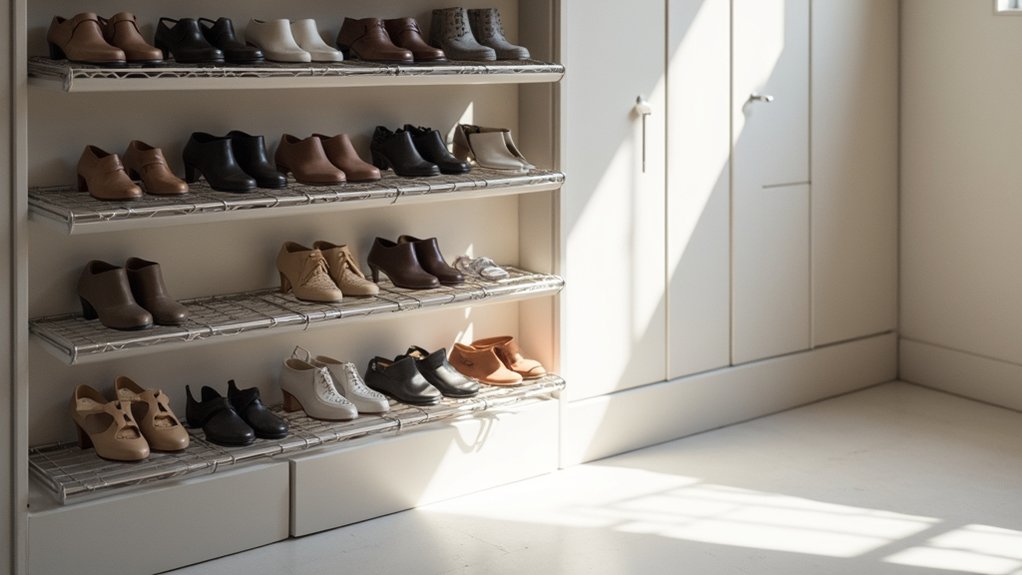
Before you invest in any shoe storage system, grab a tape measure and assess your closet’s vertical space, this single step prevents costly returns and guarantees you’ll maximize every inch. Leverage tape measure technique by placing your tape near the ceiling and extending it to the floor, keeping it taut with the locking mechanism. Record measurements at three points: baseboard level, chest height, and near the ceiling. Having a buddy for measuring makes this process easier and more accurate when dealing with larger closet spaces. Once you’ve organized your closet, consider the best solutions for managing backpacks, especially for families with children. Utilizing hooks, shelves, or dedicated compartments can streamline access and maintain order. This way, you can ensure that everything has its place, making it easier to grab and go when you’re in a hurry.
Account for molding dimensions since crown molding and baseboards extend 1-3 inches into usable space. Maintain 8 inches clearance between your system’s top and the ceiling. Always round down to the nearest 1/16th inch and measure three times to catch wall irregularities. Sketch your closet with labeled dimensions before purchasing. When measuring width, secure the 1″ mark against the left wall and pull the tape to the right wall, recording the smallest of three measurements taken at different heights to account for uneven walls. For shoe shelves specifically, plan for 6, 8 inches spacing between each shelf to accommodate most footwear styles while maximizing your vertical storage capacity.
Choose Vertical Organizers That Match Your Shoe Count
Once you’ve mapped your closet’s dimensions, selecting the right vertical organizer depends entirely on your shoe inventory. Assess overall storage needs by counting every pair you own, including seasonal footwear. When it comes to achieving optimal closet configurations for small spaces, consider incorporating multifunctional furniture to maximize utility. Additionally, utilizing vertical space with shelving or hanging organizers can create a more efficient layout, ensuring that your shoe collection is both accessible and neatly arranged. Don’t forget to leave room for seasonal rotation, allowing you to adapt your closet as your inventory changes throughout the year.
For collections under 15 pairs, the Simple Houseware 2-Tier Stackable Rack offers expandable storage without bulk. Mid-size collections of 30 pairs work well with the Seville Classics 6-Tier Rack, featuring adjustable shelves that accommodate everything from flats to boots.
Match your organizer to your collection size, stackable racks for minimalists, adjustable multi-tier systems for growing wardrobes.
Consider budget friendly options like the AmazonBasics 50-Pair Shoe Rack if you’re managing a larger household or growing collection. Its 10-tier design maximizes vertical space while assembling in minutes. For shoe lovers who want their collection always dust-free and visible, modular drop-front boxes stack securely while providing lasting protection.
Don’t overlook door-mounted solutions, the Whitmor Over-the-Door Rack holds 36 pairs without touching your floor. For compact spaces like studio apartments, a Lazy Susan shoe shelf maximizes vertical space with its rotating design that allows easy viewing and access to multiple pairs. Match your organizer’s capacity to your actual count, leaving room for future purchases.
Stack Modular Racks to Use Every Inch of Wall Height
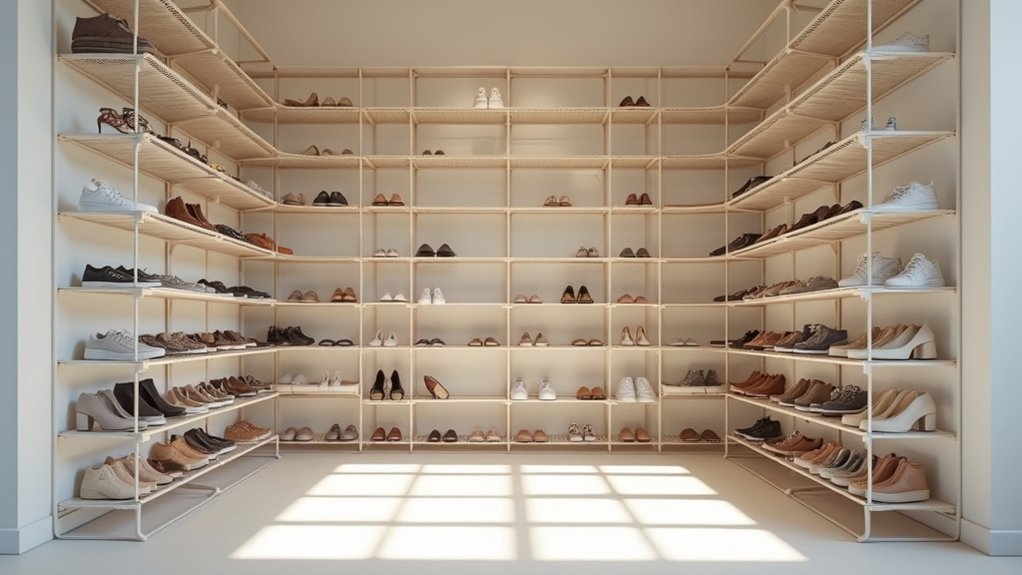
Everything in your vertical storage strategy changes when you start stacking modular racks, you’re no longer limited by a single unit’s capacity. You’ll easily integrate stacking pins by removing the caps from your base unit and inserting pins into the frame legs. Then lift your second unit onto the base, aligning all four pins for a secure connection.
For stacks exceeding two units, you’ll need to secure multiple units with wall mounting. Position your stack against the wall, insert an anchor above the top center, and wrap the mounting strap around the top horizontal back bar. Loop it through the wall bracket and fasten with the mounting screw. The included wall anchors provide essential stability and safety, and assembly requires 2 people to ensure proper installation.
Each modular segment holds 12 pairs, giving you 36 pairs across three stacked segments, all without expanding your floor footprint.
Install and Secure Your Vertical Shoe Storage System
Now that you’ve mastered stacking modular racks, you’ll want to build a custom vertical system that fits your exact closet dimensions.
Ready to level up? A custom vertical system transforms wasted closet space into perfectly organized shoe storage.
Start by drilling 1/2″ holes every inch along your uprights, skipping the last two inches at each end. Incorporating dowel bars as crossbars creates adjustable shoe supports that adapt to different footwear sizes. Mark precise locations before drilling to guarantee proper alignment.
Utilizing wood glue for sturdy assembly, clamp upright parts together and insert pegs with a hammer. Install two pegs per upright bottom to prevent twisting during use. Begin inserting 24″ dowels at the top and bottom positions first, this establishes structural stability before adding middle crossbars.
Finally, secure wheels or anti-slip feet to your base, giving you mobility without sacrificing steadiness. When mounting wall clips, ensure they are level and securely fastened to provide reliable support for your shoe shelves.
Keep Shoes Dust-Free With Covered Storage Solutions
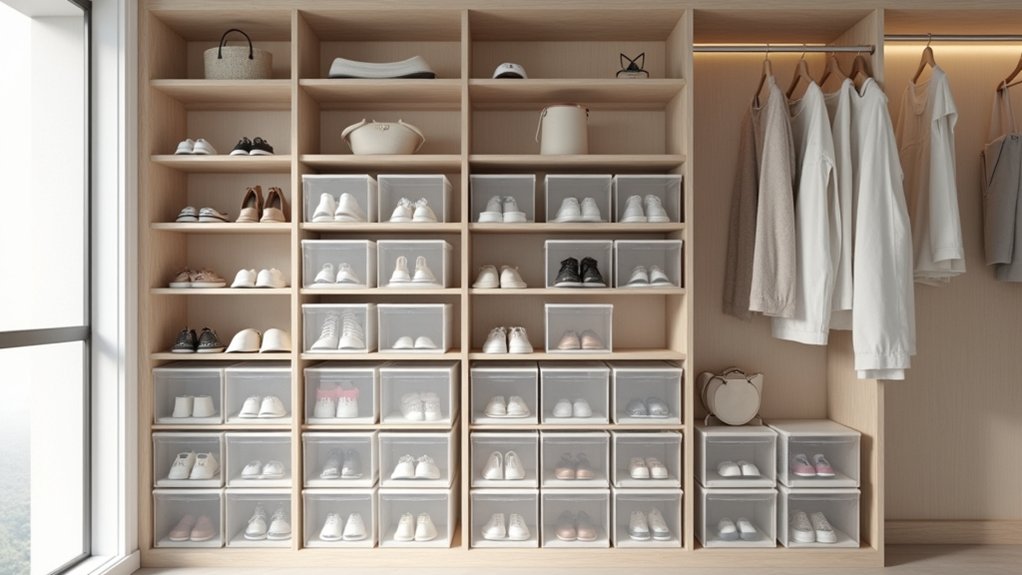
Whether you’ve built a custom vertical system or opted for modular racks, protecting your footwear from dust guarantees your shoes stay pristine and ready to wear. Fabric-covered cabinets and transparent dust cover systems create moisture resistant enclosures that shield your collection from environmental debris while maintaining visibility.
You’ll find that compact cubby designs with front flaps and side covers deliver complete protection without sacrificing accessibility. Tiered antibacterial racks add an extra layer of defense, reducing mold and bacteria risks that can damage leather and fabric materials.
Choose stackable units with transparent covers so you can identify each pair instantly. These enclosed systems fit narrow closet spaces, keeping your entryway clean while preventing messy shoe piles. Your footwear maintains its condition longer when stored in protected environments. For larger collections, a 10-tier metal shoe rack with dustproof cover can hold up to 50 pairs while maintaining a compact footprint. SONGMICS offers stackable shoe boxes in packs of 18 that provide individual dust protection for each pair while allowing easy visibility and access. In addition to stackable shoe boxes, consider implementing spacesaving entryway storage ideas like multi-functional benches that double as storage units. A well-organized entryway can greatly enhance your home’s overall aesthetic, making it feel more inviting and functional. Look for designs that incorporate hooks, shelves, and compartments to keep everything in place while maximizing your available space.
Ready to Transform Your Space?
A well-designed closet or storage system can completely change the way you live at home, and at Creative Closet Design, we make that transformation effortless. From custom closets and pantry systems to garage storage, office systems, and entertainment centers, our experienced team designs and installs solutions tailored specifically to your space and your lifestyle. Call (863) 591-4500 today to schedule your free design consultation.
Frequently Asked Questions
Can Over-The-Door Shoe Organizers Damage My Closet Door Over Time?
Yes, over-the-door shoe organizers can damage your closet door over time. You’ll notice hooks scratching door surfaces and creating stress on hinges with repeated use. Heavy loads strain door frames, especially in homes with existing settlement issues. You can minimize damage by using over the door reinforcements like padded barriers and ensuring proper weight distribution across the organizer. Consider command hooks or ribbon alternatives to protect your door’s finish and alignment.
How Do I Store Tall Boots Without Them Flopping Over?
You’ll keep tall boots upright by using freestanding boot stands with prongs or shapers that maintain their structure. These stands hold boots vertically, preventing collapse while maximizing floor space. Alternatively, hanging boot organizers suspend from your closet rod, storing boots in dedicated compartments without floor contact. For best results, you can also insert boot shapers inside each pair, which preserves their original form and eliminates flopping during storage.
What’s the Best Way to Organize Shoes by Frequency of Use?
Organize your shoes by placing daily pairs at eye level using vertical positioning for quick access. Store weekly shoes on middle shelves, while monthly pairs go higher or lower. Move seasonal footwear to seasonal storage areas like top shelves or labeled boxes. You’ll want to dedicate your prime real estate, about 20-30% of your space, to frequently worn pairs. This systematic approach minimizes search time and keeps floors completely clear.
Will Stackable Shoe Racks Work on Carpet or Only Hard Floors?
Stackable shoe racks work well on carpet, not just hard floors. You’ll want to choose vertical shoe storage units with wear-resistant foot covers that prevent sinking into carpet fibers. Look for metal frames with sturdy bases, they’ll maintain stability without leaving deep impressions. Space saving shoe carousels and stackable options with connecting pegs reduce wobble on softer surfaces. Position heavier shoes at the bottom to keep your setup’s center of gravity low and secure.
How Often Should I Declutter and Reorganize My Shoe Collection?
You should declutter your shoe collection at least twice a year, following a seasonal rotation schedule that aligns with weather changes. This timing lets you assess which pairs you’ve actually worn and identify donation opportunities for shoes that no longer fit your lifestyle. During each session, check condition, comfort, and fit. You’ll maximize your closet space by consistently removing what you don’t wear and reorganizing what remains.