Your laundry room layout directly impacts how quickly you move from dirty hamper to neatly folded stacks. Start with a rolling hamper system for easy transport between rooms, then add color-coded sorting bins to eliminate confusion on wash day. A counter-over-machines setup gives you instant folding space, while wall-mounted drying racks and vertical storage maximize every square inch. These seven strategic setups will transform your entire laundry routine from start to finish.
Rolling Hamper System for Easy Bedroom-to-Laundry Transport
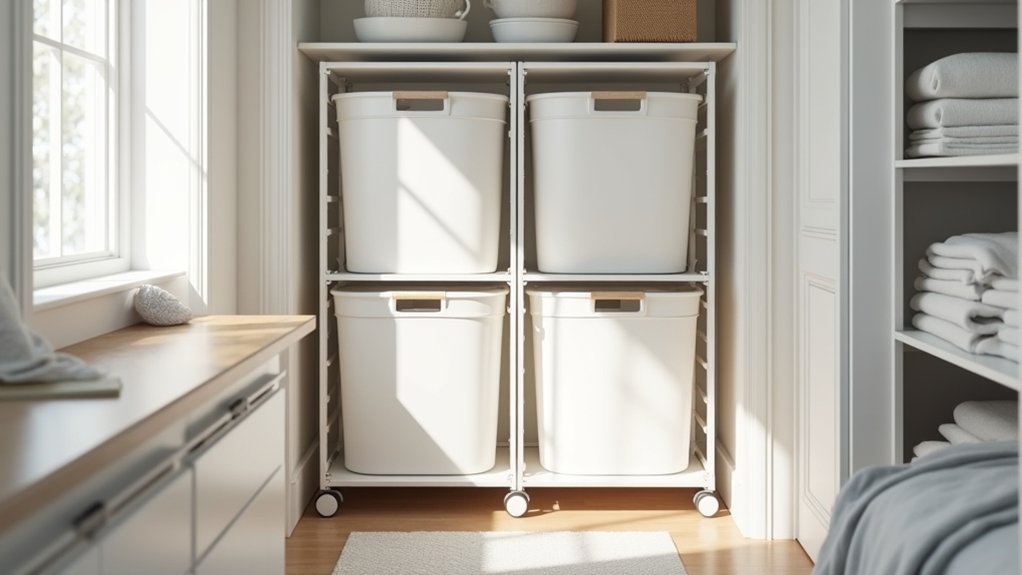
Mobility changes everything when you’re hauling dirty clothes across your home. A rolling hamper with smooth-gliding caster wheels lets you push or pull heavy loads without lifting, eliminating the back and arm strain that comes with lugging traditional baskets. You’ll glide effortlessly over carpets, hardwood, and tile, even traversing multi-level spaces becomes manageable. Some models feature a unique stair-climbing design that makes navigating between floors simple and safe.
Look for sturdy frame construction with reinforced galvanized wire mesh or durable plastic that withstands frequent use. Adjustable handle heights accommodate different users, making maneuvering around corners comfortable for everyone. Quality models hold up to 200 pounds, letting you transport multiple loads in one trip. The corrosion-resistant galvanized finish ensures your investment stays in excellent condition for years, minimizing replacement and maintenance costs.
Three-compartment designs with breathable canvas sections keep colors and fabrics sorted during transport, preventing mixing while maximizing your efficiency from bedroom to laundry room. This organizational approach helps maintain cleanliness and hygiene by ensuring dirty items never come into contact with freshly washed clothes.
Color-Coded Sorting Bins to Simplify Laundry Day
You’ll simplify laundry day by labeling each bin clearly with both text and color-matched tags for lights, darks, brights, and delicates. For families, assign each household member a unique bin color so everyone pre-sorts their own clothes before they hit the laundry room. This system turns chaotic piles into an organized workflow that saves you time and prevents color transfer disasters. Using slim velvet hangers in a neutral shade throughout your folding station creates a unified, boutique-like appearance while maximizing space. Adding a separate basket for heavily-soiled work clothes keeps grease and grime from contaminating your everyday items during the sorting process. Just like color-coded waste bins simplify recycling by making sorting intuitive, applying the same visual system to your laundry routine reinforces consistent habits for every family member.
Bin Labeling Best Practices
Clear, easy-to-read labels transform your sorting bins from generic containers into an organized system that every household member can follow.
When selecting materials, prioritize label longevity considerations for your laundry environment. Laminated label durability matters because moisture and humidity quickly destroy standard paper options. A Silhouette machine creates custom fabric labels that add a personalized touch while withstanding the humidity of laundry spaces.
Best practices for effective bin labeling:
- Use heavy cardstock with clear packing tape as a budget-friendly laminating alternative
- Position labels on both front and top surfaces for visibility from multiple angles
- Choose high-contrast text and symbols to improve scanning speed during sorting
- Select removable adhesive options when categories may shift seasonally
Magnetic labels work well on smooth basket surfaces, while label holders create a polished appearance. For baskets with holes or woven textures, peel-and-stick Velcro squares provide an exceptionally strong hold that keeps labels securely in place. Consistent placement across all containers establishes intuitive sorting patterns that reduce errors and keep items off the floor. Implementing color-coded labels for different categories allows family members to quickly identify where whites, darks, and delicates belong without reading each label individually.
Family-Friendly Color Systems
When every family member knows that red means darks and blue means whites, sorting becomes second nature rather than a guessing game. You’ll eliminate the daily confusion that slows down laundry routines by assigning each color category its own bin. Color coding families use to organize laundry transforms chaotic piles into streamlined systems that even young children can follow. This visual system accelerates onboarding when guests or babysitters help with household chores.
Consider adding color coded tags for linens to track which sheets belong to specific beds or family members. This approach prevents mix-ups and guarantees items return to their proper rooms promptly. You’ll reduce sorting time considerably while teaching kids responsibility through simple visual cues. Separating items by color also keeps whites looking bright and prevents dye transfer that can ruin lighter fabrics. Just as professional cleaning services use color-coded systems to prevent cross-contamination, your family can apply similar principles to keep cleaning rags and household cloths properly separated. The system scales easily as your family grows, making laundry day manageable rather than overwhelming.
Counter-Over-Machines Setup for Wrinkle-Free Folding
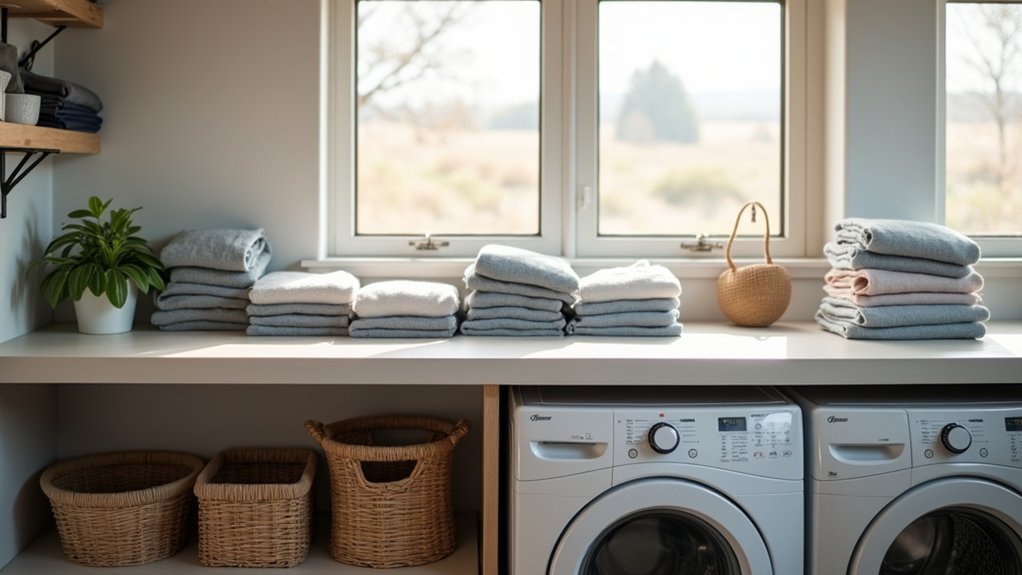
A counter-over-machines setup transforms your laundry routine by giving you a dedicated folding station right where clothes exit the dryer. You’ll eliminate wrinkles by folding garments immediately on a flat, seamless surface. The three-wall containment prevents items from falling behind or beside machines. This upgrade can also increase home value and appeal to prospective buyers looking for functional living spaces.
Your material selection impacts durability and aesthetics:
- Laminate delivers affordability with diverse color options
- Butcher block adds warmth for multi-purpose use
- Quartz provides superior stain and scratch resistance
- Black wood grain finishes offer stylish machine protection
The customizable design options let you maximize your space. Choose a floating style for a modern, open feel or add built-in cabinets underneath for storing detergents. Standard sizes fit typical side-by-side setups, while plus-size options accommodate larger machines with expanded workspace. High-quality materials ensure your countertop remains resistant to stains and scratches through years of everyday use. Budget-conscious homeowners can explore options like the Balconeras Washer Dryer Countertop, which retails at $114.99 and delivers practical value without compromising quality.
Wall-Mounted Drying Racks That Fold Flat When Empty
When you’re working with limited square footage, wall-mounted drying racks like the Foxydry Fold or Amish Wooden Rack give you full drying capacity that disappears to just inches when not in use. You’ll want to position your rack near a heat source or in an area with good airflow, keeping it at a comfortable height for loading wet laundry without straining. Consider mounting above your washer-dryer setup or on an adjacent wall where the rack won’t interfere with cabinet doors or foot traffic when extended. Options like the Hills Supa Fold Compact offer space-saving drying for balcony, terrace, or dedicated drying room setups with easy assembly using included mounting accessories.
Space-Saving Design Benefits
Because floor space in laundry rooms often comes at a premium, wall-mounted drying racks offer an ideal solution that maximizes vertical real estate while virtually disappearing when you’re not using them.
You’ll appreciate the compact storage dimensions these racks provide. The X-cosrack folds to just 25.2″ x 3.94″ x 8.31″, while the Amish Rack reduces to a mere 6-inch closed width.
Consider these weight capacity support options for your needs:
- Premier Z-Fold aluminum rack holds up to 220 pounds
- X-cosrack steel rack manages 80 pounds
- Wayfair foldable metal rack supports 60 pounds
- Everbilt stainless steel rack withstands 50 pounds
The Foxydry Fold disappears with a one-click folding clip, giving you instant access to wall space when laundry day ends.
Optimal Placement Strategies
Figuring out where to mount your wall-mounted drying rack determines how well it’ll integrate into your daily laundry routine.
Position your rack 7-8 feet above the floor for ergonomic access, securing it to load-bearing studs spaced 16 inches apart. You’ll want to place it above your washer-dryer stack to maximize floor space while aligning with your 36-inch sorting table for seamless workflow.
Consider ceiling mounted solutions that sit 6-12 inches below joists, centered over your laundry counter for direct dryer-to-rack transfers. Keep racks 22 inches from corner walls to allow full swing clearance.
For enhanced functionality, position wall mounted accessories near electrical outlets if you’re using heated drying attachments. Mount 12 inches above countertop edges to create an efficient sorting-to-folding path that streamlines your entire put-away routine.
Vertical Storage Solutions for Detergents and Supplies
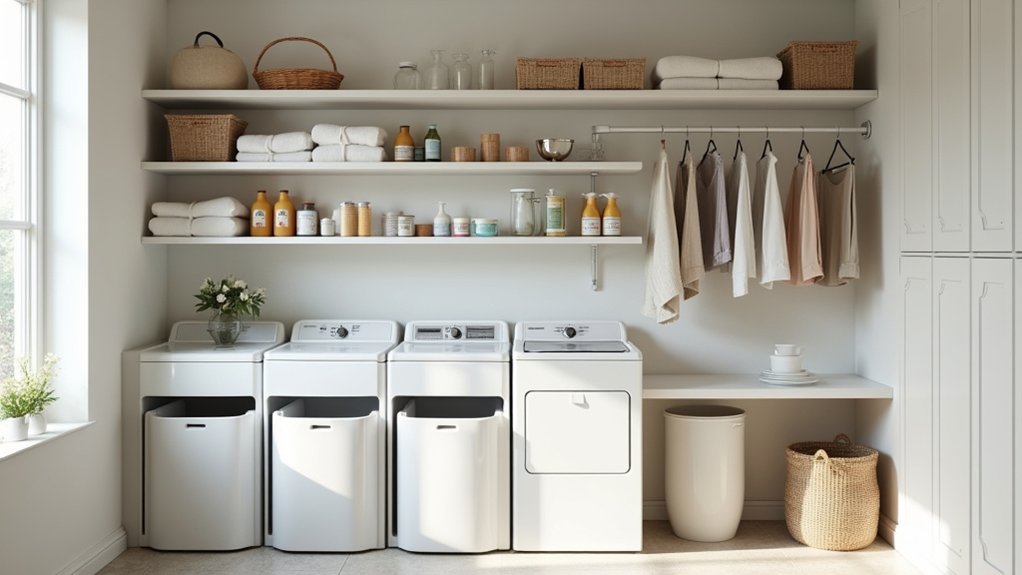
Although floor space in laundry rooms often runs tight, your walls offer untapped potential for storing detergents, stain removers, and cleaning supplies. Wall cabinets with adjustable wall shelves let you customize compartment heights for bottles of varying sizes, while hidden storage compartments keep products tucked away for a cleaner look.
Consider these vertical solutions:
- Floating shelves above your washer provide direct access to frequently used items post-wash.
- Wall-mounted bins collect stray socks, lint, or trash without cluttering counters.
- Pegboards organize brushes, clothespins, and spray bottles within arm’s reach.
- Narrow cubbies store detergent pods and dryer balls efficiently.
You’ll maximize every inch by reclaiming vertical zones that typically go unused. Match finishes to your existing décor or choose contrasting colors for visual interest.
Stacked Washer-Dryer Layout to Maximize Cabinet Space
When you stack your washer and dryer, you free up valuable floor space that transforms into storage opportunities throughout your laundry room. This efficient appliance configuration works best with front-loading models and a proper stacking kit, creating a compact footprint of approximately 2×2 feet.
Custom cabinet integration around your stacked units delivers seamless storage that maximizes every vertical inch. You’ll want tall cabinetry extending to the ceiling beside your appliances, providing dedicated space for detergents, cleaning supplies, and even a concealed ironing board. Consider pre-made pantry units painted to match your walls, they’ll reduce costs compared to fully custom options.
For precise results, measure carefully since stacked units range 74-80 inches tall and 23-32 inches wide. Allow 1-inch side clearance for proper ventilation and ideal appliance performance.
Three-Zone Layout With Dedicated Sort, Fold, and Store Areas
How efficiently you move through laundry tasks depends largely on your room’s zone organization. A three-zone layout separates sorting, folding, and storage into distinct areas that mirror proven kitchen workflow principles.
Zone-based organization transforms chaotic laundry routines into streamlined workflows that save time and reduce frustration.
Your dirty laundry zone needs these essentials:
- A combination utility sink positioned near your washer for stain treatment and handwashing
- Hampers for sorting clothes by color and fabric type
- Counter space on both sides of your washing machine for prep work
- An integrated ironing board that folds away when not in use
The folding zone requires countertops at 36-42″ height with minimum 36″ width for comfortable work. Position overhead shelving and wall-mounted organizers in your storage zone to maximize vertical space. This L-shape configuration delivers 45 square feet of functional workspace.
Frequently Asked Questions
How Do I Prevent Laundry Bottlenecks During Peak Family Usage Times?
You’ll prevent bottlenecks when you stagger laundry schedules across different time slots, assign each family member specific days or evening windows. Encourage family participation by giving everyone responsibility for their own loads, from washing to folding. Run full loads during off-peak hours like late evenings to maximize efficiency. Install sorting bins so clothes are ready when it’s someone’s turn, eliminating prep delays and keeping your laundry flow moving smoothly.
What Eco-Friendly Hamper Materials Are Best for Sustainable Laundry Routines?
You’ll find the best eco-friendly options include GOTS-certified organic cotton, bamboo, and jute, all compostable laundry bag materials that break down naturally. For durability, consider renewable wicker hamper options made from rattan or willow, which last 20+ years and provide excellent breathability to prevent odors. Handwoven seagrass and water hyacinth baskets also maximize sustainability while supporting fair trade artisans. Choose collapsible designs to save space and connect multiple hampers for intuitive pre-sorting.
How Can Data Analytics Improve My Laundry Room Workflow Efficiency?
You can leverage data analytics to transform your laundry workflow by implementing data driven task scheduling that aligns washing cycles with your household’s peak and off-peak hours. Sensor based load detection monitors machine utilization in real-time, helping you identify bottlenecks and optimize cycle times. Track energy consumption patterns to reduce costs, while predictive maintenance alerts prevent unexpected breakdowns. These insights let you maximize your space’s efficiency and streamline every step of your routine.
What Height Should Folding Surfaces Be for Ergonomic Comfort?
Set your tabletop height between 34, 36 inches for standard comfort, though you’ll want to ponder your specific needs. Women often prefer 30, 36 inches, while men typically find 33, 39 inches more comfortable. For ideal ergonomics, position surfaces 2, 6 inches below your elbow height. Adjustable surfaces offer the best solution, letting you customize height for different tasks and users while maximizing space underneath for basket storage.
How Do Heatmaps Help Determine Optimal Placement for Laundry Stations?
Heatmaps show you exactly where residents cluster and which machines see the most action. Through traffic flow analysis, you’ll identify bottlenecks and congestion points that slow everyone down. This data drives spatial optimization, helping you relocate high-demand washers and dryers to accessible spots while repurposing underused areas. You can tailor your laundry station placement to your property’s specific usage patterns, reducing wait times and creating smoother, more efficient layouts.