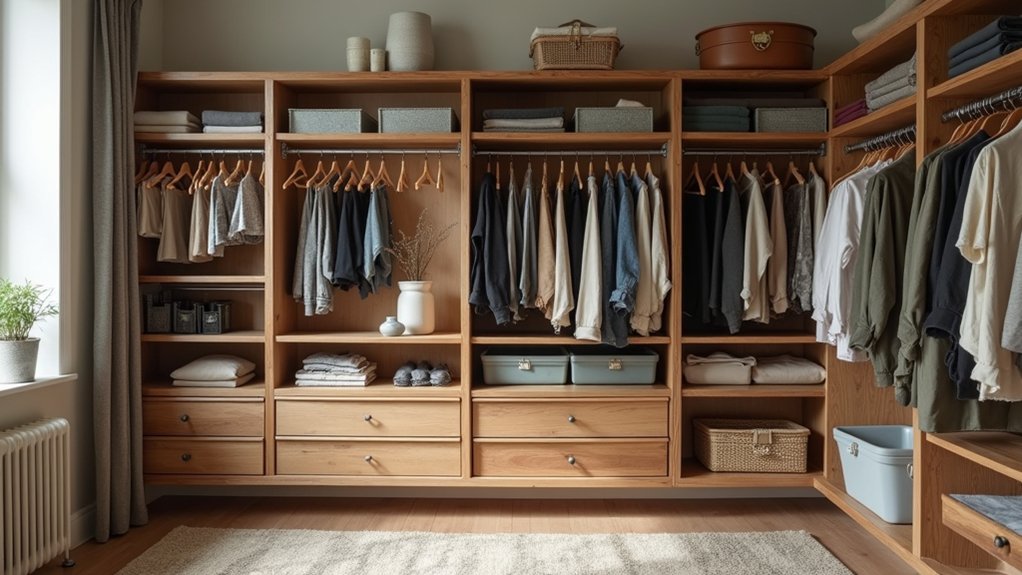
You’ll get the most functional closet storage when you size drawers at 24 inches wide for folded clothes, hampers at 18-24 inches to fit standard cabinet openings, and cubbies at 12-14 inches deep for easy reach-back access. These dimensions maximize your space while preventing common issues like sagging bottoms and overcrowded compartments. The right width depends on what you’re storing, and understanding the specific measurements for each item type will help you create a perfectly organized system.
Why 24 Inches Is the Standard Closet Drawer Width
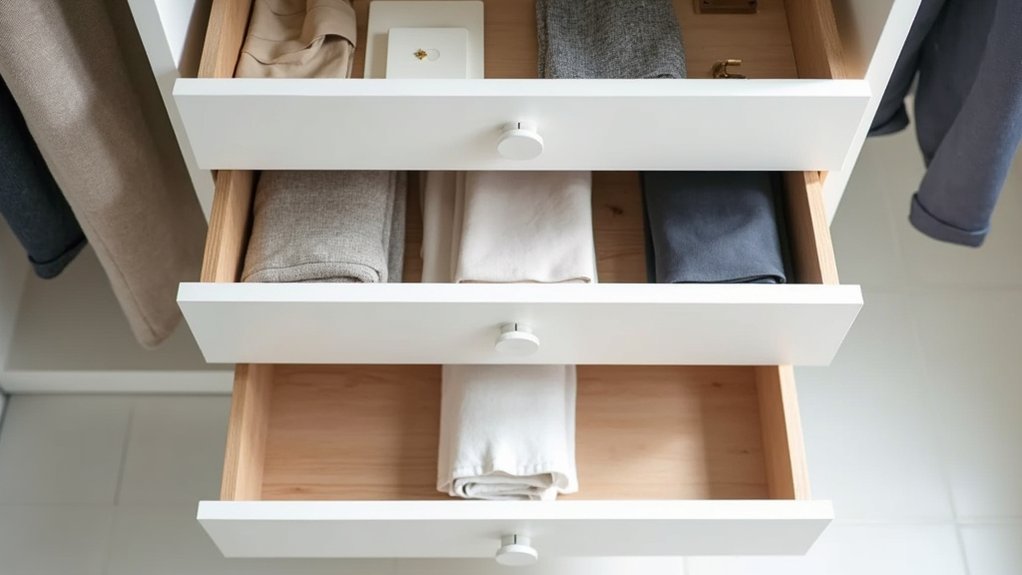
When you’re planning closet drawers, 24 inches stands out as the go-to width for good reason. This measurement accommodates two stacks of folded clothing side-by-side, whether you’re organizing t-shirts, sweaters, or jeans that typically fold to 9-11 inches wide. You’ll achieve ideal use of existing space without gaps or overcrowding.
The 24-inch width also prevents structural issues. Drawer bottoms won’t sag under heavy denim, and slides maintain their integrity through thousands of opening cycles. Wider drawers create weight distribution problems that shorten lifespan. To ensure smooth operation, maintain at least 1/4 inch clearance above and below each drawer during installation.
Most modular systems standardize on this dimension, giving you room for future expansion with matching components. You can reach everything without straining across an oversized drawer. It’s the perfect spot where capacity meets accessibility, maximizing storage while keeping daily use effortless. This width also aligns with the standard closet depth of 24 inches, creating a cohesive system where drawers fit flush within the overall closet framework. Whether you’re working with a reach-in or walk-in closet, this consistent 24-inch measurement ensures your drawer components integrate seamlessly with the overall storage design.
Closet Drawer Width Depends on What You’re Storing
While 24 inches works as a reliable default, your actual drawer width should match what’s going inside. T-shirts and activewear fit perfectly in 24-inch drawers, holding two stacks of folded items side-by-side. For reach-in closets with limited space, 18-inch drawers accommodate a single stack of shirts or leggings without wasting room.
Bulkier items demand more width. Jeans measure 9-10 inches folded, so 30-inch drawers let you store heavy denim stacks front-to-back. Sweaters and hoodies also benefit from this extra capacity. When planning drawer depth, keep in mind that drawers for folded clothes need a minimum of 18 inches, though 24-inch depths allow for multiple rows of stacked garments.
Flexible sizing options help you address seasonal storage needs effectively. You might use narrower drawers for everyday basics and wider ones for chunky winter knits. Modular systems offering 18-inch, 24-inch, and 30-inch configurations give you the versatility to customize each drawer’s function.
Narrow Closet Drawers (12, 15 Inches) for Socks and Accessories
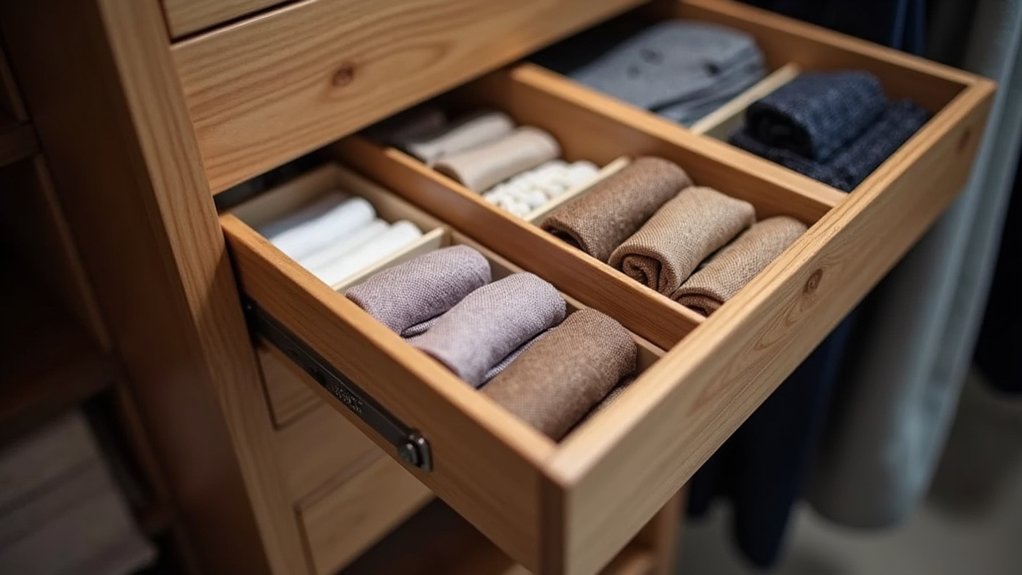
Narrow drawers measuring 12 to 15 inches wide handle socks, ties, jewelry, and other small accessories that would get lost in larger compartments. These compact dimensions fit standard 18-inch closet sections while providing space saving benefits that maximize every inch of your bedroom storage. Tall narrow dressers with multiple drawers can maximize vertical space when floor area is limited, making them ideal companions for closet drawer systems.
A shallow 4-inch height prevents overcrowding and lets you see contents at a glance. You won’t bend excessively or dig through piled items to find what you need. The 14-inch depth allows placement in tight closet sections without protruding into your walking space.
Compact organization becomes effortless with fabric-lined dividers that customize each drawer for your specific accessories. Full extension ball bearing slides provide smooth operation and complete visibility, making daily retrieval quick and strain-free. For extended reach in higher closet installations, wardrobe lifts with adjustable width bring hanging items down to accessible levels without straining.
Medium Closet Drawers (18, 24 Inches) for T-Shirts and Everyday Clothes
Medium drawers spanning 18 to 24 inches wide create the ideal storage zone for t-shirts, lightweight sweaters, and everyday folded garments. This drawer configuration lets you fit two side-by-side stacks comfortably, maximizing your garment storage needs without risking fabric sag. A quiet and soft close mechanism ensures peaceful operation when accessing your clothing throughout the day.
Consider these specifications when planning your medium drawer layout:
- Width: 24 inches serves as the sweet spot for closet systems
- Depth: Aim for 20-22 inches to accommodate front-to-back stacking
- Height: 6-8 inches works best for folded t-shirts and shorts
- Load capacity: Quality drawers support up to 55 pounds
- Features: Self-closing dampers and full-extension slides improve daily access
You’ll want smooth-running hardware that pulls out fully, giving you a complete overview of contents. Inner organizers help maintain neat stacks while preventing items from shifting during use.
Large Closet Drawers (30, 36 Inches) for Bulky and Seasonal Items
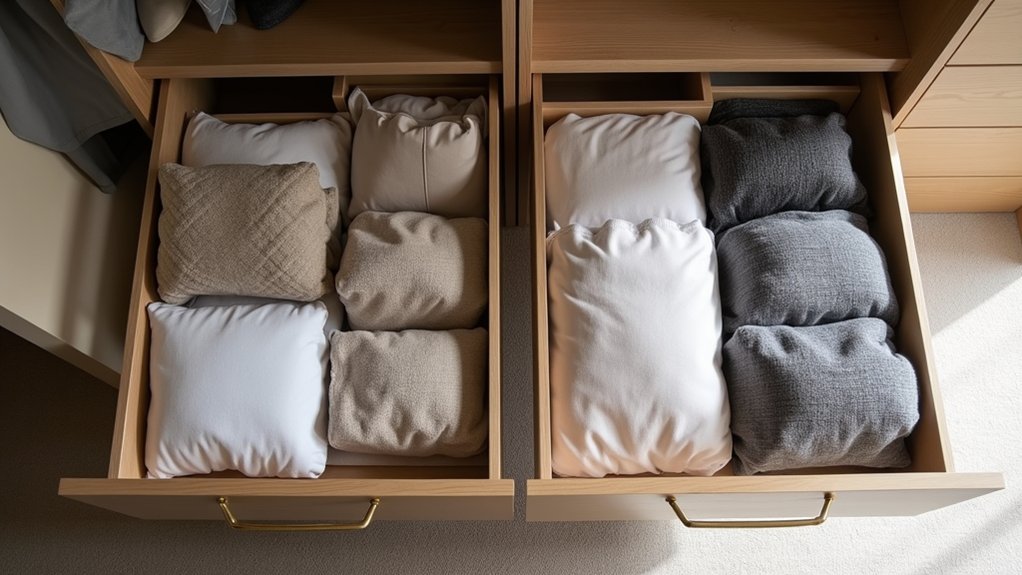
Large closet drawers measuring 30 to 36 inches wide give you the capacity to store bulky sweaters, denim, seasonal bedding, and heavy fabrics that won’t fit comfortably in standard configurations. These dimensions support bulk storage organization by allowing two stacks side-by-side.
| Feature | Specification |
|---|---|
| Width Range | 30, 36 inches |
| Recommended Depth | 18 inches |
| Drawer Height | 8, 10 inches |
| Extension Clearance | 20, 24 inches |
You’ll need reinforced bottoms for widths exceeding 30 inches to prevent bowing under heavy loads. Soft close drawer hardware rated for heavy-duty use holds 50% more weight in wide setups. Always verify your closet provides adequate clearance for full drawer extension before installation. When measuring depth, subtract 36 inches from the measured space between the wall and nearest furniture piece to ensure drawers open conveniently without obstruction.
Closet Drawer Depth and Height You Shouldn’t Overlook
While width matters, you can’t ignore how depth and height affect your closet drawers’ functionality. Standard depths range from 14 to 24 inches depending on what you’re storing, and heights typically fall between 4 and 12 inches based on item bulk. Getting these dimensions wrong means you’ll either waste space or bury items where you can’t easily reach them. For optimal organization, match drawer heights to their intended purpose, shorter 5-inch drawers work best for small accessories like jewelry and belts, while taller 12-inch drawers accommodate bulky sweaters and blankets.
Standard Depth Guidelines
How deep should your closet drawers actually be to keep folded clothes accessible without wasting precious space? Your drawer spacing preferences matter when selecting dimensions that work for your wardrobe. Standard depths range from 14 to 24 inches, with 16-20 inches hitting the sweet spot for most folded garments. This ideal range ensures smooth drawer gliding operation while providing sufficient room for organized storage. With sizing options available from 4 to 72 inches in 1/16 increments, you can achieve the exact depth your specific storage needs require.
Consider these ideal drawer configurations based on item type:
- Minimum for folded clothes: 18 inches keeps stacks visible and reachable
- Accessories and socks: 14-16 inches prevents items from getting buried
- Sweaters and bulky knits: 20-24 inches accommodates thicker folds
- Multiple clothing rows: 24 inches maximizes vertical storage
- Custom options: 12-24 inches in various increments for precise fits
Match your drawer depth to what you’re storing, and you’ll maximize every inch of your closet system.
Height Varies By Item
Three key drawer heights, 5, 8, and 12 inches, cover nearly every storage need in your closet system. You’ll want 4-5 inch shallow drawers for socks, ties, jewelry, and undergarments, items you need to locate quickly without rummaging. Medium 6-8 inch drawers work perfectly for t-shirts, casual pants, and lightweight sweaters.
When optimizing drawer heights, consider your bulkiest items. Thick sweaters and blankets require 12-inch deep drawers to prevent cramming and wrinkling. Item height considerations matter because storing socks in oversized 12-inch drawers makes finding specific pairs frustrating.
Avoid uniform drawer heights throughout your closet. Instead, vary them based on what you’re storing. This approach maximizes every inch of vertical space while keeping your belongings organized and accessible. You’ll reach items faster and maintain tidier storage long-term.
Avoiding Access Problems
Getting drawer heights right solves one problem, but you’ll create another if you disregard depth measurements. Avoiding drawer clearance problems starts with understanding reach limitations. Standard drawers need 14-24 inches of depth, while built-in options max out at 27 inches.
For preventing hamper accessibility issues, consider these critical measurements:
- Maintain minimum 24-inch closet depth to prevent garment-wall contact
- Keep shelves at 12-14 inches deep for comfortable reach-back access
- Guarantee door openings reach 2 feet wide for basket removal
- Allow 18-24 inches depth for pullout hamper functionality
- Provide 16 inches minimum depth for hamper clearance
You’ll maximize your space when you respect these boundaries. Exceeding 14-inch shelf depths creates frustrating reach problems, while 30-inch depths offer ideal storage without sacrificing accessibility. For folded clothing storage, maintain 12 inches between shelving to ensure items remain organized and easily accessible. Shoe shelves spaced 6-8 inches apart provide optimal accessibility while maximizing vertical storage capacity. When planning your layout, closet design software can help you visualize these measurements and ensure efficient use of every inch before installation.
Best Widths for Closet Hampers and Cubbies
Choosing the right hamper width depends on your cabinet dimensions and laundry volume. For standard installations, a 24″ wide hamper fits a 25.50″ cabinet, while an 18″ option works in 19.50″ cabinets. If you need more capacity, 30″ hampers integrate into 31.50″ wide cabinets.
When planning hamper integration into cabinetry, guarantee your frameless opening provides at least 24″ clearance for 21″ baskets. Tilt-out styles require this same minimum opening. For pullout models, you’ll need 14″ cabinet depth to support the mechanism properly. Standard depth options start at 15 13/16″, with extended depths up to 24 13/16″ available for additional cost.
Consider hamper weight capacity before loading up. Quality 24″ wide frame hampers handle 100 pounds, making them ideal for busy households. Removable bags in 18″ to 30″ units simplify laundry transport while maximizing your available closet space.
How to Combine Multiple Drawer Widths in One Closet
Mixing drawer widths lets you customize storage for different clothing types while maximizing every inch of closet space. Strategic space planning means pairing 18-inch drawers for socks and accessories with 24-inch drawers for t-shirts and activewear.
Consider these proportional sizing guidelines for your layout:
- Use 24-inch widths as your primary drawer size for versatility
- Add 18-inch drawers for small items like jewelry and undergarments
- Reserve 30-inch drawers only when reinforced to prevent sagging
- Vary heights within each width using 5-inch, 8-inch, and 12-inch increments
- Guarantee 20-24 inches of pull-out clearance in tight configurations
You’ll create a cohesive look by grouping similar widths together in banks. This approach delivers both visual appeal and functional storage that matches your specific wardrobe needs. For children’s closets, include extra drill holes in your drawer unit design to allow repositioning as storage needs change over time.
Common Closet Drawer Width Mistakes and How to Avoid Them
You might assume wider drawers offer more storage, but oversized widths actually waste valuable closet real estate while creating organizational chaos. A 36-inch drawer designed for kitchen pots becomes overkill for folded clothing, causing items to shift, bunch, and become difficult to locate. Instead, match your drawer width to specific items, 24 inches provides the sweet spot for two side-by-side stacks of folded shirts without the structural sag that plagues 30-inch or wider options.
Oversized Drawers Waste Space
When closet drawers exceed the standard 24-inch width, you’re actually losing usable storage space rather than gaining it. Those 30-inch drawers create dead zones where clothes shift around, reducing your overall storage capacity considerably.
Clothes slide and bunch up, creating disorganization. Drawer bottoms sag under heavy items like denim. Corner areas become inaccessible dead zones. Space efficiency drops as items sit beyond easy reach. Valuable closet real estate gets consumed without proportional benefit.
The 24-inch width works because it accommodates two stacks of folded garments side-by-side. Since most folded clothing measures about 11 inches wide, you’re maximizing every inch. Stick with this proven standard to avoid wasting premium closet space.
Ignoring Item-Specific Sizing
Beyond width considerations, drawer sizing mistakes often stem from ignoring the specific items you’ll store. When you overlook item clearance needs, you’ll find jeans catching on drawer frames or sweaters compressed beyond recognition.
Folded jeans measure 9-10 inches wide and stack 2-3 inches high per pair. If you’re storing 3-4 pairs, you’ll need 10-12 inches of internal clearance, not face height. Remember, an 8-inch face yields only 6 inches usable space after accounting for slides.
You’ll underestimate volume demands if you don’t plan for bulky items. Sweaters and hoodies require 12-inch face heights, while socks and jewelry fit comfortably in 5-inch drawers with 3.5 inches usable height.
Match your drawer dimensions to actual garment measurements, and you’ll maximize every inch of storage capacity.
Frequently Asked Questions
What Materials Work Best for Closet Drawers, Hampers, and Cubby Storage Sections?
For closet drawers, hampers, and cubby storage sections, you’ll want wood or laminate for lasting durability and a polished look. Metal hardware adds flexibility when your storage needs change. Durable plastic materials work perfectly for organizing bins in linen areas, while ventilated wire mesh keeps clothes fresh and wrinkle-free in hanging sections. Composite materials offer excellent strength for wardrobe units. Choose materials that maximize your space while standing up to daily use.
How Much Weight Can Standard Closet Drawers Safely Hold Without Sagging?
Your drawers’ weight capacity depends entirely on drawer construction quality. Basic wire systems hold just 10, 20 pounds before sagging, while mid-level reinforced options support 20, 25 pounds comfortably. If you’re storing heavier items, solid wood drawers handle 25, 30+ pounds reliably. For maximum durability, professional-grade slides with dovetail construction and ball-bearing glides safely support up to 100 pounds per drawer, giving you flexibility to store whatever you need without worrying about sagging or failure.
Should Closet Drawers Have Soft-Close or Standard Slide Mechanisms Installed?
You’ll want quiet soft-close mechanisms for your closet drawers, they’re worth the investment. These systems prevent slamming, reduce wear on your cabinetry, and create a more peaceful morning routine. Smooth ball bearing slides offer effortless operation, letting you access folded clothes without jarring movements that disturb neatly stacked items. While standard slides cost less upfront, soft-close mechanisms extend drawer lifespan and add a premium feel to your custom closet system.
How Do I Measure My Existing Closet Space Before Ordering Custom Drawers?
Measure wall dimensions by taking three readings at high, middle, and low positions across each wall, then record the smallest measurement. You’ll want to measure width (side-to-side), height (floor-to-ceiling), and depth (back wall to front). Evaluate existing storage by noting any obstructions like outlets, vents, or windows. Don’t forget to measure return walls separately and document door swing direction, these details guarantee your custom drawers fit perfectly.
Can I Install Closet Drawers Myself or Should I Hire a Professional?
You can handle DIY closet drawer installation if your closet meets standard dimensions, 24 inches deep with 30 inches of front clearance for full drawer extension. Basic tools like a drill, level, and measuring tape will get the job done. However, you’ll want professional closet drawer installation for walk-in closets, custom configurations, or if you’re dealing with non-standard depths. Pros maximize your storage capacity and prevent costly alignment errors.