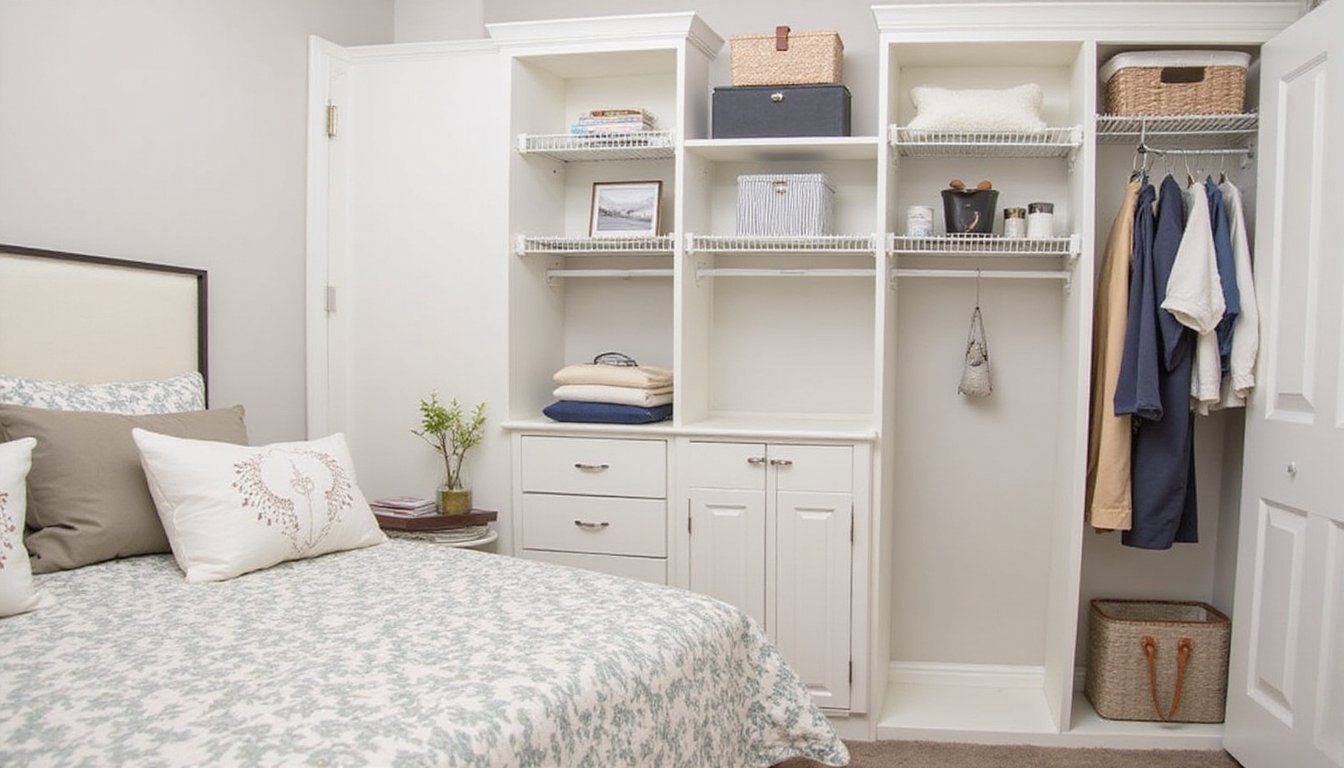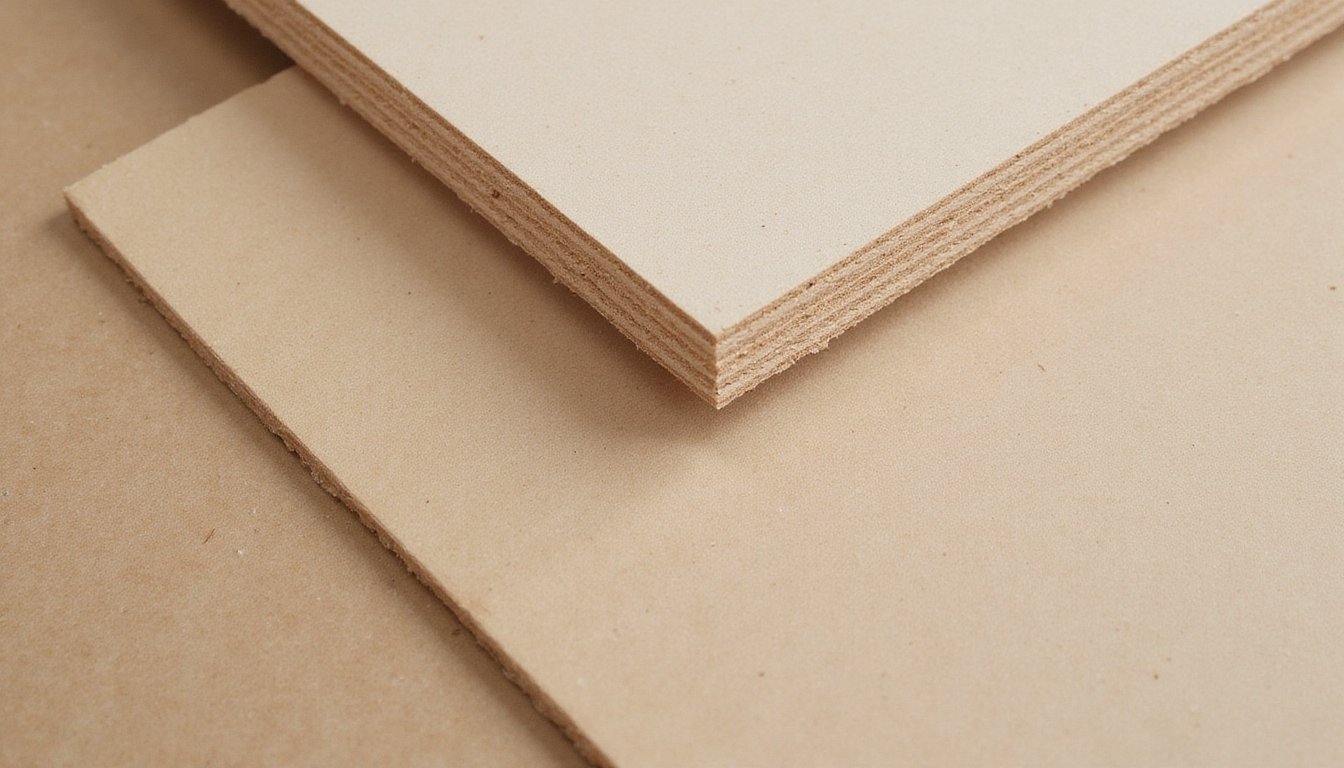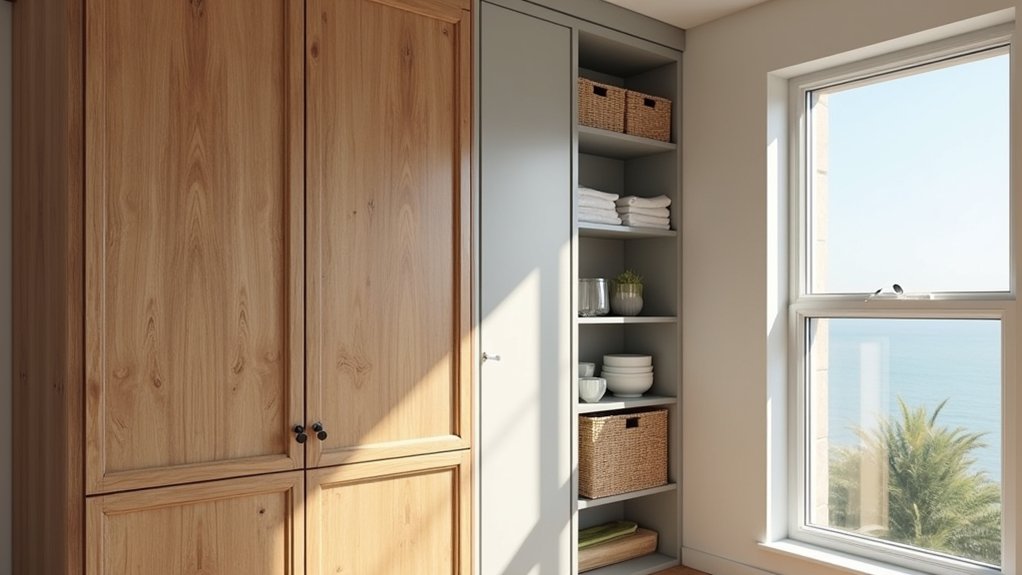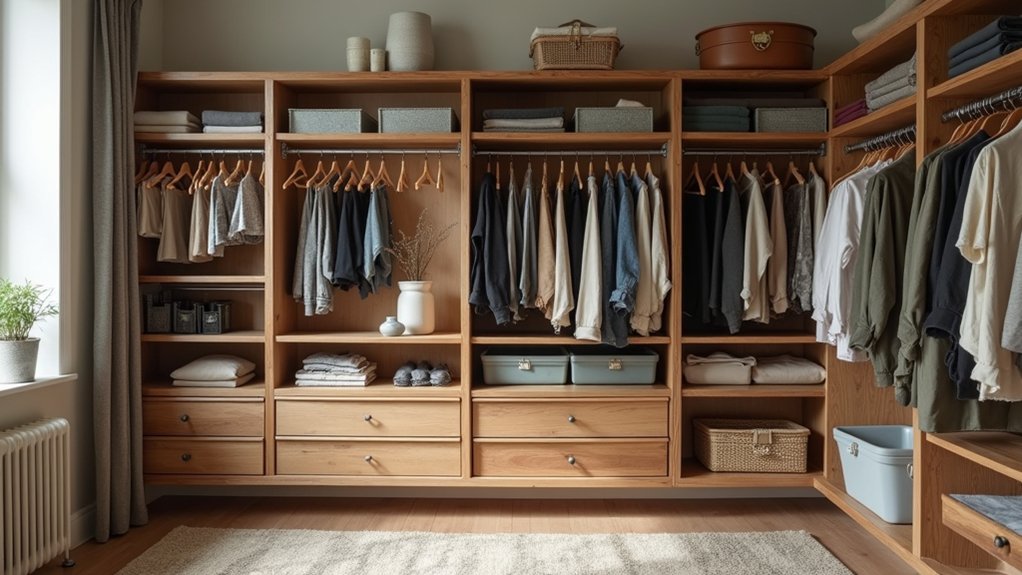
MDF works fine for light-duty closet applications, but plywood’s cross-laminated grain structure delivers superior strength when you’re storing heavy items. You’ll notice MDF shelves start sagging within months under constant load, while plywood maintains its form for 15-25 years. Plywood also handles humidity far better, critical if you’re building near bathrooms or in damp climates. The comparisons below break down exactly where each material performs best.
MDF vs. Plywood: What Actually Matters for Closets?
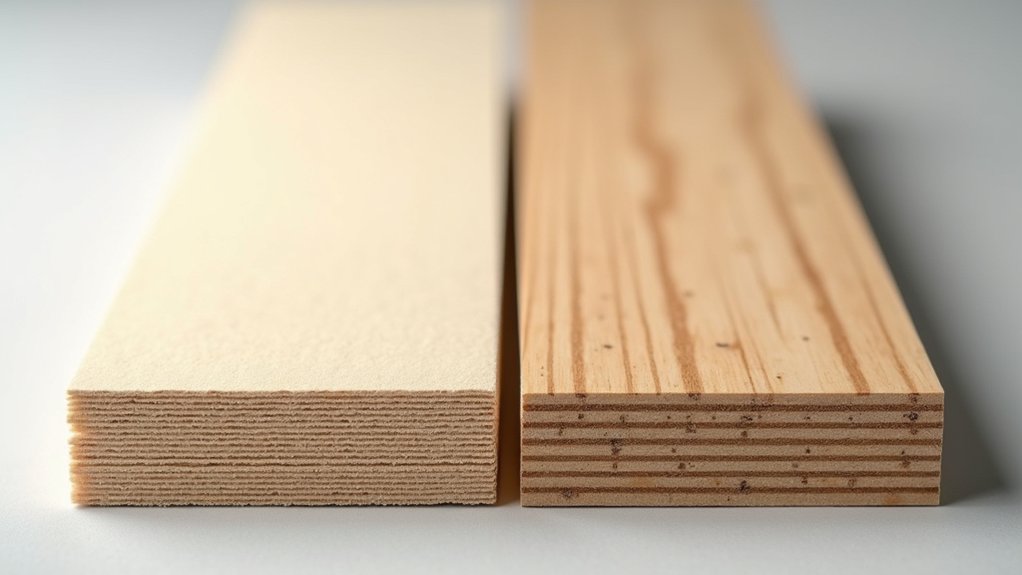
When you’re building closets, the material debate usually comes down to two contenders: MDF and plywood. Both have their place, but your choice depends on specific performance factors that’ll determine how well your closet holds up over time.
MDF versus plywood isn’t about picking a winner, it’s about matching material performance to your specific closet application.
You need to ponder structural integrity, moisture resistance, and fastener retention. Plywood delivers superior bending strength and load-bearing capacity for shelving and cabinet boxes. MDF works fine for painted doors and decorative panels where strength isn’t critical. For drawer slides and hinges that experience repeated side loads, plywood side panels provide the long-term durability that MDF simply can’t match. Additionally, MDF shelves often sag over time when overloaded or exposed to high humidity conditions.
Don’t disregard environmental impact either. Both materials use wood fibers, but sustainable materials sourcing varies by manufacturer. Check certifications before purchasing. To minimize health concerns, look for E0/E1 or CARB compliant products that limit formaldehyde emissions.
The real question isn’t which material is universally better, it’s which performs where you’re installing it. Match the material to the application, and you’ll build closets that last.
Which Material Handles Heavy Closet Storage Better?
When you’re stacking heavy sweaters, bins, or shoe boxes, load-bearing capacity becomes the deciding factor between MDF and plywood. You’ll notice MDF shelves start to bow under sustained weight, while plywood’s cross-grain lamination holds firm across longer spans. Quality MDF holds weight well and won’t crack like cheaper boards, but it still can’t match plywood’s structural performance over time. Plywood’s strength comes from thin veneers glued together with alternating grain directions, creating exceptional resistance to bending and warping. For homeowners seeking the most durable option, Melamine is stronger than regular wood due to its engineered composition and laminate coating that provides superior resistance. Let’s break down how each material performs under real closet loads and what happens to your shelves after years of use.
Load-Bearing Capacity Compared
The cross-laminated construction of plywood gives it a clear edge over MDF for heavy closet storage applications. When you’re building shelves that need to hold bins, appliances, or stacked items, plywood’s structural weight capacity outperforms MDF’s compressed fiber composition. The alternating grain layers resist sagging across spans exceeding 24 inches.
For durability under high loads, consider these key differences:
- 18mm plywood supports sustained weight without deformation for 15-25 years
- MDF requires reinforcement or thicker panels to match plywood’s load tolerance
- Screw-holding strength in plywood maintains hardware integrity under repeated stress
You’ll find MDF adequate for light storage, but it’ll fail under heavy, dynamic loads. For closet rods bearing hanging garments or deep shelving units, plywood’s your go-to material. Additionally, plywood’s resistance to warping makes it particularly suitable for closet environments where humidity levels may fluctuate. Professional carpenters consistently prefer plywood for structural work because it creates stronger joints that withstand years of daily use. While MDF does offer consistent strength throughout the entire panel without weak points, this advantage doesn’t compensate for its lower overall load-bearing capacity in demanding closet applications.
Shelf Sagging Over Time
Over years of use, MDF and plywood behave very differently under sustained loads, and that gap becomes obvious when you’re storing heavy items in your closet. MDF’s compressed fiber composition makes it prone to creep, gradual deformation that worsens with moisture exposure and weight. You’ll notice bowing within months on unsupported spans. MDF also tends to strip around screws if doors or drawers are used heavily, compromising hardware attachment over time.
Plywood’s cross-grain veneer layers resist this deflection. A 3/4″ birch plywood shelf shows minimal sag, roughly 1/16” across an 8-foot span under heavy loads. That’s why it’s the go-to for utility shelving. Using high-grade plywood sheets like birch also helps avoid excessive moisture absorption that can weaken the material over time. The alternating grain direction between each veneer layer is what gives plywood this superior resistance to bending under sustained weight.
For shelf sag mitigation techniques, you’ll need additional brackets every 24-32 inches with MDF. Structural support options like metal angle brackets or mid-span supports help, but they’re treating symptoms, not solving the core issue. Plywood simply handles sustained closet storage loads better long-term.
Heavy Storage Performance Tests
Shelf sag tells you part of the story, but load-bearing capacity under real-world conditions reveals the full picture. When you’re moving heavy objects in and out of your closet daily, plywood’s cross-grain lamination handles the stress without structural compromise. MDF panels max out around 200 pounds before you risk failure. For optimal performance, boards in the 19-25 mm range work best for load-bearing shelves and countertops in heavy storage applications.
Here’s what performance testing reveals about furniture weight capacity:
- Plywood supports heavy countertops, stacked dishware, and appliances without sagging or delamination over time.
- MDF handles only lighter, uniformly distributed loads and fails under concentrated weight points.
- Plywood withstands repeated impact from frequent use, while MDF dents and chips under similar conditions.
You’ll find plywood’s layered construction delivers the resilience heavy storage demands. Plywood’s moisture-resistant layers also prevent warping in closet environments where humidity levels fluctuate. This superior performance comes from plywood’s construction, where thin wood veneers are arranged with grains running in alternate directions to maximize strength. For closets handling substantial loads, plywood’s the proven performer.
Do MDF Shelves Sag More Than Plywood Over Time?
When you’re building closet shelves, you’ll notice MDF deflects under sustained weight while plywood maintains its straight edge for years. Plywood’s cross-laminated grain structure gives it superior long-term stability, resisting the creep that causes MDF to bow permanently. Your span length is the critical factor here, the longer the unsupported run, the more pronounced MDF’s sagging becomes compared to plywood. MDF’s fiber-based structure can swell or weaken when exposed to moisture, making it best suited for dry, controlled environments where heavy load-bearing is not required.
MDF Deflection Under Weight
A closet shelf loaded with heavy sweaters, bins, or storage boxes puts constant stress on the material beneath it, and MDF simply doesn’t handle that pressure as well as plywood. The soft core splits under sustained loads, causing visible bowing within months.
Controlling MDF sagging requires understanding its limitations:
- Span reduction, Keep unsupported spans under 24 inches to minimize deflection
- DIY MDF reinforcement, Add a solid wood cleat along the back edge and front lip
- Load distribution, Spread weight evenly rather than concentrating items in the center
You’ll notice MDF’s engineered composite structure lacks the cross-grain resistance that prevents plywood from bending. For heavy-duty storage, reinforce generously or switch materials entirely.
Plywood’s Long-Term Stability
How long will your closet shelves actually hold up before they start to droop? Plywood outlasts MDF by a significant margin, 15-25 years compared to MDF’s 7-10 years in humid Indian climates.
The cross-grain veneer construction gives plywood superior resistance to long term dimensional changes. You won’t see the warping, cracking, or shrinking that plagues MDF under sustained loads. Your screws stay tight in plywood edges, while MDF fasteners loosen over time, accelerating shelf failure.
Plywood moisture retention stays minimal thanks to its layered structure. In high-humidity areas like Bangalore kitchens and bathrooms, E0 grade plywood maintains its form where MDF swells and loses shape. For closet applications demanding structural integrity, plywood’s dimensional stability means fewer replacements and consistent performance throughout its extended service life.
Span Length Matters Most
Beyond lifespan considerations, the span length between your closet shelf supports determines whether you’ll deal with sagging boards within months or years. Shelf deflection behavior changes dramatically based on unsupported distance, MDF requires supports every 24 inches maximum, while plywood handles 36-inch spans without issue.
Here’s what you need to know about storage capacity impacts:
- MDF deflection increases exponentially on spans exceeding manufacturer limits, causing permanent bow under moderate loads.
- Plywood’s cross-grain lamination distributes stress across layers, maintaining flatness over longer runs.
- Heavy items like dishware or tools accelerate MDF sag on extended spans, often within the first year.
When planning your closet build, factor in bracket placement early. You’ll save yourself the headache of reinforcing failed MDF shelves later.
How MDF and Plywood Hold Up to Scratches and Dents
When you’re building closet systems, surface durability matters more than most people realize. You’ll notice distinct scratch patterns emerge on MDF faster than plywood because those fine fibers lack natural grain resistance. Plywood’s cross-laminated structure distributes impact stress, preventing crack propagation when hangers swing or bins slide.
Edge denting poses the biggest concern with MDF installations. Even moderate pressure deforms corners permanently, and you can’t sand out the damage without replacing the entire board. Plywood’s layered veneer construction lets you refinish surface flaws through sanding.
| Property | MDF | Plywood |
|---|---|---|
| Scratch Resistance | Low | High |
| Edge Durability | Weak | Strong |
| Repairability | Replace only | Sand & refinish |
For high-traffic closets, plywood’s wear resistance delivers longer service life.
Which Works Better in Bathroom and Humid Closets?
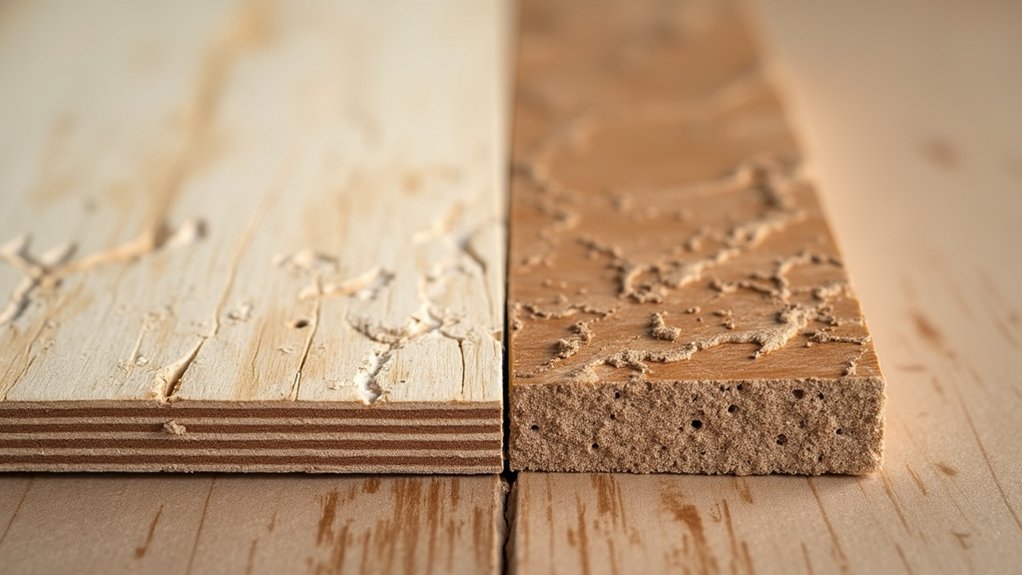
When you’re building closets in bathrooms or other high-humidity spaces, your material choice directly impacts how long that installation will last. Plywood, especially marine-grade options, handles moisture exposure far better than standard MDF, which will swell and deteriorate when it absorbs water. You’ll find moisture-resistant MDF works in moderate humidity, but it can’t match plywood’s performance where standing water or constant dampness is a concern.
Moisture Resistance Comparison
Moisture separates winners from failures in closet material selection, and this comparison reveals a clear hierarchy. Standard MDF’s water absorption levels make it unsuitable for damp environments, it swells like a sponge during monsoon seasons. MR MDF performs better with resin and wax treatments, but it’s not waterproof.
Here’s how these materials rank for humid closet applications:
- Marine plywood (BWP grade): Phenolic resins provide true waterproofing with excellent dimensional stability in humidity
- BWR plywood: Handles frequent water exposure without delamination or rot
- MR MDF: Tolerates moderate humidity when you seal edges properly
You’ll find plywood maintains structural integrity where MDF variants warp. For bathroom closets or spaces near windows with condensation issues, BWR or marine plywood delivers the longevity you need.
Humid Environment Performance
Bathroom and humid closet applications put these materials through real-world stress tests that lab ratings can’t fully capture. MDF absorbs moisture like a sponge, causing rapid swelling and shape loss in wet environments. You’ll notice shelves sagging and edges expanding within months of bathroom installation.
Plywood’s cross-grain construction handles these conditions differently. The layered structure distributes stress evenly, resisting deformation when humidity spikes. Temperature variations combined with moisture effects cause MDF to split, while E0 plywood maintains dimensional stability through repeated exposure cycles.
For bathroom vanities or humid closets, you’re better off with plywood every time. It won’t soak up ambient moisture or lose structural integrity under daily wet-area use. In high-humidity regions, plywood outlasts MDF considerably, holding screws tighter and resisting decay longer.
Screw Holding: Will Your Hardware Stay Tight?
How well your closet shelves and organizers hold up over time depends largely on screw retention, and MDF and plywood perform very differently here.
Plywood’s cross-layered veneers create interlocking fibers that grip screws tightly on both faces and edges. MDF’s uniform density offers decent face holding but struggles with edge screw holding, it crumbles under load. Edge withdrawal resistance in MDF runs about 80% of face resistance, making shelf bracket mounting problematic.
Key pilot hole considerations:
- Always drill shank-sized pilot holes in MDF to prevent stripping
- Predrill MDF holes 50-60% smaller than your screw diameter
- Use coarse-thread chipboard or confirmat screws for MDF applications
Plywood edges outperform even HDHMR MDF due to veneer interlocking. For closet hardware that’ll stay tight, plywood’s your stronger choice.
When MDF Is the Smarter Choice for Closet Builds
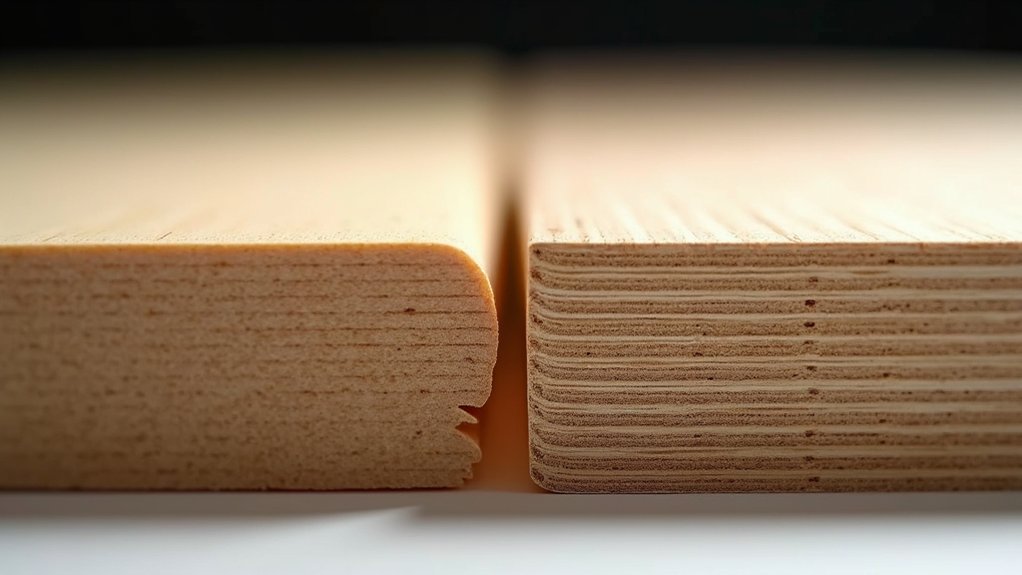
When does MDF actually outperform plywood in closet builds? You’ll want MDF when paint-grade finishes matter most. Its grain-free composition eliminates telegraphing and delivers furniture-quality results without extensive prep work.
For intricate routing on decorative closet components, think detailed mouldings and custom trim, MDF’s consistent density prevents splintering that plywood’s alternating veneers cause. Manufacturing process considerations also favor MDF for precision cuts on CNC equipment.
The eco friendly material benefits shine with CARB P2 certified boards offering low-emission performance in bedroom closets. You’re reducing harmful indoor compounds where you store clothing daily.
MDF excels in humidity-controlled spaces where dimensional stability matters. When properly supported, quality MDF shelving handles substantial loads without the warping issues solid wood presents. For painted children’s closets requiring durability and easy maintenance, MDF’s the practical choice.
Cost Comparison: Upfront Price vs. Long-Term Value
Beyond performance characteristics, your material choice impacts both immediate budget and total project cost over time.
MDF runs approximately 50% cheaper upfront, $25, $35 per sheet versus $40, $100+ for plywood. You’ll save on labor too since MDF’s smooth surface eliminates extensive prep work and edge banding. However, the economic tradeoffs become clear when you calculate long term life cycle cost.
Consider these replacement realities:
- MDF delivers 7, 10 years of service before requiring replacement
- Plywood maintains structural integrity for 15, 25 years
- MDF’s fastener holes strip with repeated use, forcing full panel replacement rather than simple repairs
For closet builds, the hybrid approach optimizes your investment, plywood for the carcase structure, MDF for door panels and decorative elements. You’ll capture cost savings without sacrificing durability where it matters most.
Will MDF or Plywood Last 10+ Years in Your Closet?
Most homeowners want their closet investment to hit that 10-year mark without major repairs or replacements. Plywood delivers 15-25 years of reliable service in typical bedroom environments, while MDF averages just 7-10 years, and that’s with ideal conditions.
Your closet’s humidity levels determine everything. MDF swells and breaks down when exposed to moisture, causing shelves to sag and edges to chip before reaching that decade milestone. Proper ventilation duration matters considerably for MDF survival, though it rarely pushes past 10 years regardless.
Plywood’s layered construction resists warping and maintains structural integrity throughout enclosed spaces. You’ll extend your periodic polishing lifespan well past 20 years with minimal upkeep. Marine-grade plywood handles high-humidity closets for 15+ years without deterioration.
For 10+ year reliability, plywood’s your clear winner.
The Hybrid Approach: Plywood Boxes With MDF Doors
Choosing between plywood and MDF doesn’t have to be an either-or decision, savvy builders combine both materials to capture their individual strengths.
You’ll get the best performance by pairing plywood’s structural integrity with MDF’s paintability. Plywood handles the load-bearing work in your closet boxes, while MDF delivers that dead-smooth finish on doors without grain telegraphing through paint.
Here’s why this hybrid method works:
- Structural reliability, Plywood’s superior screw-holding power and deflection resistance keep your shelves solid under heavy loads.
- Surface quality, MDF resists moisture induced warping better than veneer-core plywood on large door panels up to 65 inches.
- Budget optimization, Material cost implications favor using economical MDF selectively for decorative elements while reserving plywood for frames.
This approach delivers professional results without unnecessary expense.
Frequently Asked Questions
Can MDF Closet Components Be Repaired if They Get Damaged?
Yes, you can repair damaged MDF closet components using proven damage mitigation techniques. For swollen areas, sand after drying and seal to prevent moisture wicking. You’ll want to explore structural reinforcement options like metal brackets or plywood backing for sagging shelves. Fill dents with MDF-compatible putty and re-drill pilot holes for better screw purchase. However, if core saturation’s severe or spans exceed 24 inches, you’re better off replacing the entire panel.
Does Plywood Emit Fewer VOCS Than MDF for Bedroom Closets?
Yes, plywood typically emits fewer volatile organic compounds than standard MDF in bedroom closet applications. MDF requires higher adhesive concentrations, increasing formaldehyde emissions over time. You’ll find most modern plywood uses formaldehyde-free resins, cutting VOC off-gassing considerably. For sensitive spaces like bedrooms, choose GreenGuard-certified plywood or low-VOC MDF alternatives. Either way, you should seal raw edges and guarantee adequate closet ventilation to minimize accumulated emissions.
Which Material Is Easier to Paint for a Smooth Closet Finish?
MDF gives you the easiest smooth paint application for closet builds. Its grain-free surface accepts primer and topcoats without telegraphing wood patterns, so you’ll achieve a uniform paint finish with minimal prep work. You won’t need grain filler or multiple sanding passes like plywood demands. Just apply an oil-based primer, sand lightly between coats, and you’re ready for your finish coat, saving you significant labor time on cabinet doors and shelving.
How Much Weight Difference Exists Between MDF and Plywood Closet Systems?
You’re looking at MDF weighing roughly 1.5-2x more than equivalent plywood panels. At 3/4″ thickness, MDF runs about 2.7 lbs/sq ft compared to plywood’s 1.63 lbs/sq ft. A standard 4×8 sheet of MDF tips the scales around 88 lbs. This weight difference impacts load bearing capacity and span comparisons, you’ll need beefier brackets and supports for MDF installations, while plywood’s lighter weight simplifies handling during closet system builds.
Are There Fire-Resistant Options Available for MDF or Plywood Closets?
Yes, you’ll find fire-resistant options for both materials. Fire-retardant MDF and plywood undergo chemical impregnation during manufacturing to meet Class A or B ratings. You can also apply fire resistant coatings to standard panels for added protection. Check your local building code requirements, enclosed closets in high-risk areas often mandate Class A materials. Plywood edges out MDF in humid environments since moisture degrades fire-treated MDF’s performance faster.