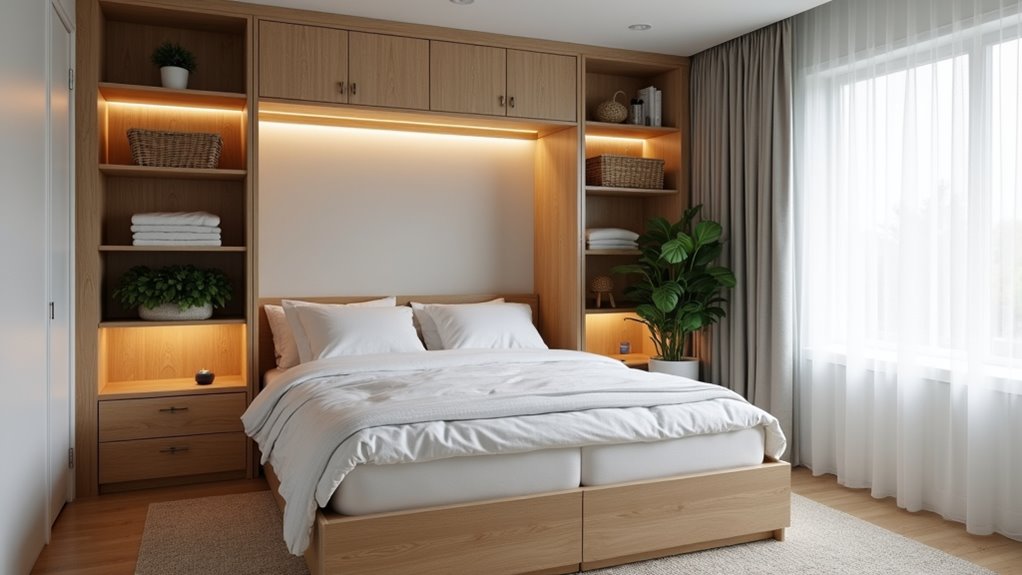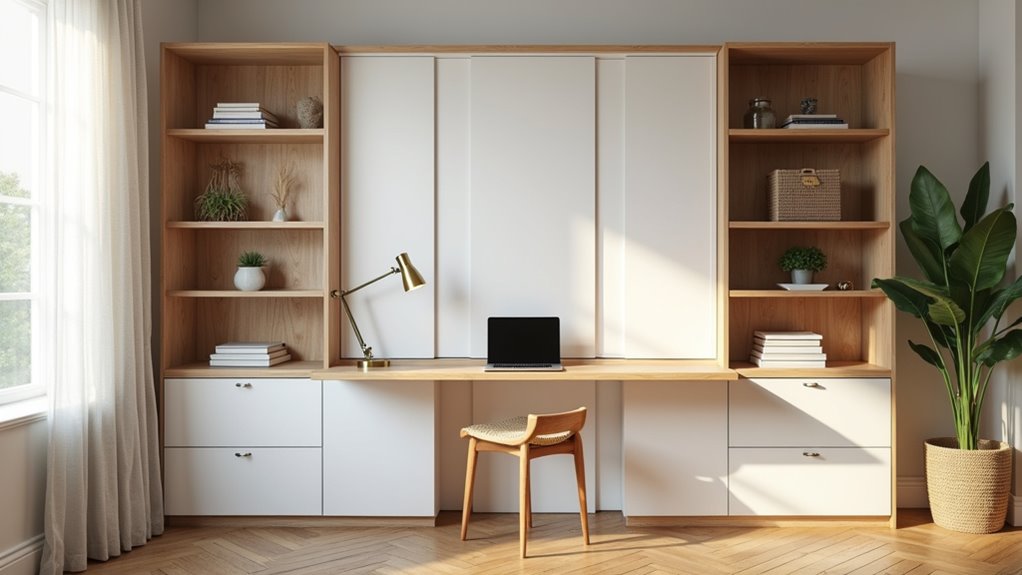
You combine a murphy bed with a closet by building one wall unit that pairs the fold-down bed cabinet with wardrobe towers. Use one tower in narrow rooms, or two when wall width allows. Match tower depth to the bed cabinet, typically 16 to 20 inches, so garments don’t overhang. Keep hanging space outside the bed’s swing path. Plot every door arc against the open bed. Next, you’ll see how to divide storage zones for easy access.
Key Takeaways
- Install a murphy bed with wardrobe towers on one or both sides, depending on wall width and room circulation.
- Place hanging space outside the bed’s swing zone so garments never snag on the frame or lifting mechanism.
- Match tower depth to the bed cabinet, typically 16 to 20 inches, for a flush, unified wall unit.
- Use sliding doors or relocated hinges if tower doors would collide with the lowered bed.
- Store everyday clothing in side towers, reserving overhead cabinets for seasonal items and linens accessed less frequently.
How Can You Combine a Murphy Bed With a Closet or Wardrobe

You can combine a Murphy bed with a closet or wardrobe by merging a fold-down bed and wardrobe cabinetry into a single wall unit that handles both sleeping and clothing storage within one compact footprint. A murphy bed with closet towers on one or both sides keeps hanging space, shelves, and drawers beside the bed frame. Choose one tower for narrow rooms and two when wall width and circulation allow.
A closet murphy bed with a wardrobe-style façade reads as cabinetry when closed. Just confirm doors and panels don’t obstruct bed operation. Plan both footprints prior to fixing a location. One full-size murphy bed wardrobe measures 107.5 by 58 inches open and 107.5 by 21.5 inches closed. Always check your specific product’s dimensions rather than assuming universal standard sizes.
What Clothing Categories Need Space Before You Design the Wardrobe
Four clothing categories need space in your wardrobe design: hanging garments, folded clothing, small accessories, and linens or personal items.
Hanging garments need full-height or double-rod sections. Measure your longest coat or dress to set rod height. Folded clothing, such as sweaters and jeans, fits adjustable shelves, while small accessories like belts, socks, and jewelry belong in shallow drawers. Linens and bulky personal items suit closed cabinets that shield them from dust.
Count the items in each category, then assign them to towers beside the bed or to storage behind the bed panel, if your system supports it. This inventory keeps your wall bed wardrobe storage balanced and ensures your bed and closet combo holds everything without crowding the bed’s operating area.
How Should Hanging Space Be Placed So Clothes Stay Clear of the Bed
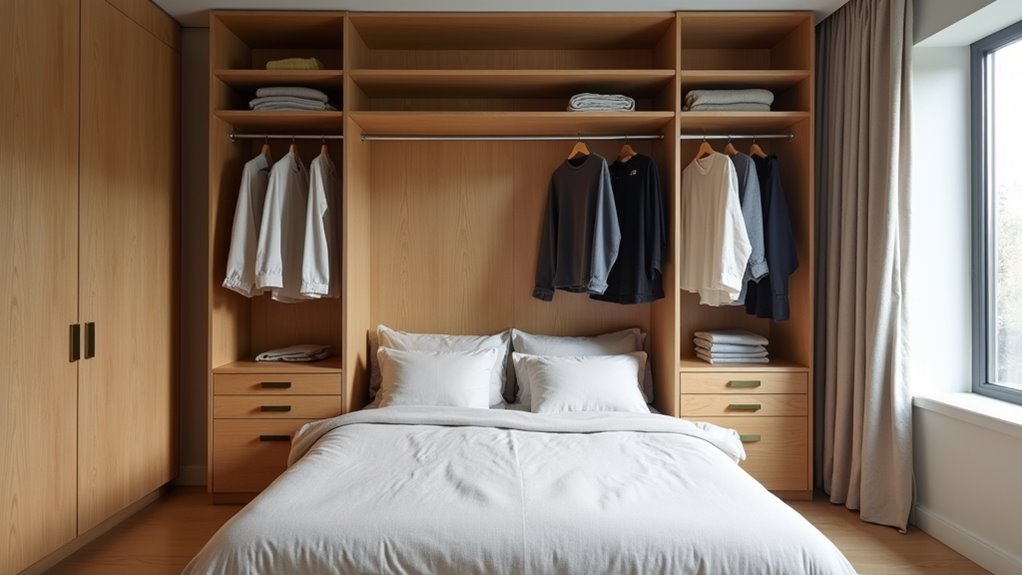
Place hanging space in full-height wardrobe towers beside the bed cabinet, outside any zone the frame sweeps through as it lowers or rises. Set towers on one side if your room is narrow, or on both sides when wall width and circulation allow. Match tower depth to the bed cabinet, typically 16 to 20 inches, so garments don’t overhang the cabinet face. Check that tower doors swing clear of the open bed. If they don’t, you’ll need sliding doors or relocated hinges instead. Keep sleeves, hems, and hangers fully inside the tower, since loose fabric can snag the lifting mechanism. Map the open-bed footprint, which can reach 107.5 inches long, prior to installation, and confirm you can still reach every rod and shelf in both configurations.
How Do Side Wardrobes Overhead Cabinets Drawers and Open Shelves Divide Clothing Storage
Side wardrobes hold hanging garments like coats, dresses, and shirts, overhead cabinets store seasonal clothing and spare linens, drawers keep socks, underwear, and folded knits, and open shelves handle shoes, bags, and frequently worn items. Assign items according to size, access frequency, and dust sensitivity to get the most from an integrated unit. Closed storage suits anything you want shielded from dust.
| Storage Type | Best Contents | Access Priority |
|---|---|---|
| Side wardrobes | Coats, dresses, shirts | Daily |
| Overhead cabinets | Seasonal clothing, spare linens | Occasional |
| Drawers | Socks, underwear, folded knits | Daily |
| Open shelves | Shoes, bags, frequently worn items | Daily |
Keep full-length hanging in the side towers so garments stay clear of the bed’s swing path. Reserve overhead cabinets for items you’ll retrieve with a step stool. Confirm drawers and wardrobe doors open fully when the bed’s lowered, and match side cabinet depth, typically 16 to 20 inches, to the bed cabinet for a unified façade.
How Can Closet Doors and Drawers Stay Clear When the Bed Opens
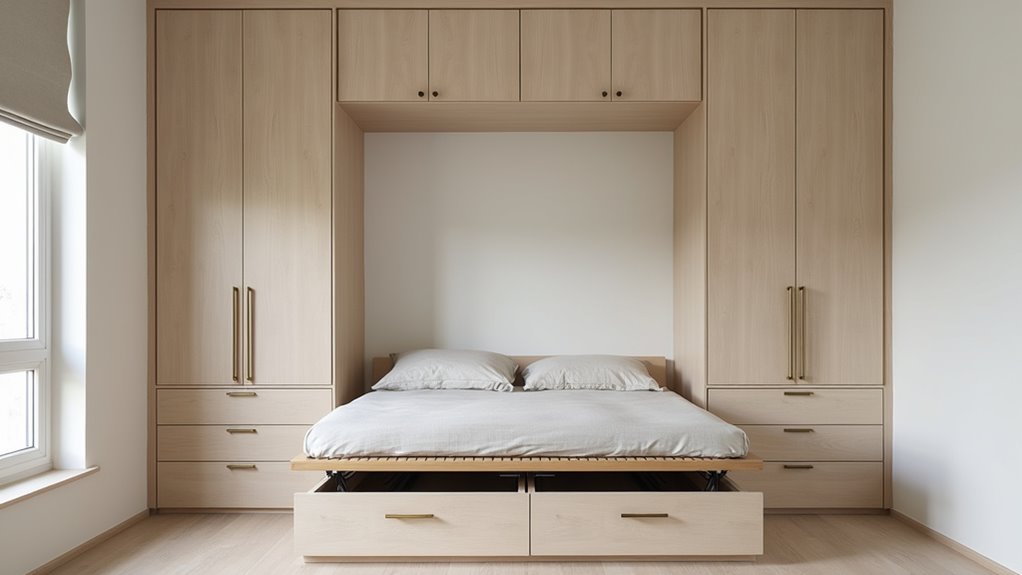
Closet doors and drawers stay clear when the bed opens if you plot the deployed bed’s footprint alongside the swing arc of every wardrobe door and the full extension of every drawer, then eliminate any overlap. Any overlap means you’ll lose access to clothing whenever the bed’s down. Place drawers in side towers rather than below the bed panel, and check that door hinges let panels swing without striking the open frame. Don’t treat the closed footprint as your only guide: one full-size unit measures 21.5 inches deep as a cabinet but 107.5 by 58 inches open. Add walking space; one design source suggests 12 to 24 inches beyond the mattress. Finally, confirm that handles stay reachable in both configurations and that room entrances, windows, and walking routes don’t collide with open wardrobe storage.
How Should Everyday Clothing Remain Accessible While the Bed Is Down
Keep everyday clothing in the side wardrobe towers, where the deployed frame won’t block doors or drawers. Storage behind the bed panel adds capacity but is effectively off-limits once the bed is down, so reserve it for linens, off-season clothing, and items you rarely need. Store workwear, sleepwear, and undergarments at waist-to-shoulder height so you can reach them comfortably without leaning over the mattress. If you only have one tower, place it on the side nearest the room entrance or main walking route. Hinged doors need swing space beside the open bed, so confirm that the clearance you planned still allows full opening. Open shelves suit frequently accessed items, while closed drawers keep folded clothing dust-free. Then test every door with the bed fully lowered.
When Does an Integrated Murphy Bed Wardrobe Work Better Than Separate Closet Furniture
An integrated Murphy bed wardrobe works better than separate closet furniture in rooms where a single wall has to handle both sleeping and clothing storage, such as a studio, guest room, or home office that can’t spare floor area for a separate dresser or armoire. Matching side towers to the bed cabinet’s depth, typically 16 to 20 inches, creates one continuous built-in face, so the closed bed reads as cabinetry rather than furniture. You also consolidate hanging space, shelves, and drawers into a footprint as shallow as 20.6 to 21.5 inches in some listed models. Separate closet furniture works better when you need flexibility to rearrange, can’t anchor into studs, or lack front clearance for the open bed plus wardrobe doors. Check both configurations carefully before committing to either approach.
A Closet and Murphy Bed That Work as One
A Murphy bed with wardrobe storage works best when hanging space, drawers, shelves, and the bed cabinet are planned as one complete wall. Creative Closet Design creates custom closet systems for Central Florida homeowners so clothing stays organized without interfering with the bed’s opening path. Serving Lakeland, Auburndale, Winter Haven, Plant City, Polk County, and Hillsborough County, our designers will look at your room, wardrobe needs, and available wall space before drawing anything. Call Our Team to schedule your free design consultation.
Frequently Asked Questions
Does a Murphy Bed Wardrobe Unit Need to Be Anchored to Wall Studs?
Yes, you’ll want to anchor your Murphy bed wardrobe unit to wall studs or other structural components to reduce the risk of tipping or collapse. Before installing, confirm your wall construction, locate studs, and use hardware the manufacturer specifies. Follow the assembly instructions exactly; Health Canada recommends professional installation when possible. Afterward, engage the safety latch, and periodically recheck anchors, latches, and moving parts so nothing shifts, sags, or loosens.
Should a Murphy Bed Wardrobe Be Installed Professionally or DIY?
You should hire a professional installer when possible, since Health Canada recommends it for Murphy beds. If you DIY, you’ll need to follow the manufacturer’s assembly and installation instructions exactly, identify studs or structural components, and use appropriate anchoring hardware. Don’t force the mechanism during testing. Before use, confirm the latch works, your mattress meets weight and thickness limits, and wardrobe doors and drawers don’t obstruct the bed’s full swing.
What Mattress Weight and Thickness Limits Apply to Murphy Bed Wardrobe Units?
No universal limits apply; your unit’s manufacturer sets the mattress weight and thickness limits, so you’ll need to check its specifications before use. Don’t assume all Murphy bed wardrobes share the same size or capacity. An overweight or overly thick mattress could impede operation, so confirm fit, engage the locking latch, support the mattress while you operate it, and recheck secure anchoring and moving components per the manufacturer’s instructions.
How Can Children Stay Safe Around a Murphy Bed With Wardrobe Storage?
Keep children out of the bed’s swing path whenever you’re opening or closing it, and supervise young kids closely. Don’t let them play on the bed. Anchor the unit to wall studs or structural components, and engage the locking feature or safety latch when it’s closed and stowed. Keep the operating area clear of toys and wardrobe contents, and recheck anchors, latches, and moving parts per the manufacturer’s instructions.
How Often Should Murphy Bed Latches and Moving Parts Be Checked?
Check latches and moving parts on the schedule your manufacturer’s instructions specify, since there’s no universal interval. During each check, confirm the unit’s still anchored to studs or structural components, the locking feature or safety latch engages fully, and the mechanism moves smoothly without you forcing it. Keep wardrobe contents and loose furniture out of the operating area, and verify your mattress still meets the manufacturer’s weight and thickness limits.