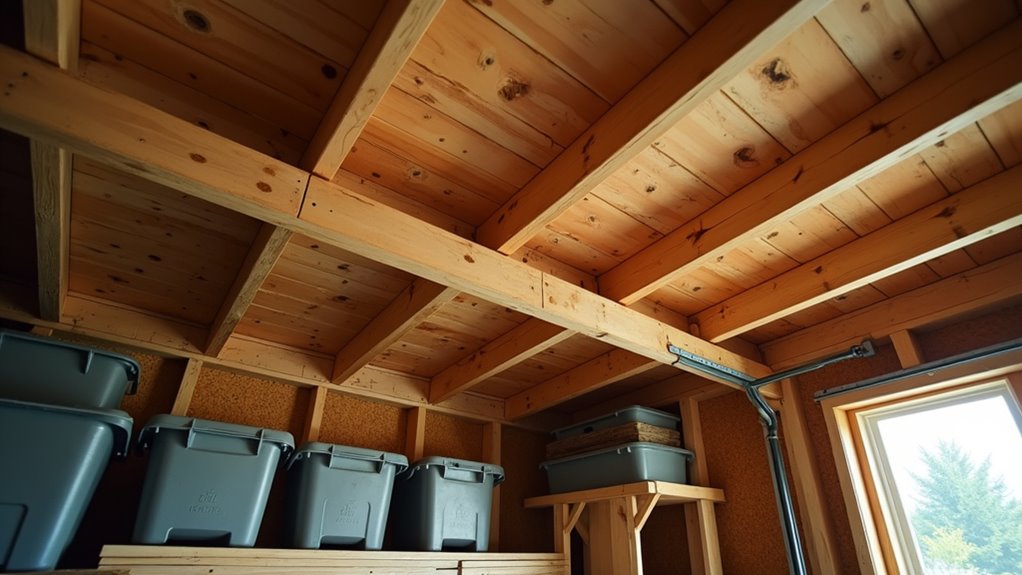
Your ceiling hook can only hold what its weakest component allows: the hook, the fastener, the ceiling material, or the framing behind it. There’s no universal number. A hook threaded into a sound wood joist may safely carry around 40–50 lb, while drywall or plaster alone shouldn’t bear heavy loads. Use working-load limits, not breaking strength, and apply a 4:1 safety margin. Next, you’ll see how anchors, angles, and swinging loads change your real limit.
Key Takeaways
- A ceiling hook’s safe load depends on the weakest part of the assembly: hook, fastener, ceiling material, or supporting structure.
- Hooks screwed into solid wood joists hold far more than drywall anchors; some joist installations safely support about 40–50 pounds.
- A printed hook rating reflects the hook alone under ideal conditions, not the installed system’s true capacity.
- Use working-load limits with a safety margin, such as 4:1, meaning a 15-pound item needs a 60-pound system rating.
- Swinging, bumping, or angled loads reduce safe capacity, so heavy or dynamic items should always be anchored into structural joists.
How much weight can a ceiling hook safely hold

A ceiling hook can safely hold only as much weight as the weakest part of its full assembly allows, and there’s no universal figure. That assembly includes the hook, fastener, ceiling material, and supporting structure. The weakest component sets your true ceiling hook weight limit, not the hook’s advertised rating. A screw eye or lag hook driven into a sound wood joist typically outperforms any drywall-only mount. One source estimates 40–50 lb as a safe working load for some joist installations, though that’s not a universal figure. Drywall, plaster, and ceiling tile alone shouldn’t carry heavy or safety-critical loads. To find out how much weight you can hang from your ceiling, check your exact hardware’s working-load rating, then apply a 4:1 safety margin.
How do hook types and anchors compare on rating
Joist-mounted hooks rate highest, toggle bolts rate moderately, and generic drywall anchors rate lowest. Joist-mounted hooks consistently outrank drywall anchors because they transfer the load into solid structural wood rather than into the ceiling surface. Drywall alone offers little resistance to downward pull, so you’ll need an anchor built for overhead use. Toggle bolts spread force behind the board, but published capacities vary widely by product.
| Hook/Anchor Type | Rating Considerations |
|---|---|
| Screw eye or lag hook in joist | Strongest; some estimates suggest 40–50 lb |
| Toggle bolt in drywall | Moderate; varies widely by product |
| Generic drywall anchor | Weakest; avoid for overhead loads |
If you’re converting a wall rating, reduce it by 30–50% for ceiling use. Always apply the lowest rating among the hook, anchor, ceiling material, and structure, and confirm the manufacturer’s exact ceiling-use specification before you hang any load.
What a ceiling hook is rated to hold on its own
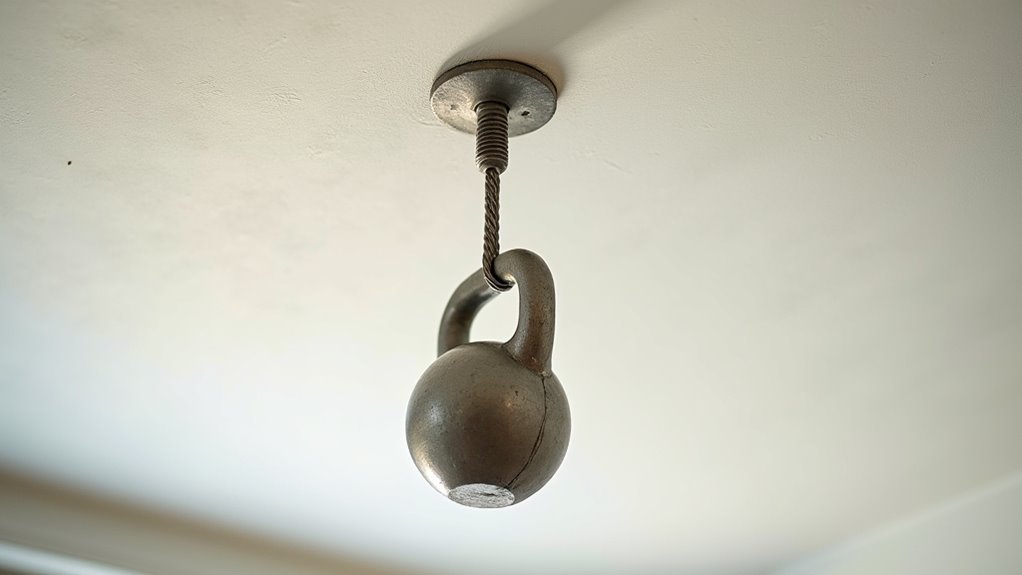
A hook’s printed rating tells you what the hook alone can hold, often tested under ideal conditions, not what it can hold once installed in your ceiling. That number doesn’t account for the fastener, the ceiling material, or the structure behind it. Your safe capacity is limited by the weakest part of the assembly, so a hook rated above your load can still fail if its anchor or drywall gives way first.
Check whether the figure is a working-load limit or a breaking strength. Never load a hook to its breaking strength; use the stated working-load limit. Then apply a safety margin. Under a 4:1 approach, a 15 lb load calls for a system rated at least 60 lb, measured against the assembly’s lowest rating.
Why does what you screw into decide the real limit
Your installation’s capacity equals its weakest component, and the hook rarely fails first, so the hook, the fastener, the ceiling material, or the structure behind it sets the real limit. That is why two identical hooks can hold very different loads. A screw eye or lag hook driven into a sound wood joist engages solid structural lumber with its threads, giving the strongest residential attachment. Thread engagement, wood species, and joist condition still matter, so drill a pilot hole to prevent splitting. Drywall, plaster, and ceiling tile offer little resistance to downward pull, so they can’t serve as structural support for heavy loads. If you can’t reach a joist, use a toggle bolt rated specifically for ceiling use. Don’t assume wall ratings apply overhead. One source advises cutting them 30–50%.
How does hitting a joist beat a drywall anchor
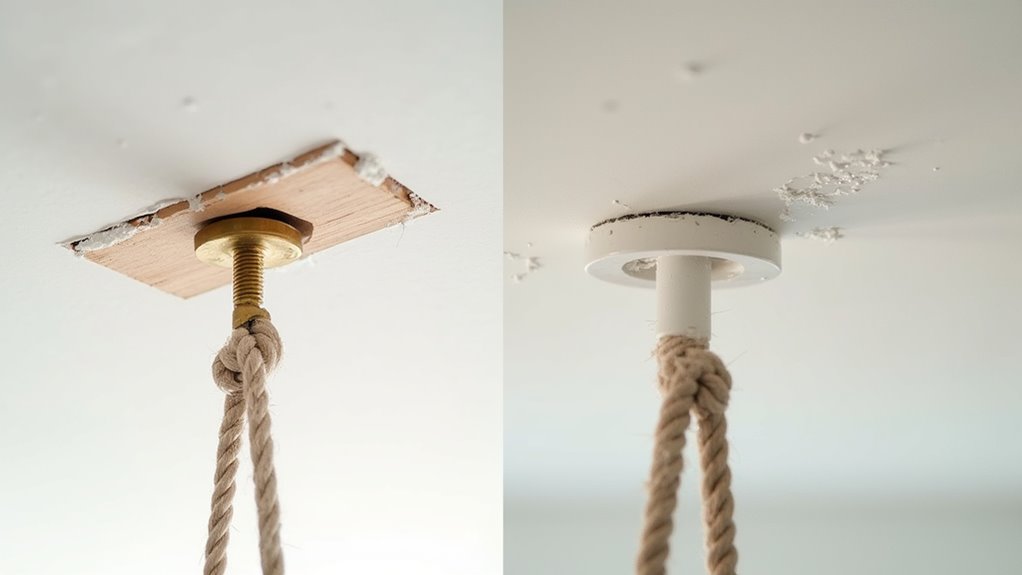
Hitting a joist beats a drywall anchor because the joist takes your load directly into the framing, but a drywall anchor depends on a thin gypsum panel that’s held up only by its own fasteners. That difference changes how your hook fails and how much margin you actually have.
A joist carries your load straight into the framing, while a drywall anchor relies on thin gypsum held up by its own fasteners.
- A screw eye or lag hook threaded into sound wood resists downward pull through full thread engagement.
- Drywall offers little pull-out resistance, so the anchor carries nearly everything.
- Toggle bolts spread force behind the board, but ceiling ratings can run 30–50% below wall ratings.
- Joist capacity still varies with hook size, wood species, and joist condition.
- A correctly sized pilot hole helps you avoid splitting the joist.
Locate the joist first, and use a rated toggle only when you can’t safely reach framing.
How do angle and swinging loads lower the safe weight
Swinging loads and angled pulls lower the safe weight because the hook no longer carries a simple straight-down force, so its effective capacity drops below the static rating.
A swinging plant or a fixture you bump adds momentum, so each movement can impose greater force than the item’s weight alone. An angled pull also stresses the hook and fastener in ways their straight-down rating may not cover, especially in drywall anchors.
Plan for this by increasing your safety margin. One source suggests 2:1 for static loads and 3:1 to 4:1 for dynamic uses, so a 15 lb swinging load could call for a 60 lb-rated system. Check the manufacturer’s rating for angled loading, and inspect regularly for loosening, cracks, or sagging. Prefer a joist-mounted hook.
How do you mount a ceiling hook for a heavy item
Mount a heavy ceiling hook directly into a wood joist or beam, not into drywall, plaster, or ceiling tile alone. Weigh the full load, including wet soil or contents, and choose hardware whose working-load limit exceeds it by your safety margin.
- Locate the joist with a stud finder and confirm it by test-drilling a small hole.
- Drill a pilot hole sized to the manufacturer’s specification so the wood doesn’t split.
- Thread the screw eye or lag hook fully into the joist’s center, not its edge.
- Check that the hook doesn’t shift, spin, or loosen under hand pressure.
- Inspect it periodically for movement, cracks, sagging, or corrosion.
For fans or heavy fixtures, use a purpose-built, structurally supported mount and consult an installer.
Need Storage Without Heavy Ceiling Hooks?
If ceiling hook weight limits restrict your storage options, Creative Closet Design creates custom garage storage systems with cabinets, shelving, and wall-mounted storage for household essentials. Serving Lakeland, Auburndale, Winter Haven, Plant City, Polk County, and Hillsborough County, our designers assess your available space and storage needs before planning a practical setup. Call Our Team to schedule your free design consultation.
Frequently Asked Questions
How Often Should I Inspect a Ceiling Hook for Signs of Wear?
You should inspect it periodically; there’s no single universal interval, so follow the hook and anchor manufacturer’s guidance. Check for movement, cracks, sagging, corrosion, or loosening fasteners. Inspect more often when you’re hanging dynamic loads, such as swinging items, or variable loads, like plants whose wet soil adds weight. If you spot any deterioration, remove the load immediately. For safety-critical loads, you’ll want a qualified installer to evaluate the mounting.
How Can You Tell If a Ceiling Hook Is Overloaded?
An overloaded ceiling hook may show signs of bending, loosening, or pulling away from the ceiling. You might also notice cracks around the mounting point, sagging drywall, or movement when the hanging item shifts. These warning signs indicate that the hook or its support may be under excessive stress. Remove the load immediately if you notice damage, and verify the hook, anchor, and framing capacity before using it again.
Can I Hang a Ceiling Fan or Light Fixture From a Regular Hook?
No, you shouldn’t hang a ceiling fan or light fixture from a regular hook. Fans generate dynamic, rotational forces, and fixtures need a support system rated for that application. Use a purpose-built mounting system, such as a fan-rated electrical box, secured to a joist or structural brace. Don’t rely on drywall or improvised anchors. If you’re unsure about the load or the structure, consult a qualified installer before you mount anything.
Can You Install a Ceiling Hook Without Drilling Into a Joist?
Yes, but only for lightweight items and when using an anchor specifically rated for overhead installation in your ceiling material. Drywall and plaster alone cannot reliably support heavy loads, and drop-ceiling tiles should never carry hanging weight. For heavier items, secure the hook directly to structural framing. Always check the manufacturer’s working-load rating and inspect the installation for signs of loosening or damage.
When Should I Hire a Professional to Install a Ceiling Hook?
Hire a professional when you can’t locate a joist, can’t identify your ceiling construction, or can’t confirm the load. You should also call one when failure could injure someone, when the load moves or swings, or when you’re mounting a ceiling fan, light fixture, or other heavy item. A qualified installer verifies structural support, selects rated hardware, and applies an appropriate safety margin, such as 4:1 for overhead static loads.