You’ll get the best custom entertainment center by balancing concealed storage with open display. Tuck controllers, cables, and game cases into handle-free cabinets with push-to-open, soft-close hardware. Reserve open shelving for curated books, art, and decorative objects that add personality. Route wires through built-in raceways and hollow floating shelves for a clean, wire-free look. Add LED strip lighting to highlight your favorite pieces. There’s plenty more to help you design yours below.
Key Takeaways
- Balance concealed storage with open display shelving to avoid a sterile or cluttered look while showcasing personality.
- Hide controllers, cables, and game cases in closed cabinets and drawers, reserving open shelves for curated decorative pieces.
- Choose a style that fits your space, from wall-mounted consoles to corner units or modular cube systems.
- Add handle-free push-to-open hardware, LED shelf lighting, and discreet cable routing for a clean, modern aesthetic.
- Expect costs from $800 for basic consoles to $15,000+ for full custom builds with lighting and premium materials.
What makes a great custom entertainment center
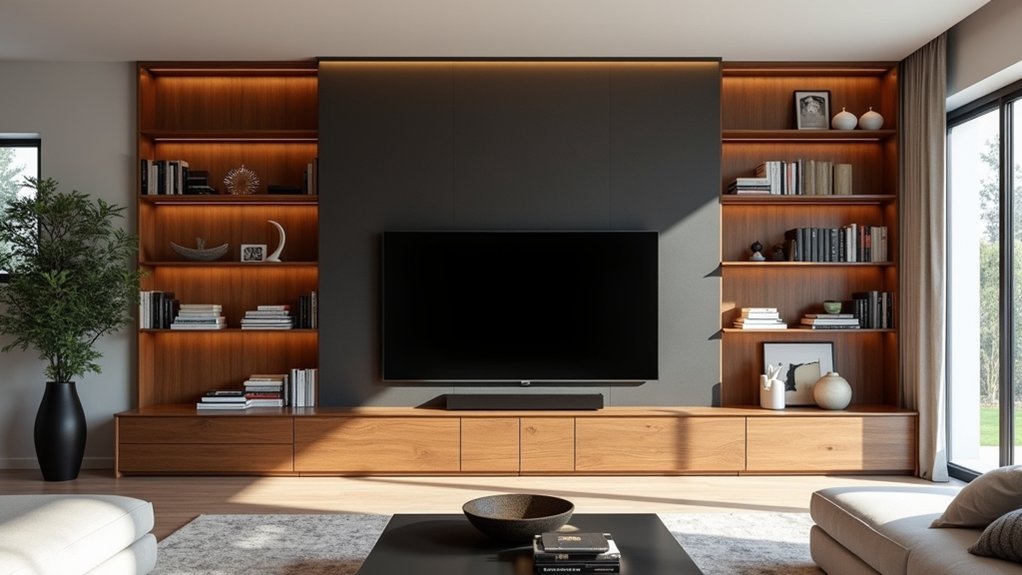
A great custom entertainment center strikes a perfect equilibrium between concealed storage and open display, so it never looks sterile or cluttered. You’ll want closed cabinets and drawers to hide clutter like controllers, cables, and game cases, while reserving open shelving for curated items that add personality, such as books, decorations, or objects worth showcasing.
The best custom built entertainment center ideas maintain a handle-free aesthetic through high-quality push-to-open and soft-close hardware, ensuring quiet, smooth operation. You’ll also route cables discreetly through built-in raceways and hollow floating shelves, achieving that coveted wire-free look.
Don’t overlook ventilation. Discreet vents in the back or base prevent enclosed electronics from overheating. Add integrated LED strip lighting to highlight displayed items, and you’ve created a space that’s both functional and visually striking.
What entertainment center styles can you choose from
Entertainment center styles range from sleek and modern to warm and industrial. Wall-mounted, low-profile media consoles create a clean, modern look that keeps your floor clear and your space feeling open. For something warmer, industrial-chic designs pair reclaimed wood with black iron pipe shelving, adding texture and character. If you’re working with limited square footage, corner entertainment centers reclaim often-wasted angles, tucking your setup neatly into an underused nook. Modular cube storage systems adapt to your room, configuring horizontally or vertically as needed. For a dramatic touch, pop-up mechanisms lift your TV from a hidden compartment at the press of a button. These entertainment center design ideas let you match your unit’s aesthetic to your room’s proportions and personality. Organizing home clutter is essential for maintaining an open, inviting atmosphere. Clever storage solutions keep everything in its place, and decorative baskets or sleek storage ottomans enhance your room’s aesthetic while minimizing visual chaos.
How do you plan storage into an entertainment center
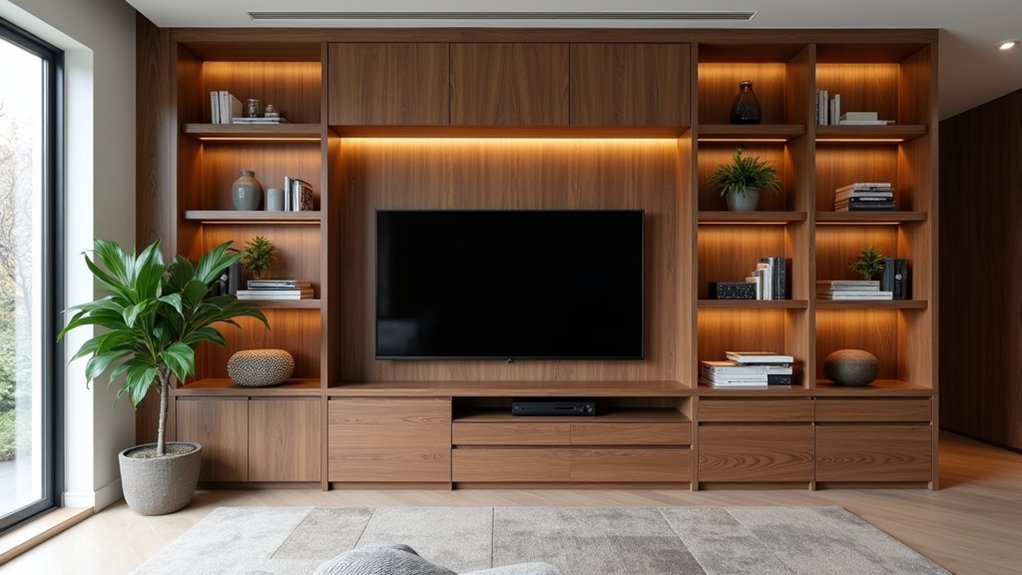
Storage planning for an entertainment center comes down to striking a balance between what you hide and what you display. The best home entertainment center ideas achieve perfect equilibrium between concealed storage and open display areas. Tuck clutter like controllers, cables, and game cases into closed cabinets and drawers, keeping messy essentials out of sight. Reserve open shelving for curated pieces that add personality, such as books, framed art, or decorative objects. This balance prevents your setup from looking either sterile or cluttered. Maximize utility with multi-purpose drawers, sliding doors, and integrated bookcases that expand functionality without sacrificing aesthetics. Think about how each compartment serves you daily, then arrange concealed and open zones to complement your room’s flow and visual rhythm.
How much does a custom entertainment center cost
A custom entertainment center costs between $800 and $15,000 or more, depending on your material choices, size, integrated lighting, cable management systems, and hardware quality. Built in entertainment center ideas featuring reclaimed wood, LED strip lighting, and soft-close mechanisms naturally cost more than basic wall-mounted consoles.
| Configuration | Typical Cost Range |
|---|---|
| Wall-mounted media console | $800, $2,500 |
| Mid-range built-in with storage | $3,000, $6,000 |
| Full custom center with lighting | $7,000, $15,000+ |
You’ll spend more when you layer in discreet ventilation, pop-up TV mechanisms, or premium finishes that complement your room’s aesthetic. Think about where your priorities lie. Balancing concealed storage, curated display space, and clean, handle-free surfaces determines exactly where you’ll land within these ranges.
What extras like lighting and media integration can you add
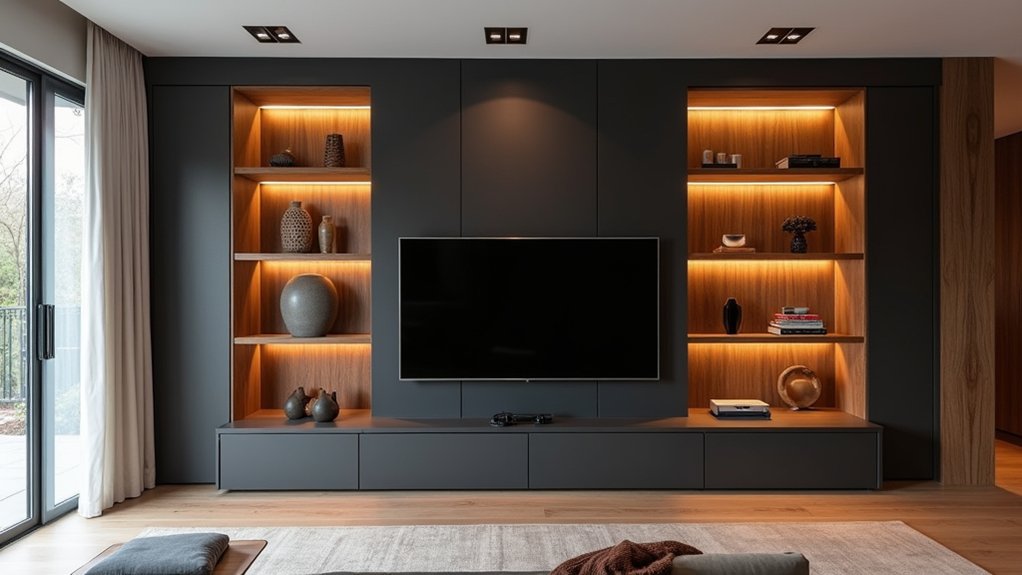
Extras like lighting and media integration include LED strip lighting, cable management, pop-up TV mechanisms, and discreet ventilation. These thoughtful additions elevate both ambiance and functionality throughout the space, transforming a functional entertainment center into a curated focal point.
Consider these standout upgrades:
- Integrated LED strip lighting installed within shelves or as spotlights highlights your decorative objects, creating warm ambiance while preventing dark shadows.
- Advanced cable management using built-in raceways and hollow floating shelves routes wiring discreetly for that coveted wire-free look.
- Pop-up TV mechanisms lift screens from hidden compartments at the touch of a button, preserving clean sightlines.
- Discreet ventilation with vents and ultra-quiet cooling fans protects enclosed electronics from overheating.
You can also adjust lighting seasonally, enhancing your room’s atmosphere and keeping displayed items beautifully illuminated year-round.
How do you design one to fit your room
Design an entertainment center that fits your room by measuring your walls, noting ceiling height, window placement, and doorway clearances before exploring custom entertainment center ideas. If you’re short on floor area, wall-mounted low-profile media consoles create a sleek look without clutter. Awkward corners? Corner entertainment centers reclaim that often-wasted space efficiently. For flexible layouts, modular cube storage systems configure horizontally or vertically, adapting to your room’s proportions. Consider how you’ll move through the space, keeping walkways unobstructed and viewing angles comfortable. Match the unit’s scale to your room, oversized pieces overwhelm small spaces, while undersized ones look lost in large ones. Balance proportion, function, and flow to achieve seamless integration.
How does Creative Closet Design build custom entertainment centers
Creative Closet Design builds custom entertainment centers by striking the perfect equilibrium between concealed storage and open display. Closed cabinets hide controllers, cables, and game cases, while open shelving showcases curated books and decorative objects that add personality to your space.
Their entertainment center ideas center on these thoughtful details:
- Integrated LED lighting within shelves and spotlights highlights your displayed items and creates ambiance.
- Advanced cable concealment using built-in raceways and hollow floating shelves achieves a completely wire-free look.
- Discreet ventilation through back and base vents keeps enclosed electronics cool and protected.
- Premium soft-close hardware maintains a handle-free aesthetic with quiet, smooth operation.
You’ll get a design that’s balanced, never sterile, never cluttered.
Design a Media Wall Built for Your Room
Getting an entertainment center right comes down to details that are hard to change later, screen height, cabinet proportions, ventilation, and where the cables run. Creative Closet Design builds custom entertainment centers for Central Florida homeowners, planning the layout around your TV, your seating, and your equipment so the finished wall looks intentional and works the way it should. Serving Lakeland, Auburndale, Winter Haven, Plant City, Polk County, and Hillsborough County, our designers will measure your space and work through the specifics before anything is built. Call (863) 591-4500 to schedule your free design consultation.
Frequently Asked Questions
How high should the TV sit in a built-in entertainment center?
Lower than most people mount it. The guiding rule is that the center of the screen should land near your eye level when you’re seated, which for most living rooms falls somewhere around 40 to 42 inches from the floor. Mounting higher than that is the most common mistake, and it causes neck strain over long viewing sessions. This is why the cabinetry has to be planned around the screen rather than the other way around. The taller your TV, the lower the base cabinet needs to sit to keep the screen center in the right place.
How wide should the unit be relative to my TV?
Wider than the screen, with margin on both sides. A unit that’s the same width as the TV or narrower makes the screen look oversized and precarious, while extra width on each side gives the composition balance and leaves room for a soundbar or a few objects. The bigger the TV, the more margin it needs to look right. Also worth noting: TVs are advertised by diagonal measurement, so measure the actual frame width edge to edge when planning, since that’s the number that matters for fit.
What do I need to plan for if I have a soundbar?
More room than people expect, in both width and vertical clearance. If the soundbar sits on the cabinet in front of the screen, the surface needs enough depth for it without crowding the TV base, and the unit needs to be comfortably wider than the soundbar so it doesn’t look like it’s hanging off the edges. If the TV is mounted above, you need adequate gap between the cabinet top and the bottom of the screen to fit the soundbar without it blocking the picture. Just as important, make sure the placement doesn’t block the TV’s infrared sensor.
How much ventilation do enclosed electronics actually need?
Enough that heat can escape, which means it has to be designed in rather than added afterward. Receivers, game consoles, streaming boxes, and routers all generate heat, and a sealed cabinet traps it, which shortens equipment life. Compartments holding electronics need vents in the back or base, adequate depth so components aren’t pressed against a solid panel, and airflow paths that actually move air rather than just looking like vents. For heat-heavy equipment like a receiver, a quiet cooling fan is worth considering. Telling your designer exactly what’s going inside lets them size and vent each compartment properly.
What if I buy a bigger TV in a few years?
This is the real risk with a permanent built-in, since screens have kept getting larger. The way to protect yourself is designing the TV opening with some headroom rather than sizing it tightly to the set you own today, and keeping the surrounding shelving adjustable where possible. It’s also worth being clear with your designer about whether you might upgrade, since planning a slightly larger opening now costs almost nothing, while modifying finished cabinetry later means real carpentry. Wall-mounting the TV within a generous recess generally gives you more flexibility than building a tight niche.