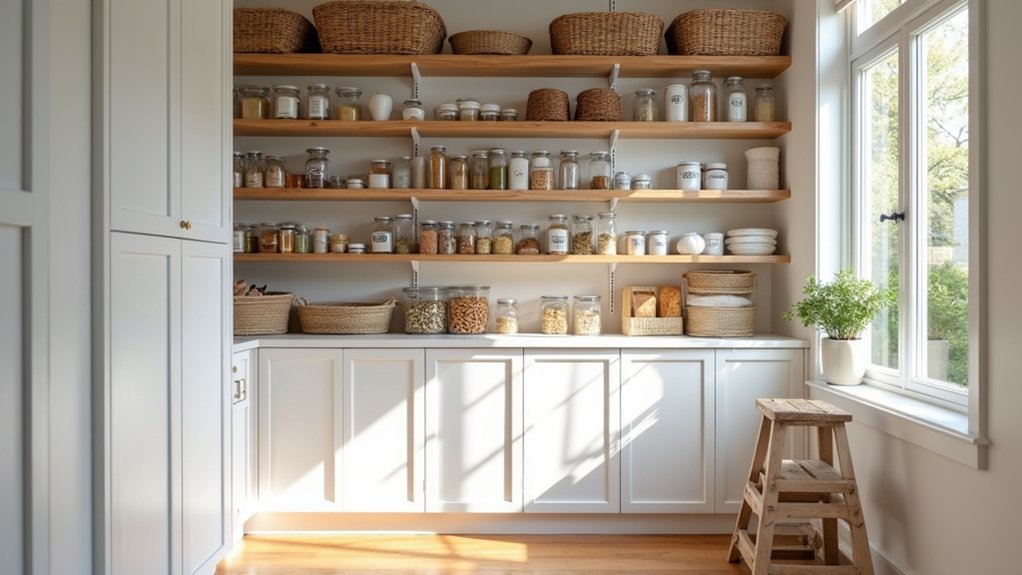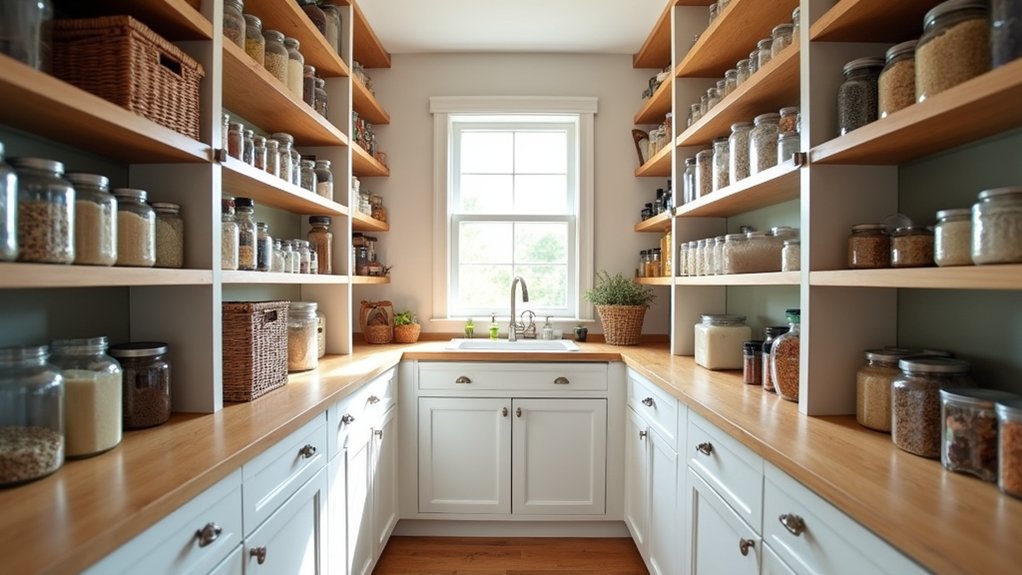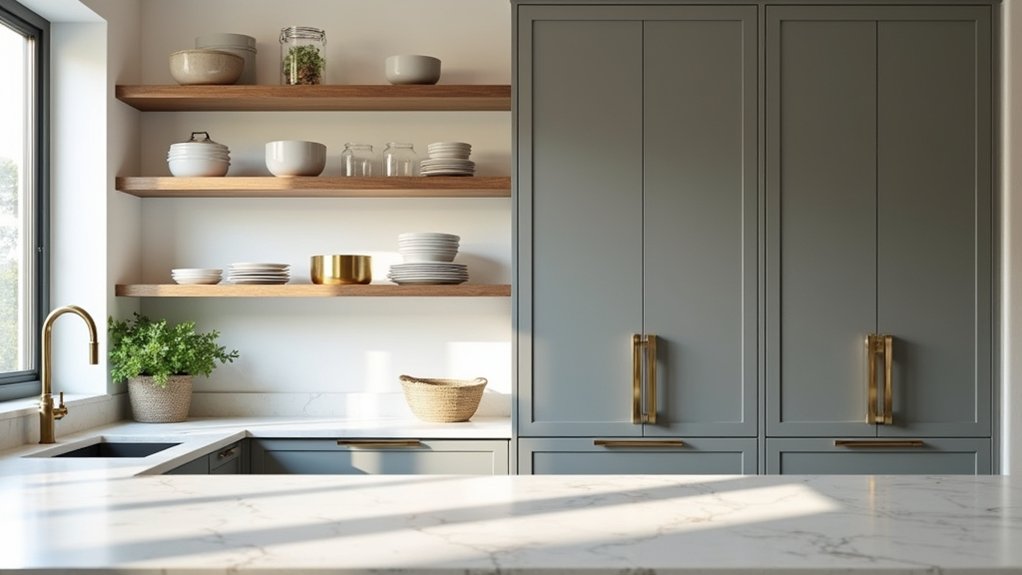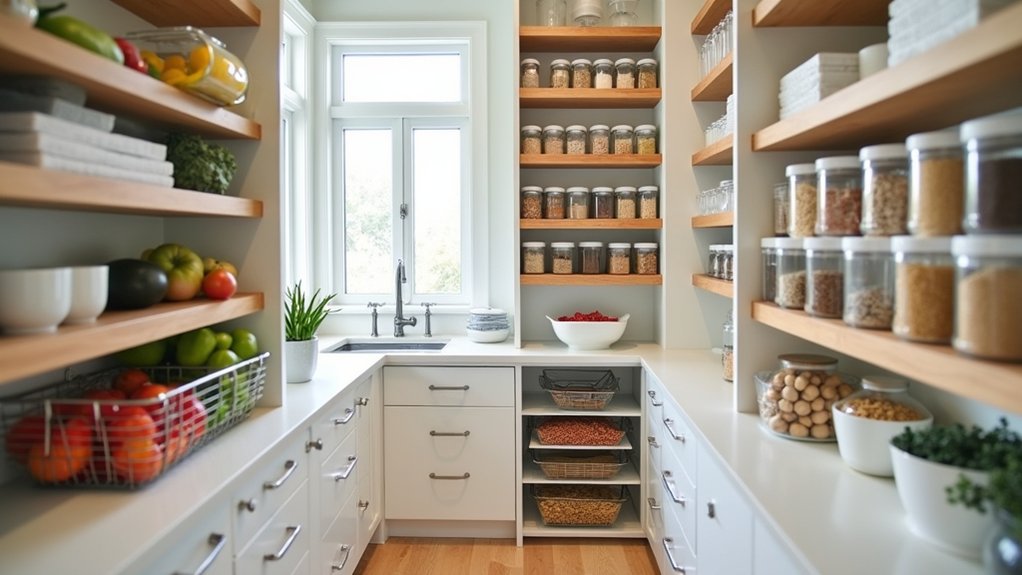
You’ll get big storage from a small pantry by building upward. Install floor-to-ceiling shelving to maximize wall height, and mount ceiling racks or hooks for bulky pots and pans. Slide narrow pull-out towers into six-to-eight-inch gaps, and add door-mounted racks for daily-use spices and snacks. Layer tiered risers, swap deep shelves for pull-out inserts, and reserve top tiers for seasonal goods. Keep a step stool handy. There’s much more you can do below.
Key Takeaways
- Install floor-to-ceiling shelving to maximize vertical storage while minimizing horizontal footprint in tight pantry spaces.
- Add narrow pull-out tower units in six-to-eight inch gaps beside pantries or between cabinets.
- Use door-mounted racks and mini shelves for spices, condiments, and lightweight snacks reached daily.
- Replace deep static shelves with pull-out inserts and tiered risers for easy front access to rear items.
- Reserve high shelves for rarely used goods, place everyday essentials at eye level, and keep a step stool handy.
How do you get big storage from a small pantry
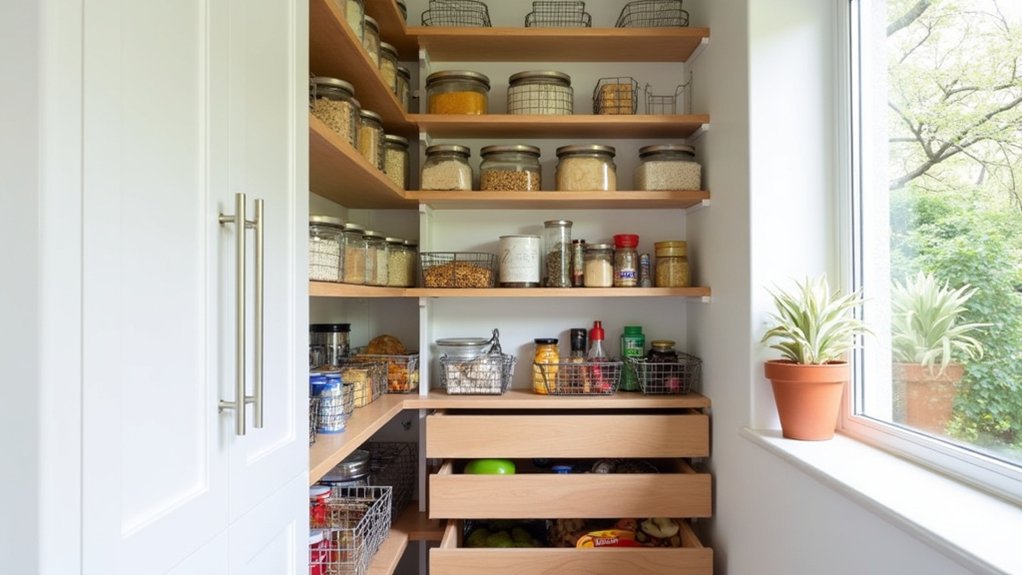
To get big storage from a small pantry, think vertically. Install floor-to-ceiling shelving to maximize storage while shrinking your horizontal footprint. Add ceiling-mounted racks or hooks for bulky pots, pans, and small appliances, freeing up your small pantry shelves for everyday items. Push rarely used backup supplies and seasonal goods to the highest shelves, and keep a step stool handy. Mount narrow racks, magnetic strips, or pegboards on empty wall pantry shelves to convert surface area into useful storage. Hang mini shelves or baskets from the door frame for extra compartments. Pair pull-out shelves up high with stationary baskets below to fill awkward gaps. Smart pantry shelfing turns wasted vertical space into serious capacity, letting your small pantry store far more than you’d expect.
How do you use wall height for extra shelving
Use wall height for extra shelving by installing floor-to-ceiling shelving to maximize storage while minimizing your horizontal footprint. Reserve the highest pantry shelf for rarely used backup supplies, specialty ingredients, or seasonal goods you don’t reach daily. Mount ceiling racks or hooks to hang bulky items like pots, pans, and small appliances, freeing lower shelves. Fill awkward vertical gaps with pull-out shelves at higher levels, pairing them with stationary baskets below. Keep a small step stool accessible so you can safely retrieve items from those top tiers. These easy pantry shelves stretch usable space upward without altering your walls. Working vertically transforms wasted ceiling area into practical, organized storage you’ll actually use.
How do narrow and door-mounted shelves add space
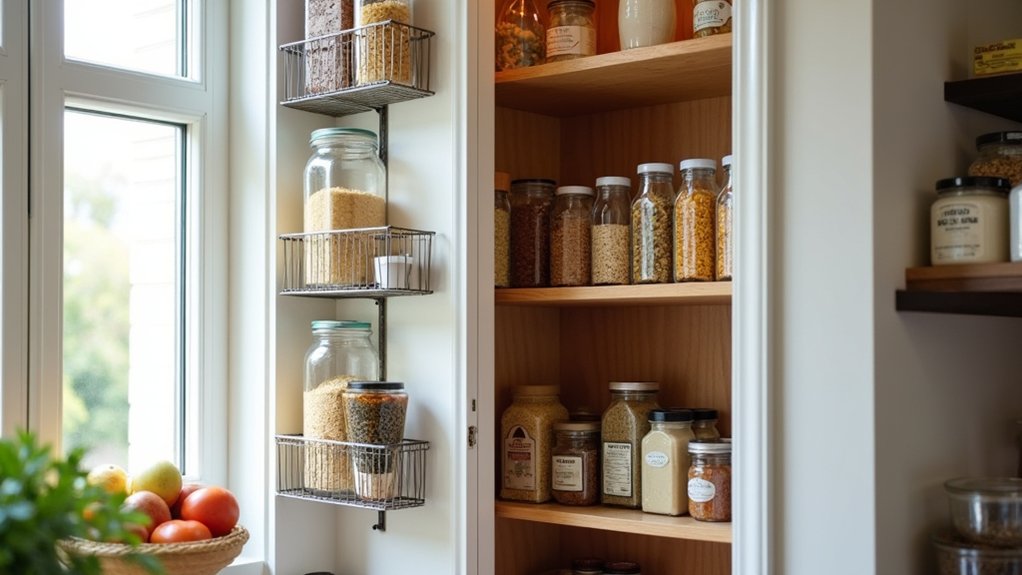
Narrow and door-mounted shelves add space by reclaiming overlooked gaps and unused surfaces. Those awkward six-to-eight inch gaps beside your pantry or between cabinets aren’t wasted anymore after you slide in a narrow pull-out tower unit. It brings items to the front, so nothing disappears into hidden corners. Your pantry door offers untapped storage for smaller, frequently grabbed items. Creative solutions like storage for reach-in pantries can maximize every inch of your kitchen. By utilizing vertical space and incorporating organizational tools, you can keep essentials easily accessible.
- Install narrow pull-out tower units in six-to-eight inch gaps beside pantries or between cabinets.
- Hang custom mini shelves or baskets directly from the door frames for extra compartments.
- Use door-mounted racks for spices, condiments, or snacks you reach for daily.
- Keep lightweight items on door shelves to avoid strain and prevent overloading.
These solutions maximize every inch.
What space-saving shelf configurations work best
The best space-saving shelf configurations combine adjustable systems with vertical layering to fit your specific items. Switch to adjustable systems like ClosetMaid or Rubbermaid so you can customize shelf heights for exact contents. Layer tiered risers to create a second row for spices, cans, and small jars. Replace deep static shelves with pull-out inserts to bring rear items forward, and pair pull-out shelves up high with stationary baskets below to close awkward gaps. Custom shelving for kitchens maximizes space and enhances organization. Pull-out trays and adjustable racks make ingredients and tools easy to access, improving functionality while adding a tailored aesthetic to your kitchen.
| Shelf Type | Best Use |
|---|---|
| Adjustable shelving | Custom heights for tall or short items |
| Tiered risers | Second row for cans and spices |
| Pull-out inserts | Front access on deep shelves |
| High pull-outs + baskets | Filling vertical gaps |
| Add-on riser kits | Doubling usable space |
Match each configuration to your inventory.
How do you keep a small pantry organized
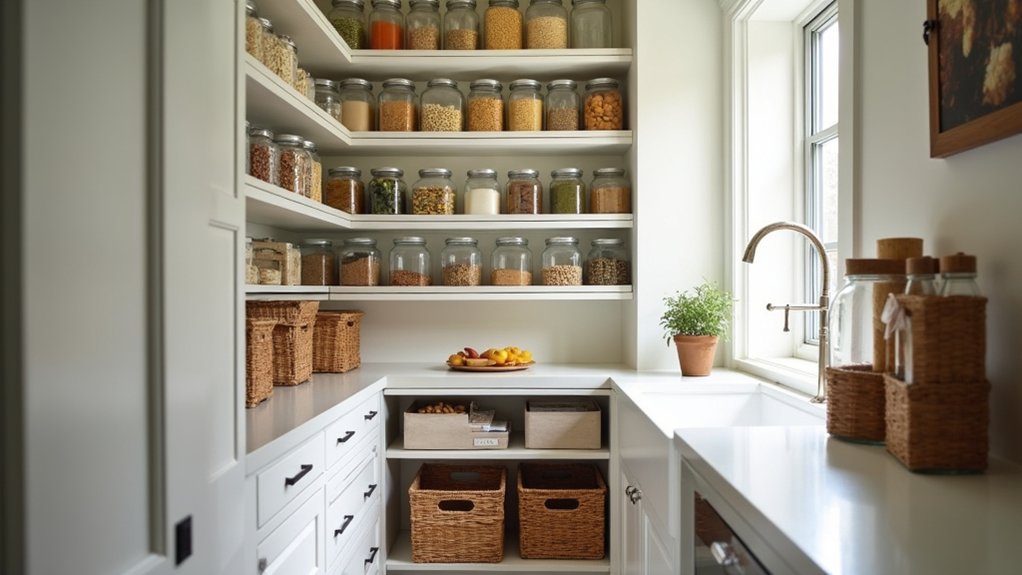
Keeping a small pantry organized comes down to a repeatable system. Start by organizing your pantry like a grocery store: group similar items together and face labels forward for instant visibility. Create dedicated zones for baking, breakfast, snacks, and lunch to maintain logical flow. Place everyday essentials at eye level, heavier items on bottom shelves, and rarely used goods up top. Smart pantry organization features make meal prep more efficient and enjoyable. Clear bins and labels help you locate items quickly, saving time and reducing food waste by ensuring nothing gets lost in the back of the pantry.
- Sort canned foods by category, tomato sauces, vegetables, beans, so you retrieve them without lifting lids.
- Transfer grains and rice into clear, uniform containers, ditching bulky cardboard packaging.
- Use pull-out organizers to rotate stock First-In-First-Out and prevent forgotten items.
- Label everything and restock in order to simplify inventory rotation.
Consistency keeps the chaos out.
How do light, shallow shelves prevent clutter
Light, shallow shelves prevent clutter by forcing every item to sit within arm’s reach, so nothing disappears into a dark back corner. When you limit depth, you eliminate the second and third rows where cans and jars vanish, forgotten until they expire. You see everything at a glance, which stops duplicate purchases and keeps inventory accurate. Pair shallow shelves with task lighting or adhesive-backed strips underneath to illuminate every label. Add battery-powered fixtures if your pantry lacks built-in lights, ensuring no shadow hides a stray box. Keep shelves light by removing bulky cardboard packaging and transferring contents into clear containers. This reduces volume and weight while improving visibility. Together, shallow depth and bright light guarantee front-to-back access, so you retrieve, restock, and rotate items without lifting or digging.
How does Creative Closet Design maximize small pantries
Creative closet design maximizes small pantries by targeting each overlooked area with a specific solution, from gaps and corners to unused vertical zones. You’ll switch to adjustable shelving systems like ClosetMaid or Rubbermaid to customize shelf heights for the exact items you store. Add-on shelf kits or extra risers double your usable space without altering wall structures. For deep corners where items disappear into the abyss, install rotating carousels to bring everything within reach.
- Fit narrow pull-out tower units into six-to-eight inch gaps beside pantries
- Add floating shelves in spots standard shelving can’t reach
- Use tiered risers to create a second row on single shelves
- Hang mini shelves or baskets from door frames for extra compartments
You’ll capture every inch.
Make Every Inch of a Small Pantry Count
A small pantry doesn’t have to mean limited storage, it just means every decision about depth, spacing, and access has to be deliberate. Creative Closet Design builds custom pantry systems for Central Florida homeowners that use the full height of the space, reclaim awkward gaps, and keep everything visible instead of buried. Serving Lakeland, Auburndale, Winter Haven, Plant City, Polk County, and Hillsborough County, our designers will measure your space and show you how much more it can hold. Call (863) 591-4500 to schedule your free design consultation.
Frequently Asked Questions
Does decanting into containers really save space in a small pantry?
For some items, yes. Bulky cardboard boxes and half-empty bags waste real space, and uniform containers stack cleanly and let you see quantities at a glance. But it isn’t universally worth it. Items you use up in one go, or buy occasionally, don’t gain anything from being transferred, and you’ve spent money on a container that now takes up space itself. The practical approach is decanting the staples you refill often, granola, oats, flour, snacks, and leaving the rest in their packaging.
Where do I put the bulk and overflow if the pantry can’t hold it?
This is the trap people hit when they start decanting in a small pantry. Once you transfer a portion into a container, the remainder of the bulk package still needs somewhere to live. In a large walk-in that’s fine, but a small pantry rarely has room. The solution is designating a secondary spot, a hall closet shelf, a garage cabinet, or a laundry room shelf, as backup storage, then refilling from it. Just remember to check that overflow before shopping, or you’ll buy duplicates of things you already own.
Will adding more shelves actually help, or just create more clutter?
It depends entirely on whether the shelves match what you store. Adding shelves at the right spacing genuinely increases capacity, since most pantries waste vertical air above short items. Adding shelves without adjusting spacing to your inventory just gives you more surfaces to pile things on. The gain comes from tightening the spacing where items are short and giving real clearance where they’re tall, which is exactly what fixed builder shelving gets wrong. More shelves at the wrong heights is not more storage.
Where should rarely used appliances and serving pieces go?
Not in the prime real estate. The waffle iron, the roasting pan, the holiday platters, these should be occupying the highest shelves or the deepest corners, not the eye-level space where you reach for things daily. If the pantry is genuinely tight, they’re also strong candidates for storage elsewhere entirely, like a garage shelf or a hall closet. A small pantry works when it’s holding what you use regularly, and it stops working when a third of it is dedicated to things you touch twice a year.
How do I know whether I need better organization or actually more storage?
Empty it completely and sort what comes out. If most of what’s inside is genuinely used and you still can’t fit it, that’s a capacity problem, and the answer is a smarter build, better depths, tighter spacing, or reclaiming vertical space. If a meaningful portion is expired, duplicated, or rarely touched, the problem is inventory rather than square footage, and no amount of shelving fixes that. Most small pantries suffer from a mix, which is why sorting first tells you exactly how much storage you actually need to design for.