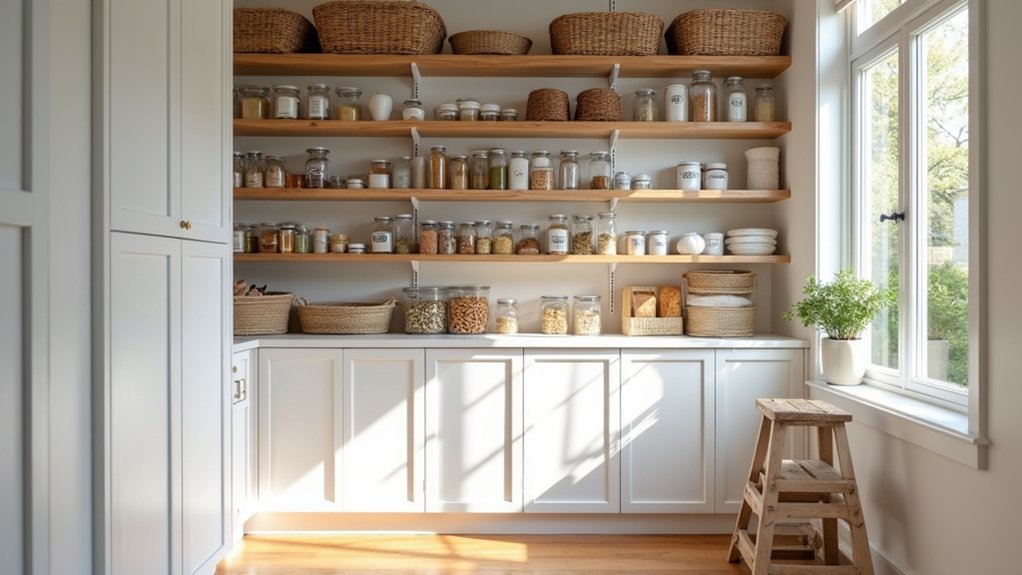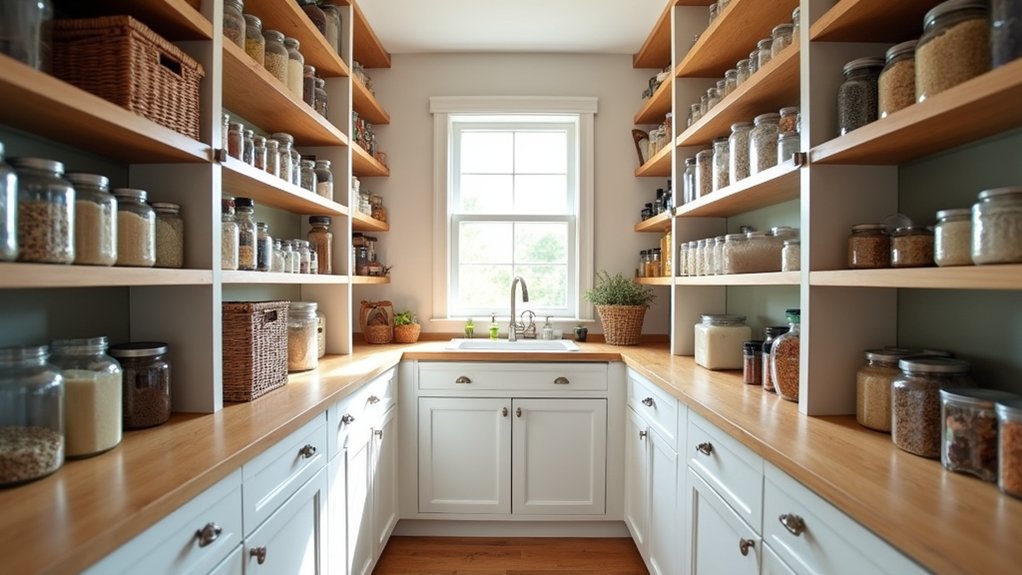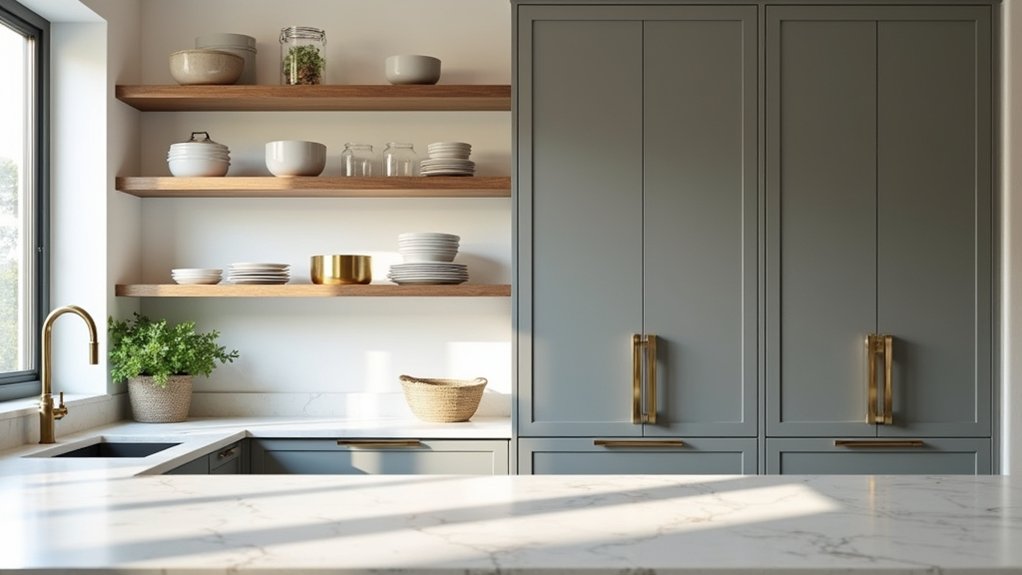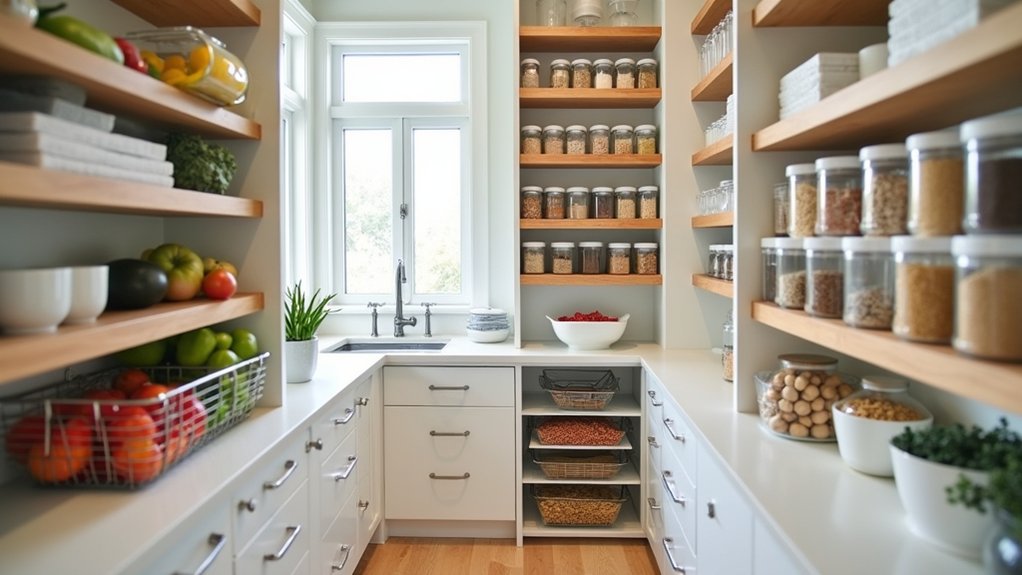
Custom pantry shelving turns wasted space into a working system. You’ll want thicker 2ʺ or 3ʺ shelves that resist sagging under heavy loads. Set 12-inch spacing for standard containers, reserve 16 inches low for 5-gallon buckets, and allow 11 inches up top for gallon jars. Add pull-out shelves so far-reaching items slide into the open. Position heaviest containers at waist-to-shoulder height for quick access. Below, you’ll find exactly how each feature works.
Key Takeaways
- Choose thick 2″ or 3″ shelves with sturdy supports to resist sagging under heavy loads.
- Set 12-inch spacing for standard containers, 11 inches up top for gallon jars.
- Install pull-out shelves to bring far-reaching items forward and reduce blind reaching toward the back.
- Reserve 16 inches on the bottom shelf for 5-gallon buckets and bulk items.
- Add tension rods for trays and integrated lighting to keep deep zones usable.
What custom pantry shelving features make organization easier
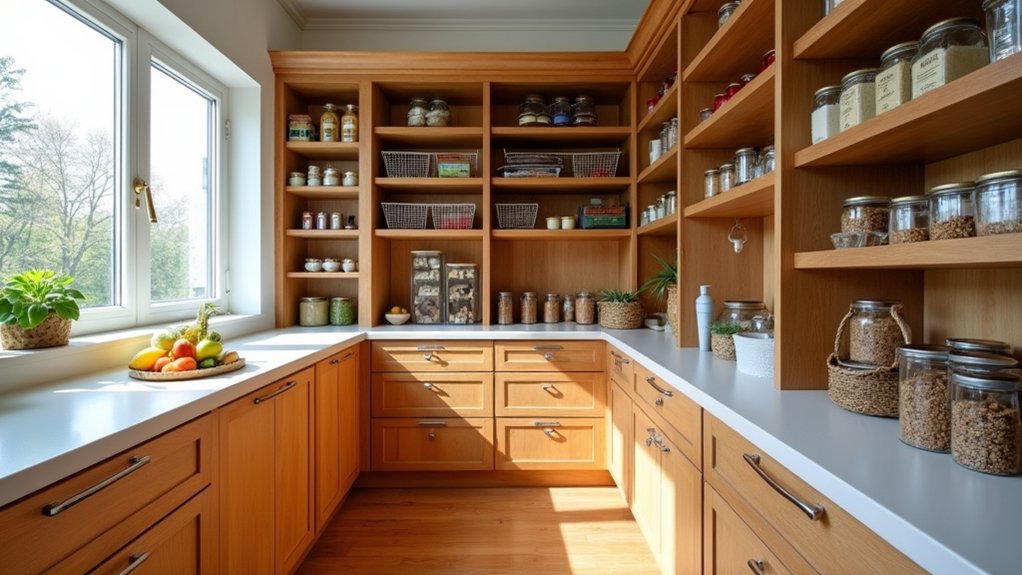
Custom pantry shelving features that make organization easier include thicker 2ʺ or 3ʺ shelves that add depth and support serious weight. Set 12-inch spacing for standard 8 to 10 inch containers, reserve 16 inches on the bottom for 5-gallon buckets, and allow 11 inches for gallon jars up top. Sturdy pantry shelf supports keep everything level under heavy loads, while pantry shelves with brackets let you adjust heights as your storage needs shift. In a walk in pantry with refrigerator, plan clearances so the door swings freely and shelving wraps efficiently around the appliance. Add pull-out shelves and tiered corner units to bring far-reaching items forward, keeping every jar and bin visible and accessible. Innovative storage ideas can also include utilizing vertical space by incorporating wall-mounted shelving or hanging storage. Consider using clear bins to categorize and display ingredients, making it easier to find what you need at a glance.
How do pull-out shelves and drawers improve access
Pull-out shelves and drawers improve access by extending outward to bring items from the far reaches of your pantry into the open, so you’re not digging blindly for that can pushed against the back wall. Instead of unloading everything to reach the back, you slide the whole shelf toward you and grab what you need. This matters most with long pantry shelves, where deep storage otherwise swallows items you forget you own. In a pantry with refrigerator or a pantry with freezer nearby, pull-outs keep your workflow tight, letting you access staples without crowding appliance doors. Soft-close drawers add smooth operation and protect your fingers. Pair them with tiered corner shelves, and you’ll reach every item quickly, cutting the daily frustration of hunting through stacked, hidden goods.
How do you fit a refrigerator or freezer into a pantry
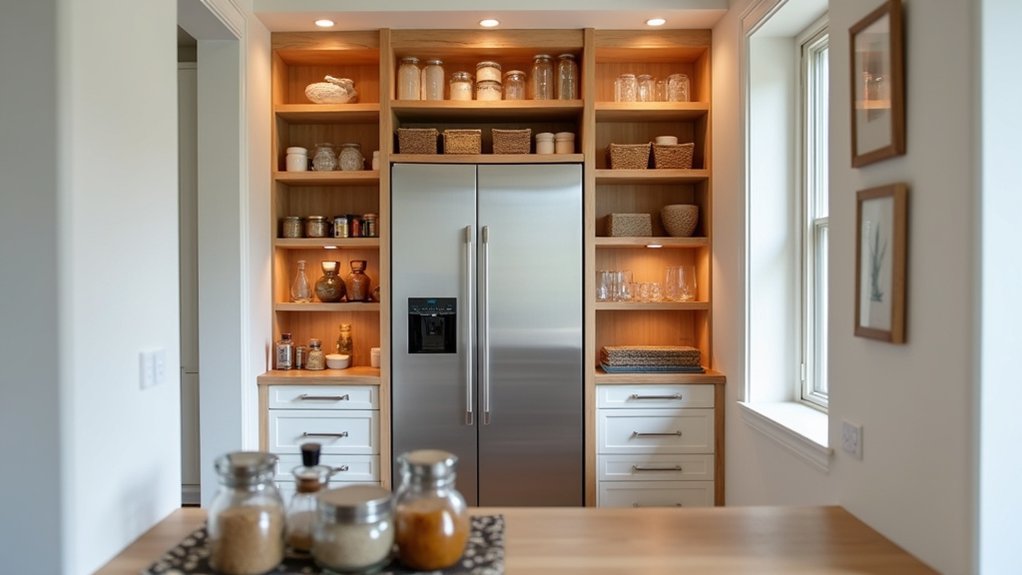
Fit a refrigerator or freezer into a pantry by mapping your available footprint. Measure the appliance’s width, depth, and height, then add clearance for ventilation and door swing. Plan your shelving around this dedicated zone so units don’t crowd the space or block airflow. Position the appliance where daily-use staples sit at waist-to-shoulder height for quick reach. Reserve 16 inches of vertical space on nearby lower shelves for 5-gallon buckets and bulk items that pair with cold storage. Integrate lighting to improve visibility in deep areas surrounding the unit. Choose adjustable shelving so you can reconfigure compartments as your needs shift. Keep a step stool accessible for reaching upper shelves safely above or beside the appliance without climbing. Adapting your layout creates a more efficient space. An adaptable pantry design offers flexible storage for both large bulk items and smaller everyday essentials, maximizing usability while keeping your pantry organized and clutter-free.
What specialty storage handles bulk and awkward items
Specialty storage for bulk and awkward items includes dedicated solutions that match their odd shapes and heavy weights. Start by allocating 16 inches of vertical space on the bottom shelf for 5-gallon buckets and large bulk items. For trays, cutting boards, and baking sheets, position tension rods vertically to create sturdy dividers that keep everything upright and accessible. Big storage for small pantries makes efficient use of corner spaces. Rotating carousels and tiered shelves give easy access to items that usually get lost in the back, maximizing your pantry’s potential while keeping everything organized and in sight.
| Item Type | Storage Solution | Vertical Space |
|---|---|---|
| 5-gallon buckets | Bottom shelf | 16 inches |
| 1-gallon jars | Upper shelf | 11 inches |
| Half-gallon jars | Upper shelf | 10 inches |
Reserve reinforced 2ʺ or 3ʺ thick shelves to handle heavy loads without sagging. Install pull-out shelves or magic corners so you can reach deep bulk items without straining or rummaging blindly.
How do shelf supports and brackets carry heavy loads
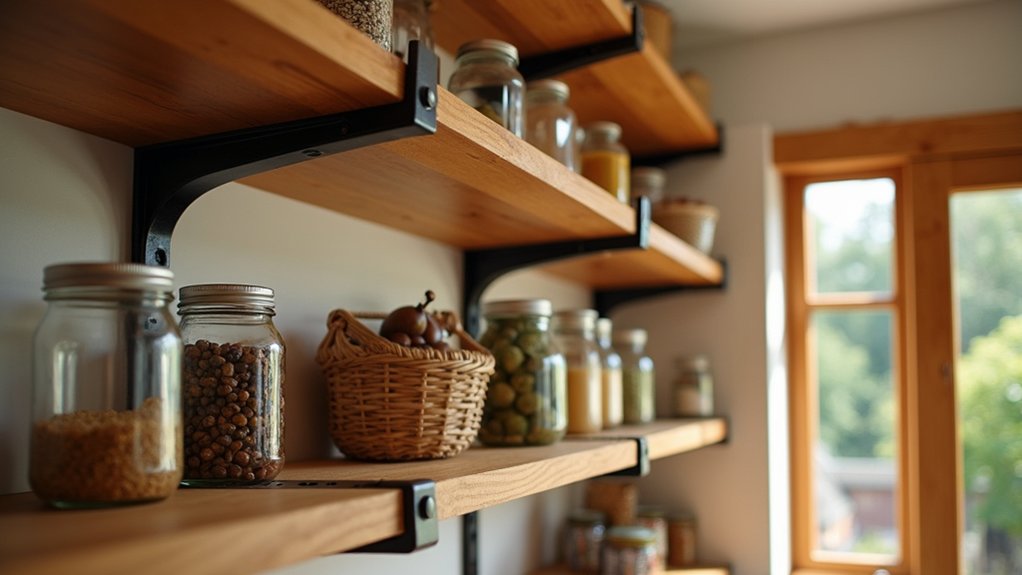
Shelf supports and brackets carry heavy loads through shelf thickness, which does the real work beneath every heavy load. When you choose 2ʺ or 3ʺ thick shelves instead of the standard 1ʺ, you’re adding bulk and depth that resist sagging under weight. This matters most on your bottom shelf, where you’ve allocated 16 inches of vertical space for 5-gallon buckets and large bulk items. Thicker shelves carry those loads without bowing over time.
Pair robust thickness with material choices that hold up: solid wood, plywood, or thermally-fused laminate all support heavy items when you build them right. Position your heaviest containers at waist-to-shoulder height, keeping bulk storage low where the sturdiest shelving lives. When you match shelf thickness to expected loads, you’re building a system that stays level and reliable for years.
How do long shelves and deep zones stay usable
Long shelves and deep zones stay usable when you bring hidden items forward instead of reaching blindly past everything up front. Items in the far reaches disappear from view and become dead space, so focus on three moves that reclaim buried space:
- Install pull-out shelves or magic corners that extend outward, pulling far items into the open where you can grab them instantly.
- Replace flat corner shelves with tiered corner shelves, so back items rise into view instead of vanishing behind front ones.
- Add integrated lighting to deep or dark zones, exposing every container you’d otherwise miss.
Combine these features and you’ll keep long runs and deep corners fully usable, with nothing lost or forgotten in the shadows.
How does Creative Closet Design add custom pantry features
Creative Closet Design adds custom pantry features by building around your exact space rather than forcing you into standard sizing, since every pantry has different dimensions and storage needs. You’ll get adjustable shelf heights and specialized compartments sized to fit your exact pantry dimensions and storage requirements. You can choose materials like MDF, plywood, thermally-fused laminate, or solid wood based on how you want the unit to match your kitchen. You’ll add integrated lighting to improve visibility in deep or dark areas, plus soft-close drawers that reduce wear, prevent pinched fingers, and deliver a smoother experience. You’ll want shelves prefinished before installation for a uniform look that protects the material from crumbs. Every feature ties back to how you actually use and organize your space.
Features Chosen for How You Actually Use the Space
The right pantry features aren’t the longest list, they’re the ones that solve the specific problems your kitchen has. Creative Closet Design plans custom pantry systems for Central Florida homeowners, working out where pull-outs earn their cost, where fixed shelving is smarter, and how to keep deep zones from swallowing your groceries. Serving Lakeland, Auburndale, Winter Haven, Plant City, Polk County, and Hillsborough County, our designers will look at your space and your habits before recommending anything. Call (863) 591-4500 to schedule your free design consultation.
Frequently Asked Questions
Are pull-out shelves worth the extra cost, or is that overkill?
They’re worth it in the right places, and unnecessary in others. Pull-outs cost meaningfully more than fixed shelves because of the hardware, and the slide mechanism consumes some interior width, so you lose a bit of storage space in exchange for access. Where they pay off is anywhere you’d otherwise be crouching and digging, which means the lower bays and deep corners. Above waist height, fixed shelves work fine, since you can see the whole shelf without pulling anything out. Putting pull-outs where you’re looking down into storage gets you most of the benefit for a fraction of the cost.
Is a lazy Susan the best answer for a corner?
It’s one answer, but not always the best one. Lazy Susans do bring items around to the front, which beats a dead corner, and they work well for jars, cans, oils, and sauces. The complaints are real though: the round tray wastes the square corners, taller items tip when it spins, and larger or awkward items don’t sit well on a curved surface. For deep blind corners, pull-out or swing-out corner systems generally recover more usable space, since they bring the entire contents into the open rather than rotating part of it forward.
Can I use the back of the pantry door for storage?
Yes, and it’s one of the most underused surfaces in any pantry. Door-mounted racks handle the small, flat items that get lost on deep shelves: spices, wraps and foils, snack packets, measuring cups, and packet mixes. It keeps them visible and frees shelf depth for larger goods. Two things to plan for. The rack needs clearance so the door still closes over whatever sits on the front edge of your shelving, and the door and hinges need to handle the added weight, which is easier to account for during design than afterward.
If I can only afford a few upgrades, where should the money go?
Start with the lower zone, because that’s where the daily frustration lives. Pull-outs or deep drawers in the bottom bays eliminate crouching and digging, which is the single most common complaint about pantries. Second, put lighting in if the space is deep or dark, since items you can’t see may as well not exist. Third, get the shelf depths and spacing right, which costs nothing extra but determines whether the pantry works at all. Specialty accessories and organizers can be added over time, but the structural decisions are the ones worth investing in up front.
What do I do about a deep blind corner?
Treat it deliberately rather than letting it become dead space. The blind corner, where part of the cabinet extends beyond the door opening, is the hardest area in any pantry to use. Purpose-built solutions exist, including pull-out and swing-out systems that bring the contents forward and around, which recover far more space than a plain fixed shelf. If a mechanical solution isn’t in the budget, the practical alternative is assigning that corner to things you genuinely reach for rarely, like holiday serving pieces or backup stock, rather than everyday items you’ll be fishing for constantly.