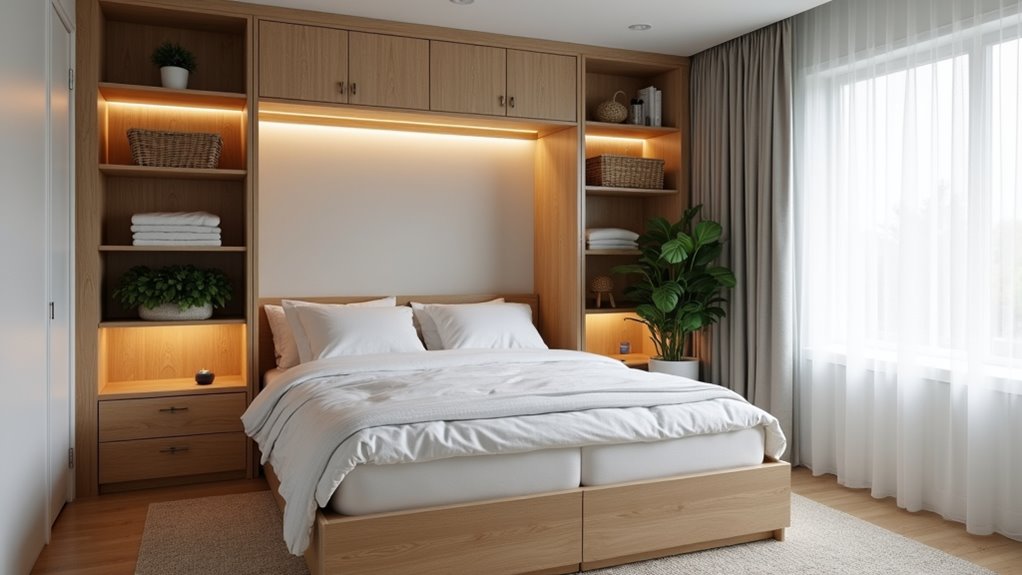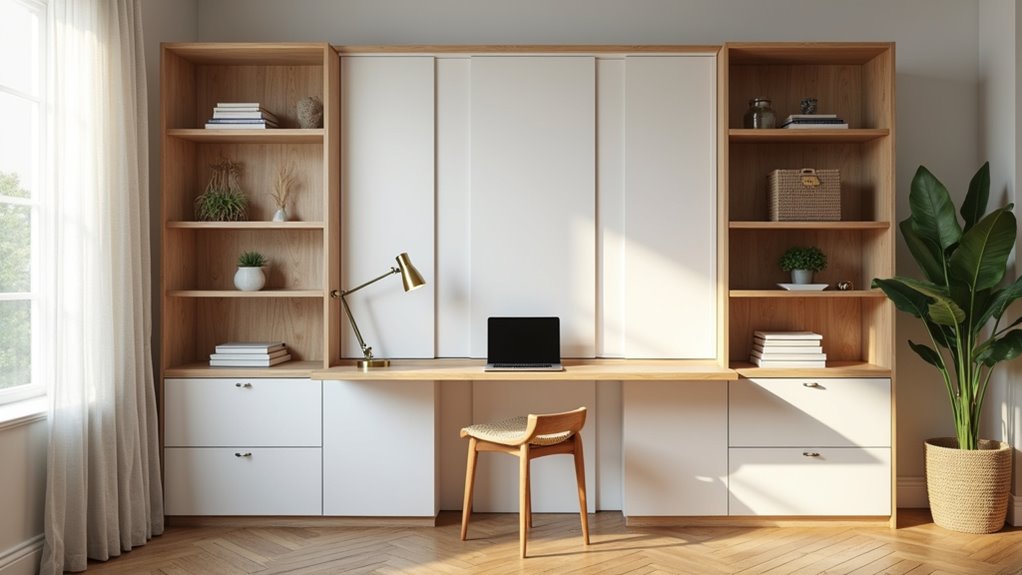
Store lightweight, rarely used items above your Murphy bed, like paperbacks, small decor, and seasonal accessories in lidded bins. Keep heavier essentials low so overhead shelves don’t strain. Beside the bed, use 12 to 24 inch side cabinets for everyday clothing, linens, and spare blankets. Limit bedside surfaces to a book, glasses, or a lamp. Make sure nothing blocks the bed’s swing path, handles, or safety latches. Next, you’ll see how weight, access frequency, and organizers shape each zone.
Key Takeaways
- Store lightweight, rarely used items above a Murphy bed, such as paperbacks, small decor, keepsakes, and seasonal accessories in lidded bins.
- Keep heavier essentials out of overhead storage and place them in lower drawers or cabinets to avoid straining shelves.
- Use side cabinets beside the Murphy bed for clothing, linens, books, and everyday items you access most often.
- Allow 12 to 24 inches per side for side cabinets, and keep every item clear of the bed’s operating path.
- Limit bedside surfaces to essentials like a book, glasses, or a lamp, and ensure nothing blocks handles or safety latches.
What Should You Store Above and Beside a Murphy Bed
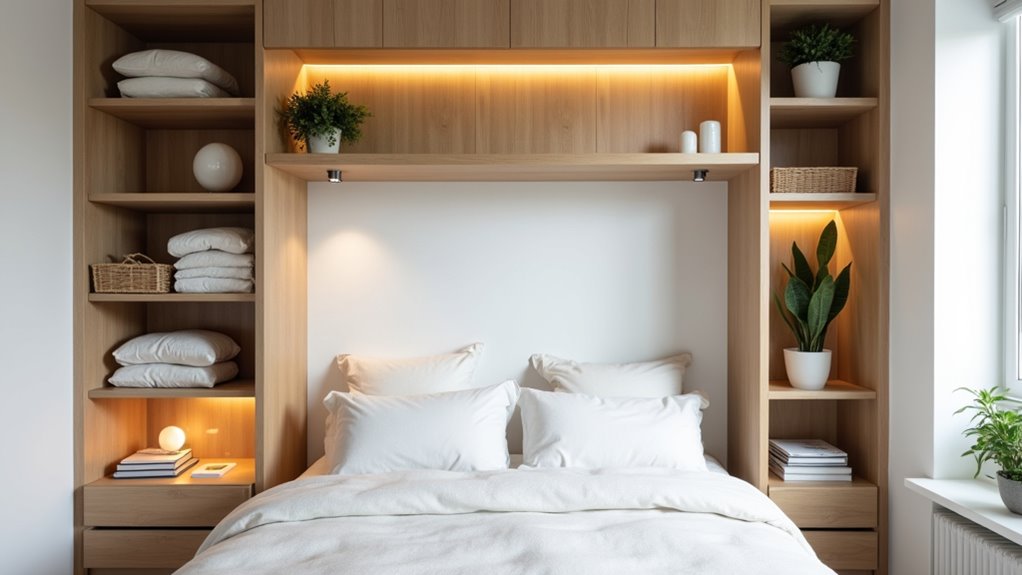
Store lightweight books and small decor on sturdy shelves above the Murphy bed cabinet, and place cabinets holding clothing, linens, and everyday items beside it, keeping every item clear of the bed’s operating path. Match each item you store around murphy bed walls to how often you’ll use it. For murphy bed side storage, allow 12 to 24 inches per side for these cabinets. Keep bedside surfaces limited to a book, glasses, or lamp. Good murphy bed cabinet organization means spare bedding goes in drawers, frequently handled objects stay on open shelves, and less-used items stay enclosed. Confirm your model’s clearance specifications and make sure nothing blocks the handles or safety latches.
Which Lightweight or Infrequent Items Belong in Overhead Storage
Lightweight books, small decor, and items you reach for least belong in murphy bed overhead storage, since the shelves sit above the bed cabinet and shouldn’t be strained. Keep heavier essentials in lower wall bed storage zones.
Store lightweight books, small decor, and rarely used items overhead, and keep heavier essentials in lower wall bed storage zones.
- Paperbacks and slim reference books you don’t read nightly
- Small decor pieces, like framed photos or compact plants
- Seasonal accessories stored in light, lidded bins
- Spare pillowcases or folded throws kept in labeled baskets
- Keepsakes you want displayed but rarely handle
Keep every item outside the bed’s operating path, and confirm clearance against your model’s specifications. Don’t treat these shelves as structural supports. Anchor the cabinet separately to wall framing or masonry. Add under-shelf LED lighting for visibility.
Which Frequently Used Items Belong in Side Cabinets or Shelves

Books, clothing, linens, and the everyday items you use most belong in side cabinets and shelves within arm’s reach of the bed. Put daily clothing in side wardrobes or storage towers, and assign shoes or seasonal pieces to purpose-sized cubbies. Keep spare bedding in cabinet drawers so you can make the bed quickly, and use vacuum-sealed bags to shrink bulky linens.
Reserve open shelves for things you grab often, like a current book, glasses, or a lamp, and move less-used items behind doors. If the room doubles as a workspace, give office supplies their own labeled cubbies.
Plan 12 to 24 inches of wall width per side, and don’t let storage depth block the bed’s opening path, handles, controls, or everyday walking routes.
Which Items Work Best in Lower Drawers or Cabinets
Heavier, bulkier, and less-used items you don’t need to see work best in drawers and cabinets below waist height. Reserve them for things you’d otherwise stack on the floor, and keep the lower zone organized so nothing spills into the bed’s opening path.
- Spare bedding: Store extra sheets, blankets, and pillows in drawers. Vacuum-sealed bags cut their volume.
- Seasonal clothing: Rotate off-season sweaters and coats into purpose-sized cubbies or wardrobe bases.
- Shoes: Line them up in low cubbies so they stay off the walking route.
- Office supplies: Keep paper, files, and chargers in enclosed cabinets when the room doubles as a workspace.
- Guest items: Tuck towels and toiletries into hidden compartments near the bed.
Don’t overfill. Check that contents never interfere with folding, latching, or access.
How Do Access Frequency Weight Size and Display Value Change Where Items Belong

Access frequency, weight, size, and display value each point an item to a different spot around a Murphy bed. Daily items go on open side shelves, heavy items go low, bulky linens go in drawers, and a few decor pieces go on exterior shelves. Lower drawers handle only part of the job, so sort everything else by these four factors.
| Factor | Where It Belongs |
|---|---|
| Access frequency | Daily items on open side shelves; seasonal items in enclosed cabinets |
| Weight | Heavy items low in side cabinets; lightweight books above the bed |
| Size | Bulky linens in drawers or vacuum bags; small items in cubbies |
| Display value | A few decor pieces on exterior shelves, clear of the fold path |
Confirm nothing sits in the bed’s 89-inch open footprint or blocks handles and latches. Don’t treat overhead shelves as supports, and keep lighting and wiring clear of moving parts.
What Should Stay Out of Storage Near Moving Bed Hardware
Deep units, protruding decor, loose wiring, overstuffed bedding, surface clutter, and anything that blocks controls should stay out of storage near Murphy bed hardware. A Murphy bed moves through a fixed arc every time you open or close it, so anything that crowds that path or its hardware doesn’t belong nearby. Check the model’s clearance specs prior to loading any shelves or cabinets, and keep these out:
- Deep units or protruding decor: they intrude into the bed’s operating path and can snag the mattress.
- Loose wiring and lighting cords: route LED strips and reading-light cables well clear of pivots and springs.
- Overstuffed spare bedding: excess linens inside the cabinet can interfere with folding or latching.
- Clutter on bedside surfaces: limit fold-down nightstands to essentials like a book, glasses, or a lamp.
- Anything blocking controls: keep accessories away from handles, safety latches, and the bed’s roughly 89 inch open footprint.
How Can Bins Dividers or Other Organizers Keep Each Storage Zone Easy to Maintain
Bins, dividers, and other organizers keep each storage zone easy to maintain by giving every item a set place, so clutter can’t spread toward the bed’s moving parts.
On above-bed shelves, use shallow bins that sit fully within the shelf depth, keeping lightweight books and decor from creeping into the bed’s operating path. In side cabinets, add drawer dividers for linens and clothing, and assign purpose-sized cubbies to shoes, seasonal items, or office supplies.
Vacuum-sealed bags compress spare bedding, but you’ll still need to check that filled drawers stay within capacity and don’t interfere with folding or latching. Label each bin clearly so you can return items quickly after use, and keep frequently handled objects in front while less-used items stay enclosed behind them.
Storage That Works Around the Bed
The best Murphy bed storage keeps everyday items within reach while heavier and less-used pieces stay in the right zones. Creative Closet Design plans custom entertainment centers for Central Florida homeowners with shelving, cabinets, drawers, and built-ins sized around the way each room is used. Serving Lakeland, Auburndale, Winter Haven, Plant City, Polk County, and Hillsborough County, our designers will look at your storage needs, available wall space, and daily routine before drawing anything. Call Our Team to schedule your free design consultation.
Frequently Asked Questions
How Much Overhead Clearance Does a Queen Murphy Bed Need for Shelving?
You’ll want about 5 inches of overhead clearance above a standard queen vertical Murphy-bed cabinet, which one guide reports at roughly 88 inches tall. That means you’ll need about 93 inches before adding shelving, so measure your ceiling first. Keep shelves outside the bed’s operating path, don’t use them as structural supports, anchor the cabinet separately to wall framing, and confirm exact clearance with your model’s specifications and installation instructions.
How Much Extra Wall Width Should You Plan for Side Cabinets?
Plan 12 to 24 inches of extra wall width per side for cabinets or shelving, according to one guide. You’ll also want at least 3 inches on each side for installation access before adding storage. Measure your wall carefully, subtract the bed cabinet’s width and those clearances, then pick side units that fit. Choose depths that won’t block opening, closing, or walking routes, and confirm your exact model’s specifications before you buy.
Can Overhead Shelves Help Support or Anchor a Murphy Bed Cabinet?
No, you shouldn’t treat overhead shelves as structural supports. Anchor the bed cabinet separately to solid masonry or wood-framed walls, not unsupported drywall alone, and secure it before you operate the bed. Keep shelves light-duty, holding books, small decor, or everyday items, and size them to the wall and cabinet rather than adding deep units. Confirm they sit outside the bed’s operating path and check your model’s clearance specifications before installing.
What Wall Types Are Suitable for Securely Mounting a Murphy Bed?
You’ll want solid masonry or wood-framed walls to mount a Murphy bed securely; don’t rely on unsupported drywall alone. Anchor the bed cabinet directly into the framing or masonry, and don’t treat overhead shelves as supports. Before you install, check your ceiling height, wall obstructions, and the manufacturer’s instructions. Confirm the model’s clearance needs, too, since a queen cabinet stands about 88 inches tall and needs roughly 5 inches overhead.
How Far Does a Queen Murphy Bed Extend Into the Room When Open?
A queen Murphy bed can extend about 89 inches into your room when it’s open, so you’ll want to keep that entire footprint clear of furniture, decor, and stored items. Before you commit, measure from the wall outward and mark the zone with tape. You should also check your specific model’s specifications, since dimensions vary. Then plan side cabinets, nightstands, and shelving outside that path so everything stays easily accessible.