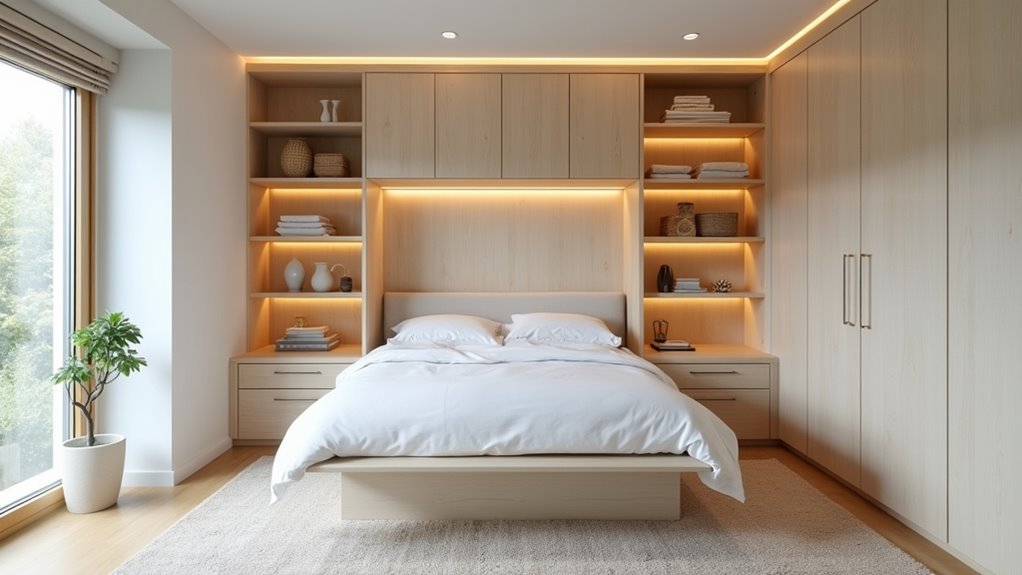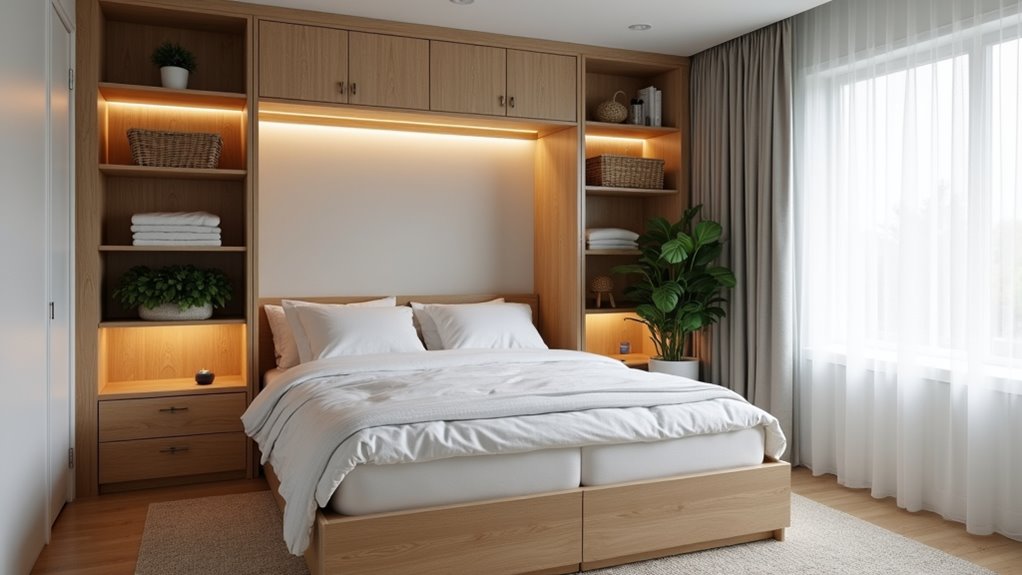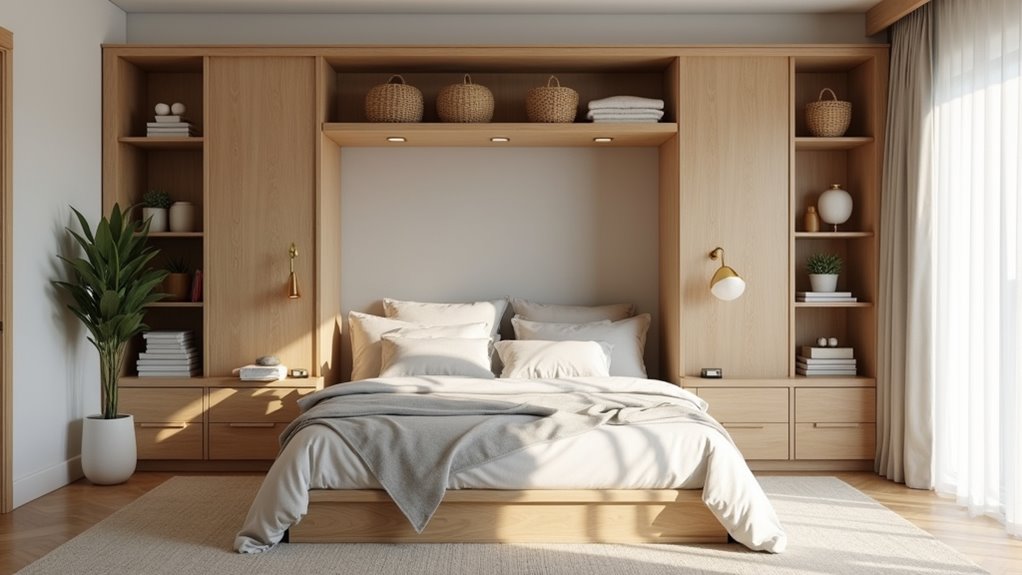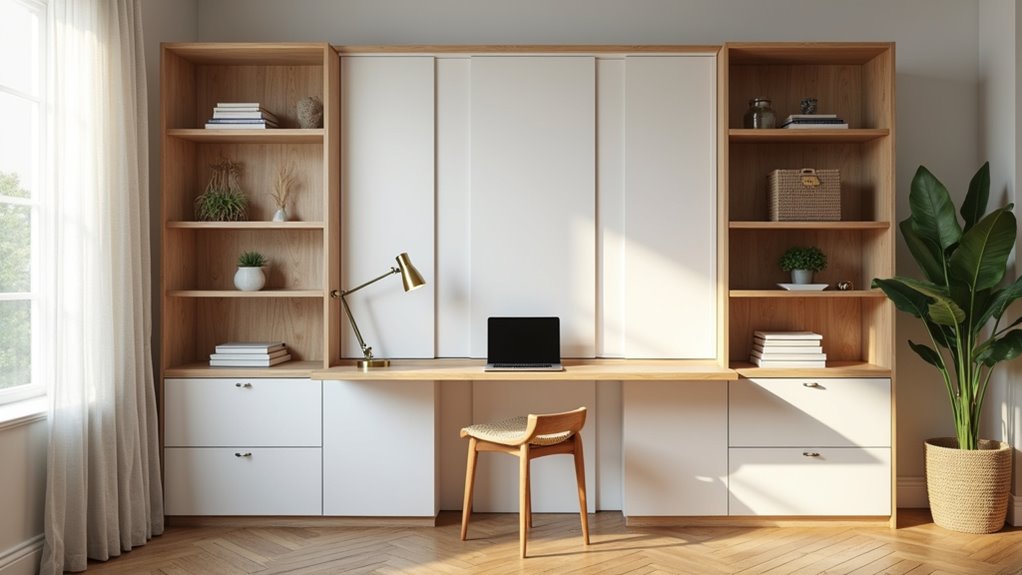
For the strongest pantry shelves, you’ll want solid hardwoods like oak, maple, or ash, they hold heavy cans without sagging and resist the dents and warping that split pine and MDF. Choose 3/4-inch stock for spans up to 30 inches, then step up to 1-inch or add support beyond that. Prefer plywood? Edge-band it for budget-friendly strength. Laminate shrugs off spills, but watch those exposed edges. Below, you’ll find exactly how to match material to your space.
Key Takeaways
- Hardwoods like oak, maple, and ash offer the strongest performance, resisting dents, warping, and sagging under heavy loads.
- Plywood at 3/4-inch with edge-banding provides a budget-friendly alternative, outperforming MDF and particle board in structural integrity.
- Laminate and melamine surfaces resist spills and moisture, though exposed edges can wick water and delaminate over time.
- A 3/4-inch hardwood panel prevents sagging across spans up to 30 inches; wider spans require 1-inch stock or added support.
- For style, walnut and mahogany suit luxury looks, while cherry and ash showcase distinct decorative grain patterns.
What is the best material for pantry shelves
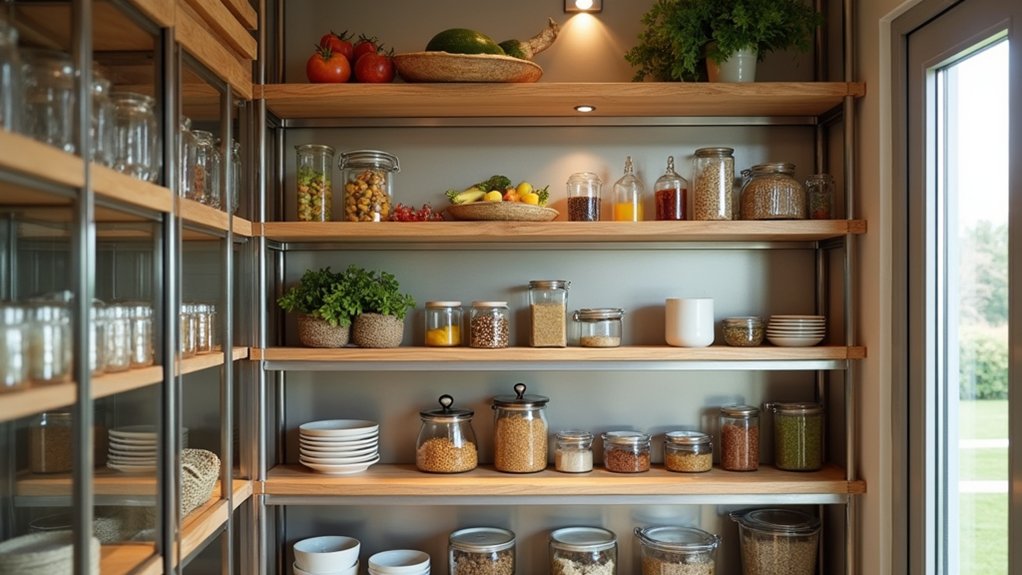
Hardwoods like oak, maple, and ash deliver the strongest performance for heavy loads on pantry shelves. These species resist dents far better than softwoods like pine, giving you long-term structural integrity for heavy cans and appliances. If you’re weighing the best material for pantry shelves, tight-grained maple or birch prevents warping and sagging under standard conditions. For moisture and humidity resistance, choose cedar, cherry, or cypress, which naturally repel rot, insects, and dampness without chemical treatments. Wood pantry shelving also offers hygienic advantages: unfinished maple or oak sanded to 220-grit shows the lowest bacterial retention thanks to natural tannins that inhibit biofilm. Avoid particle board and lightweight engineered panels, they sag and split under weight. Solid hardwood remains your best long-term investment.
How does solid wood perform for pantry shelving
Solid wood performs exceptionally well for pantry shelving because it combines load capacity with dimensional stability, making it the benchmark for shelves that carry heavy cans and small appliances. When you choose hardwoods like oak, maple, cherry, and mahogany, you get the highest load capacity and superior dent resistance over softwoods like pine. Oak pantry shelves rank among the strongest options for strength and longevity, and tight-grained species prevent warping under standard conditions. Beyond choosing the right kitchen storage, consider how you arrange items. Efficient use of vertical space maximizes functionality and accessibility, and placing heavier items lower minimizes strain when reaching for them.
- Strength: Oak, maple, and ash resist sagging and denting, ensuring long-term structural integrity.
- Moisture resistance: Cedar pantry shelves naturally repel insects, moisture, and rot without chemical treatments.
- Hygiene: Unfinished maple or oak sanded to 220-grit inhibits biofilm, retaining just 0.3 CFU/cm² after 72 hours.
For stability, beauty, and low maintenance, wood pantry shelves deliver the best long-term investment. Organized pantry solutions can greatly enhance the efficiency of your kitchen space. They allow for easy access to ingredients while maintaining a visually appealing environment. Investing in these smart storage options can transform your cooking experience.
How do plywood and MDF compare for strength and cost
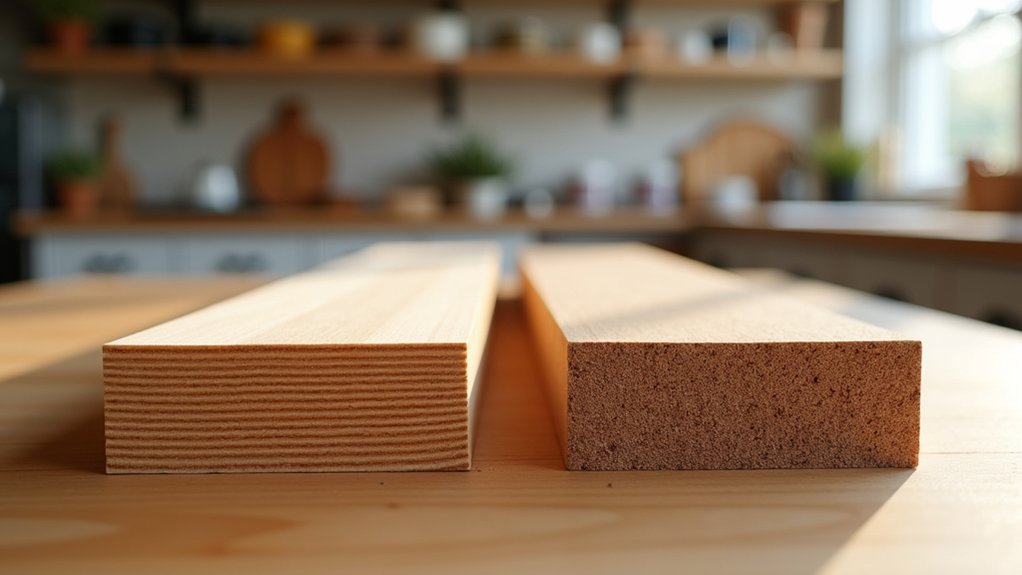
Plywood is stronger than MDF but costs more, making it the better choice for heavy loads while MDF suits budget, light-duty needs. For pantry shelves, plywood wins on structural integrity: edge-band the exposed plies and you’ll get a sturdy, budget-friendly alternative to solid wood. MDF pantry shelves cost less, but the lightweight engineered core sags and splits under heavy cans.
| Material | Strength | Cost |
|---|---|---|
| Plywood | High (edge-banded) | Mid-range |
| MDF | Low, sags under load | Low |
| Solid Hardwood | Highest | High |
Reserve MDF for light-duty storage where budget’s your primary constraint. Choose plywood when you’re loading appliances or bulk goods and need dependable, long-term rigidity without solid wood’s premium price.
How does melamine or laminate hold up to spills
Laminate and melamine hold up well to spills because their non-porous surface seals the substrate, letting them shrug off liquids that would swell or stain bare wood. Coated wire and laminate shelves deliver moisture-resistant, rust-proof performance ideal for humid pantries, so a quick wipe clears juice, oil, or brine before it penetrates. The real vulnerability lies at the edges, where an exposed core wicks moisture and delaminates. Guard those seams and you’ll extend the panel’s service life considerably.
The surface shrugs off spills; it’s the exposed edges that quietly drink them in.
- Edge-band every cut to seal the particleboard or MDF core against liquid intrusion.
- Wipe spills promptly, since standing water eventually breaches unsealed joints and fasteners.
- Inspect seams periodically for lifting, bubbling, or swelling that signals moisture penetration.
Handle the edges correctly, and laminate resists spills reliably for years.
What thickness keeps shelves from sagging
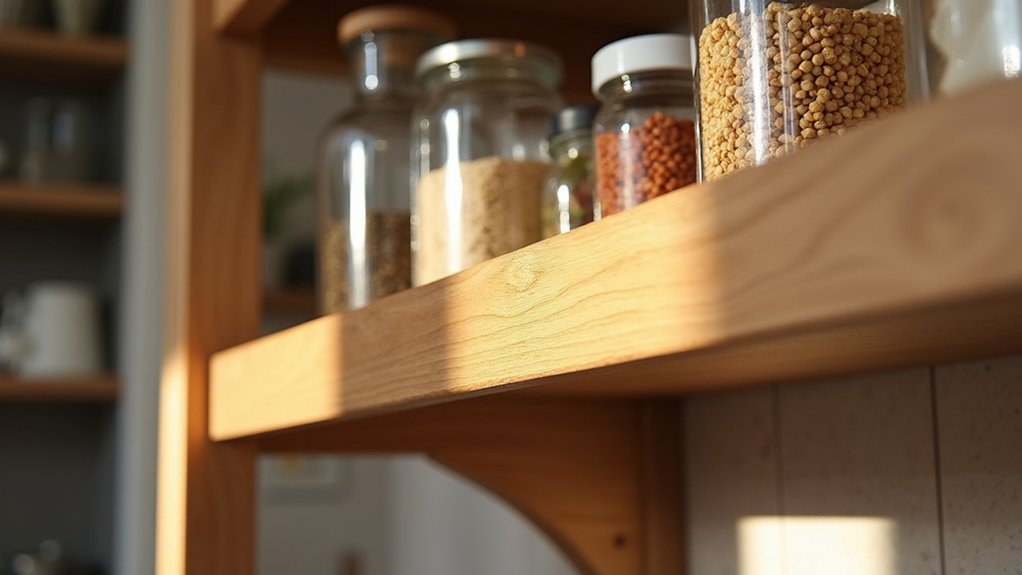
A 3/4-inch panel of solid hardwood like oak, maple, or ash keeps shelves from sagging across moderate spans up to about 30 inches when you’re stacking heavy cans and appliances. Under load, thickness governs how far a shelf deflects between supports, so you’ll want to match the panel’s dimension to the span and the weight it carries. Push beyond that and you’ll need 1-inch stock or added support to prevent sagging. Plywood, when edge-banded properly, performs comparably at 3/4-inch, resisting deflection better than particle board or MDF, which sag and split under sustained weight. Tight-grained species like maple and birch hold their line best. Shorten your spans, add center supports, or step up thickness, and you’ll keep every shelf flat and rigid for years.
How do you match material to your budget and look
The wood species you choose defines both cost and character, matching your budget to your aesthetic goals. Hardwoods like oak, maple, and ash deliver premium strength and longevity, but they demand a higher initial investment. If you’re working within tighter constraints, pine, plywood, or MDF cut costs without sacrificing all functionality. Match your selection to how the space reads visually:
Your wood species defines cost and character alike, balance budget against beauty to match your space perfectly.
- High-end luxury: Walnut or mahogany deliver darker tones and rich grain for refined pantry designs.
- Mid-range balance: Birch, poplar, and ash pair reasonable pricing with dependable toughness.
- Budget-conscious: Pine and edge-banded plywood keep expenses low while staying structurally sound.
For decorative value, cherry and ash showcase distinct grain patterns, while glass jars on shelves reinforce airtight storage and cohesive organization.
How does Creative Closet Design build durable pantry shelves
Creative Closet Design builds durable pantry shelves by starting with the strongest materials available. You’ll get hardwoods like oak, maple, and ash, the top-ranked species for load capacity, dent resistance, and longevity. These tight-grained woods prevent warping and sagging under standard pantry conditions, so your shelves stay rigid for years. With the right materials, you can explore various seasonal food preservation techniques. Well-designed storage solutions extend the longevity of preserved items, and properly maintained pantry shelves keep them organized and easily accessible.
You won’t find particle board or lightweight engineered boards here, since they’re prone to sagging and splitting under heavy cans and appliances. When budget allows, you can upgrade to African padauk, koa, or mahogany for superior strength.
Every board’s carefully graded to eliminate loose knots and rough-hewn textures. If you choose plywood, we edge-band it properly, delivering a sturdy, budget-friendly alternative that won’t compromise structural integrity.
Shelves Built to Carry What You Put on Them
Material, thickness, span, and support all work together, and getting them right is the difference between shelves that stay flat for decades and shelves that bow under a row of canned goods. Creative Closet Design builds custom pantry shelving for Central Florida homeowners using materials and construction matched to the loads you’ll actually carry. Serving Lakeland, Auburndale, Winter Haven, Plant City, Polk County, and Hillsborough County, our designers will look at your space, your storage, and recommend a build that holds up. Call (863) 591-4500 to schedule your free design consultation.
Frequently Asked Questions
Is there a way to make a shelf stronger without going thicker?
Yes, and it’s the most cost-effective upgrade available. Adding a solid hardwood strip along the front edge of a plywood shelf dramatically increases its stiffness for very little added material. The edge band works structurally, resisting the downward bend where deflection is most visible, and it finishes the raw plywood edge at the same time. For most pantry applications, a properly edged plywood shelf outperforms a thicker unedged one. It’s the single best return on investment in shelf construction.
Do adjustable shelves hold less weight than fixed ones?
They do, and it’s worth understanding the tradeoff. A shelf resting on pins or clips is supported at contact points and can flex more freely under load. A fixed shelf, secured to the sides and ideally the back panel, is held rigid at those joints and resists bending considerably better. That difference can meaningfully change how far a shelf can span before it starts to bow. A practical approach is fixing the shelves carrying the heaviest loads, typically the lower bays, while keeping the upper shelves adjustable where flexibility matters more than maximum capacity.
How much weight can a pantry shelf actually hold?
It depends on material, thickness, span, and support, so the range is wide. A properly supported hardwood or edge-banded plywood shelf at a reasonable span handles substantial loads without noticeable deflection, comfortably more than a pantry typically demands. Wire shelving generally carries considerably less and is better suited to lighter goods. The number that matters most isn’t the shelf’s theoretical capacity but whether the span between supports matches the load. Shortening the span or adding a center support raises real-world capacity more than any other single change.
Is wire shelving ever the better choice?
For some situations, yes. Wire costs meaningfully less, and its open construction promotes airflow, which is worth considering in humid climates where moisture buildup is a concern. The drawbacks are practical: bottles wobble, small packages tip or slip through the gaps, weight limits are lower, and it reads utilitarian in a finished kitchen. It works fine for boxed and canned goods in a utility space. For a pantry meant to look like part of the home and carry appliances or bulk items, solid shelving is the sturdier and better-looking choice.
How do these materials handle Florida humidity?
Differently, which is worth planning around. Solid wood can swell, warp, or move with sustained humidity swings unless it’s properly finished and sealed on all faces. Quality plywood is more dimensionally stable than solid wood because of its cross-laminated construction. Laminate and melamine handle moisture well on the surface, but the exposed core at cut edges will wick water over time, which is exactly why edge-banding every cut matters here more than in a dry climate. Whatever the material, sealing the edges and keeping the pantry ventilated does most of the work.