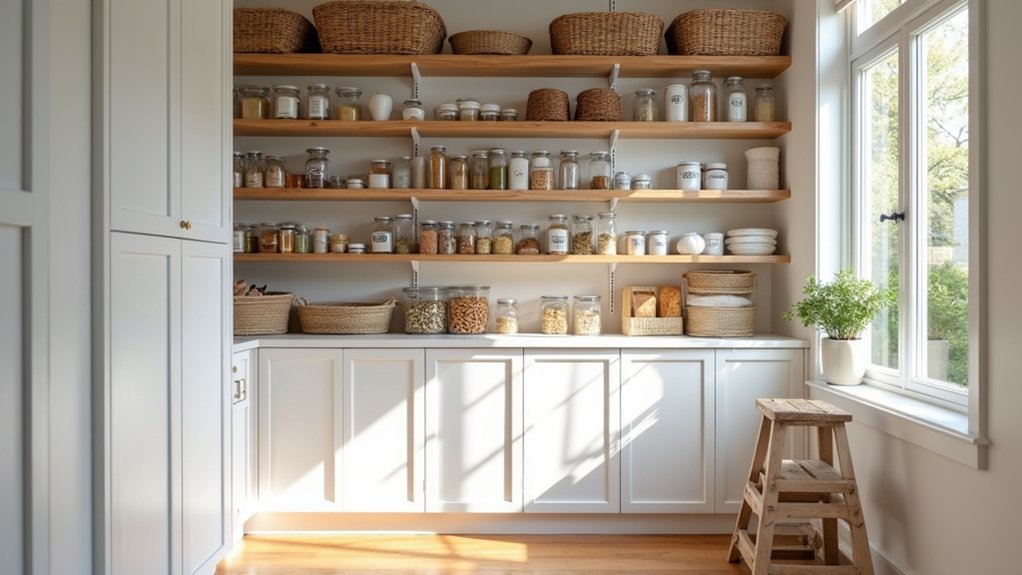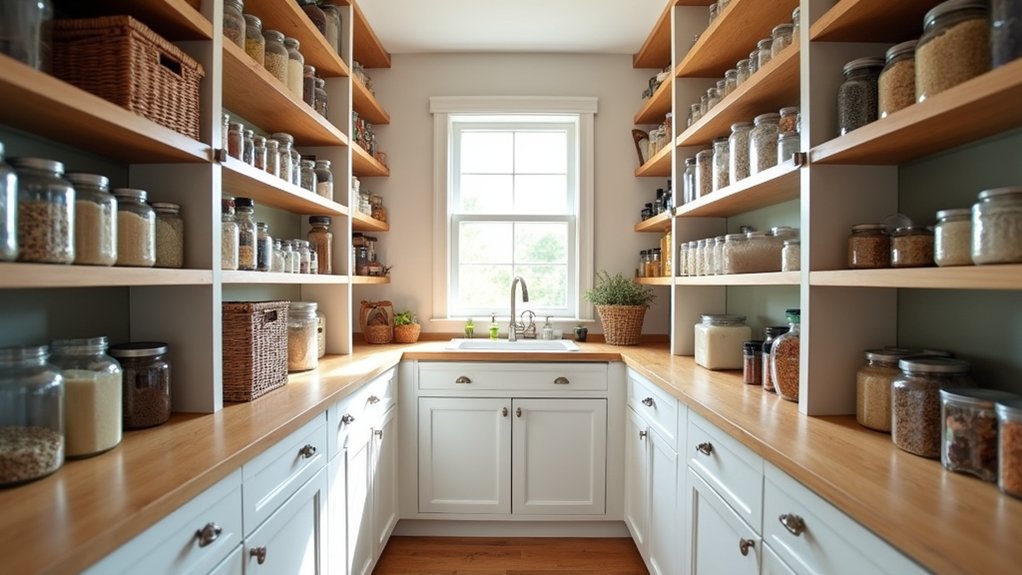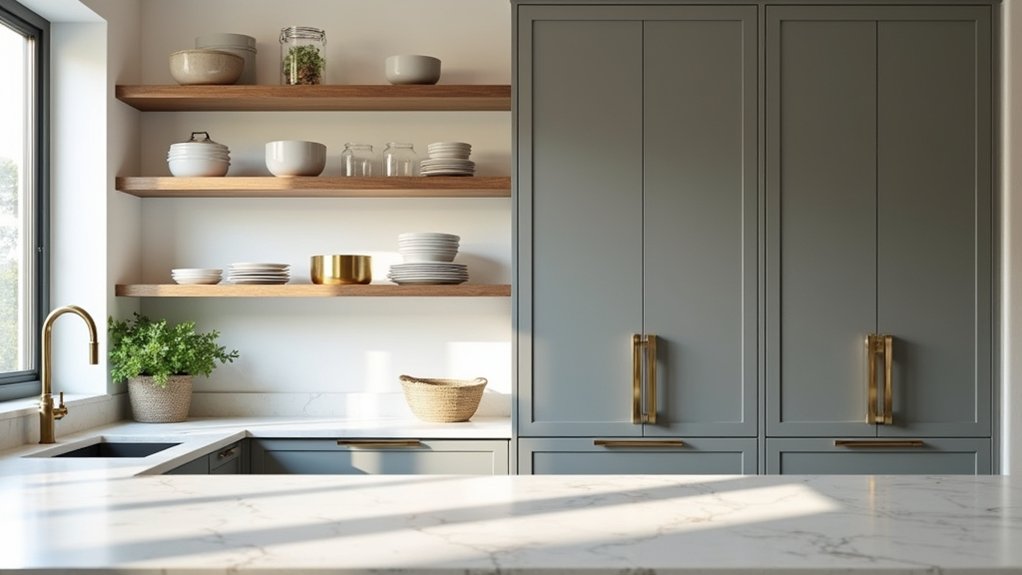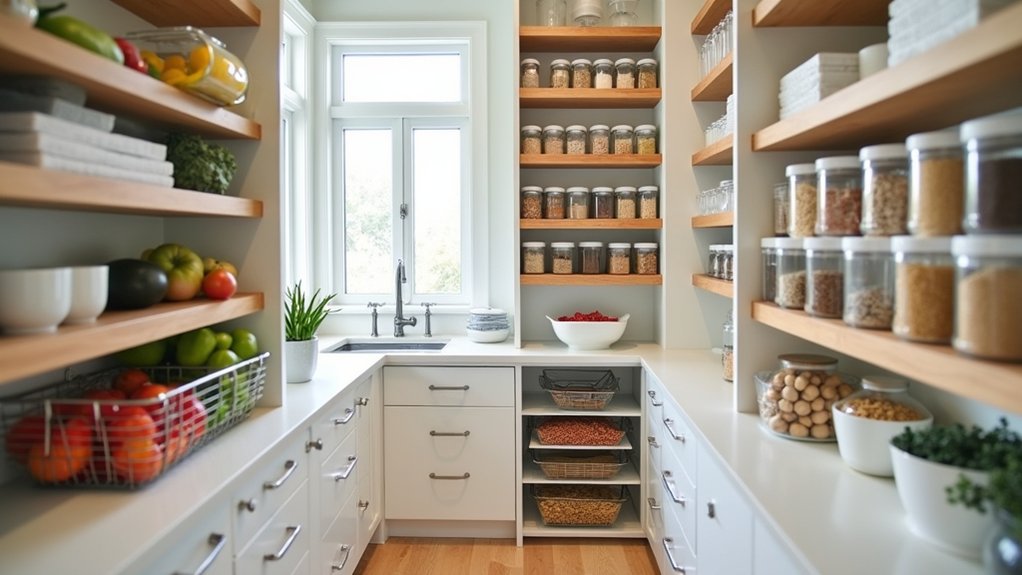
Your choice depends on how you access items and what you’re storing. Open shelving mounts 18 to 24 inches above your counter, giving you glance-and-grab access with shallow 8- to 9-inch depths for mugs and glassware. Built-in cabinets seal contents away, using 12-inch depths for pots and bulk goods while cutting upkeep. Hybrid layouts blend both, showing curated pieces and hiding clutter. Match your inventory to shelf depth, and the right fit becomes clear.
Key Takeaways
- Open shelving offers glance-and-grab access with a casual, custom look and lower cost than traditional cabinetry.
- Closed pantry cabinets hide contents, reduce dusting, and slide neatly into layouts without claiming extra square footage.
- Match shelf depth to contents: 8-9 inches for mugs and glassware, 12 inches for pots and bulky items.
- Mount open pantry shelves 18 to 24 inches above the countertop for practical everyday reach.
- Hybrid designs suit small kitchens by displaying curated pieces on open shelves while hiding clutter behind closed cabinets.
Should you choose open shelving or built-in pantry cabinets
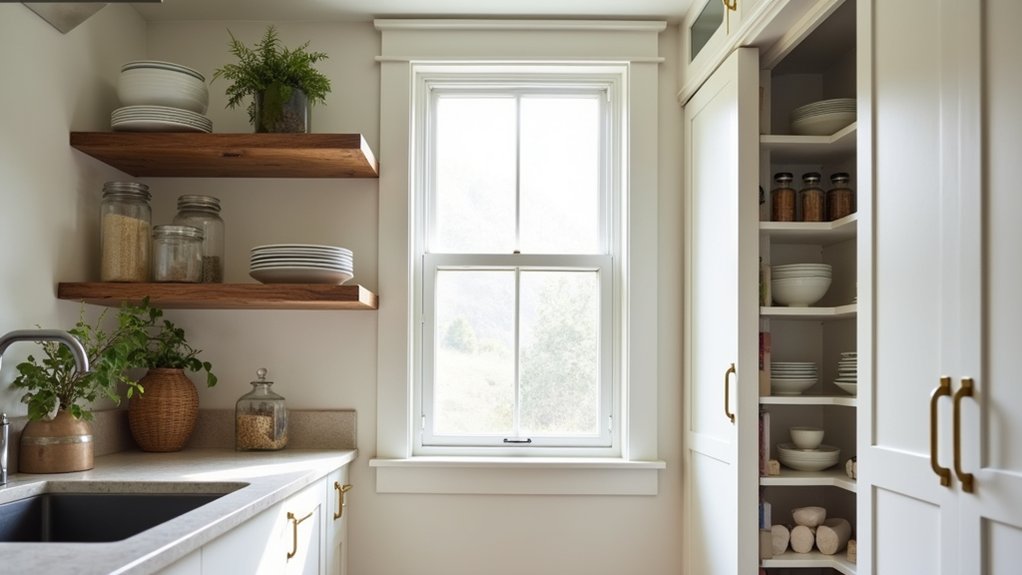
Choose open shelving for visible, glance-and-grab access, or built-in pantry cabinets for permanent, hidden storage that blends into your layout. Open pantry shelves in the kitchen typically start 18 to 24 inches above your countertop, keeping frequently used items within easy reach. If you want visible, glance-and-grab access, they’re ideal, though they demand intentional organization to stay dust-free and clutter-free. Built-in shelves offer a permanent, space-efficient solution that blends into your layout while hiding heavy-duty storage behind closed doors. Consider your shelf depth: 8 to 9 inches handles mugs and glassware, while 12 inches accommodates pots and larger items. For many small kitchens, hybrid pantry shelf ideas, open displays paired with closed cabinets, deliver both style and function. Efficient kitchen space solutions can transform even the smallest areas into functional culinary havens. By maximizing vertical space and using multipurpose furniture, you can ensure that every inch serves a purpose.
What are the benefits of open pantry shelves
Open pantry shelves deliver visible storage that eliminates shuffling through dark cabinets, giving you items right at a glance. You’ll position shelves for a pantry 18 to 24 inches above your countertop to maintain accessibility, then size the depth to match your contents. 8 to 9 inches handles mugs and glassware, while 12 inches accommodates pots and larger items. As you explore pantry shelves ideas, you’ll find they create a casual, custom look that connects visually to your living space. Durable pantry design enhances both your kitchen’s aesthetic and functionality. Choose materials that withstand wear and tear while complementing your decor, creating a cohesive look that blends practicality with style.
- Coffee mugs and glassware lined neatly on 8-inch shelves
- Contrasting painted interiors framing your displayed items
- Everyday ingredients within arm’s reach of your cooking station
- Decorative accents styled intentionally, not overflow clutter
You’ll also cut update costs, since open shelving beats traditional cabinetry affordably.
What are the benefits of closed pantry cabinets
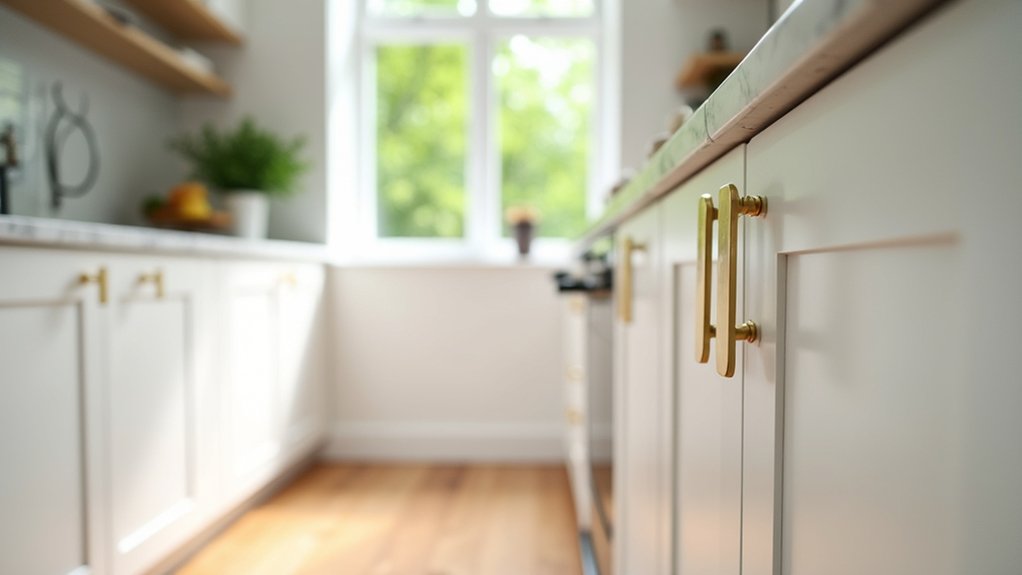
Closed pantry cabinets give you a tidier look with far less upkeep than open shelves, which put everything on display. You’ll spend less time dusting, since doors seal contents away from airborne particles. Cabinet pantries fit every kitchen size, tucking storage right beside your cooking station without claiming extra square footage. For smaller homes, they slide neatly into existing layouts. You’ll also save money, with prices typically between $200 and $1,000.
| Feature | Cabinet Pantry | Benefit to You |
|---|---|---|
| Upkeep | Minimal cleaning | Saves your time |
| Cost | $200, $1,000 | Budget-friendly |
| Footprint | Fits any size | No wasted space |
If you prefer a streamlined kitchen and want practical storage near your prep zone, closed cabinets deliver clean, compact function.
How does a hybrid design combine both
A hybrid design combines both approaches by assigning each zone a specific job. You mount open shelving 18 to 24 inches above the countertop in display areas, keeping your daily glassware and mugs within reach on 8- to 9-inch-deep boards. Then you dedicate closed cabinets to heavy-duty storage, tucking pots, pans, and bulk items behind doors on 12-inch-deep shelves. This layout suits small kitchens especially well, letting you show off curated pieces while hiding clutter. Pantry layout comparison is essential for maximizing storage and improving workflow. A well-organized pantry makes it easier to find ingredients and tools, and considering different arrangements lets you tailor the space to your culinary habits and lifestyle.
- Floating shelves staging your favorite mugs beside the coffee station
- Deep lower cabinets swallowing stacked pots and pans
- Painted cabinet interiors peeking through as intentional accents
- A clean sightline blending display zones into your living space
You gain function and visual balance without sacrificing either.
How does each option affect your kitchen’s look
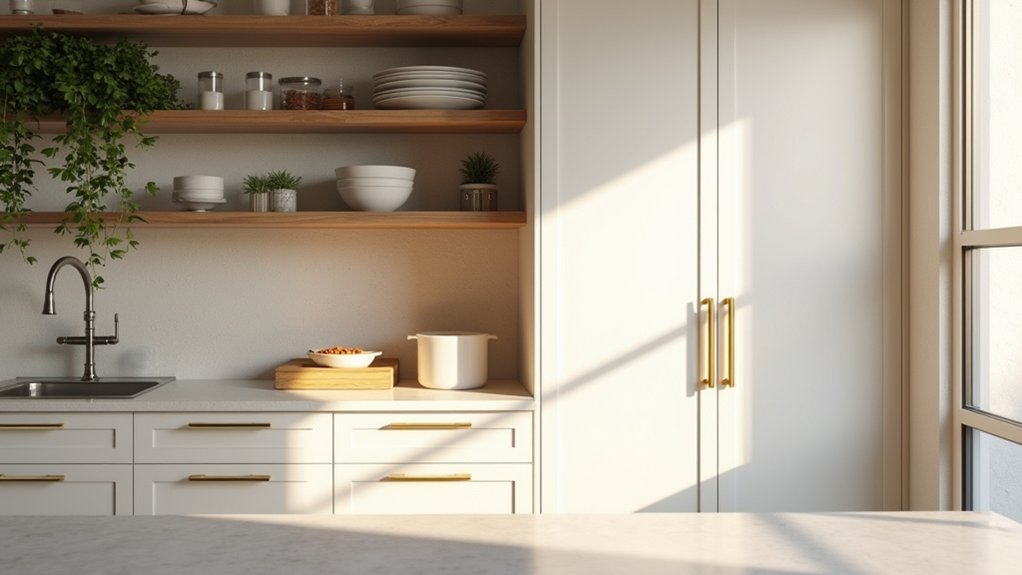
Each option shapes the visual character of your space in distinct ways. Open shelving creates a casual, custom look that feels visually connected to the rest of your living space. You’ll see it in modern, farmhouse, Scandinavian, and minimalist kitchens, where shelves function as intentional decorative accents rather than overflow storage. Position them 18 to 24 inches above your countertop to maintain accessibility and clean sightlines. Closed cabinets, by contrast, deliver a tidier look, concealing contents behind doors for a streamlined layout. If you want the open aesthetic without a full remodel, remove cabinet doors and paint the interiors a contrasting color. For 2026, the most popular designs lean into a blended approach, mixing open shelves in display zones with closed cabinets for heavy storage.
How do you decide based on what you store
Cataloging your inventory tells you how much depth and access you need. Match your items to shelf dimensions before committing to a layout. Shallow depths keep everyday items visible and reachable, while deeper shelves and enclosed cabinets handle bulk and bulky cookware.
- Coffee mugs and glassware slide neatly onto 8-to-9-inch-deep open shelves, right at eye level.
- Pots, pans, and oversized pantry goods demand a full 12-inch depth to sit securely.
- Bulk groceries and rarely-used appliances belong in a walk-in, spread across generous square footage.
- Decorative dishware earns a spot on open shelving as an intentional accent, not overflow.
Mapping your inventory to depth makes the right storage solution obvious.
How does Creative Closet Design design pantry storage
Creative Closet Design designs pantry storage by starting with your inventory and your kitchen’s dimensions, then building storage that fits both. If you’ve got 4 to 5 feet of width and depth to spare, we’ll design a walk-in pantry for bulk groceries and appliances you don’t reach daily. Tighter kitchens get cabinet pantries positioned near your cooking station, saving square footage without sacrificing capacity. We spec shelf depths to match your items: 8 to 9 inches for mugs and glassware, 12 inches for pots, pans, and larger goods. When you want visible access, we’ll place open shelving 18 to 24 inches above your countertop. For many small kitchens, we’ll blend both, open shelves for display, closed cabinets for heavy-duty storage, matching your layout, your workflow, and your budget.
Get the Balance Right for How You Cook
Open shelving looks effortless in photos and behaves differently in a kitchen where dinner actually gets made. Creative Closet Design plans kitchen and pantry storage for Central Florida homeowners around real habits, putting display where it works and concealed storage where it earns its keep. Serving Lakeland, Auburndale, Winter Haven, Plant City, Polk County, and Hillsborough County, our designers will look at your layout, your cooking, and your storage before recommending a mix. Call (863) 591-4500 to schedule your free design consultation.
Frequently Asked Questions
Does open shelving really get greasy if I cook a lot?
Yes, and it’s the most common regret people report. Dust alone is manageable with a regular wipe, but cooking oil becomes airborne and settles as a fine film on everything within a few feet of the stove. Items you don’t use often develop a sticky layer that means rinsing before use. A good vented range hood run consistently during cooking cuts this significantly, while a recirculating hood helps less and no hood at all makes it noticeably worse. If you cook most nights, this is worth planning around rather than discovering later.
Where should open shelving actually go?
Away from the stove and sink. The grease and steam zone is the worst place for exposed dishware, so the practical move is putting open shelves in a coffee station, a beverage area, a dining-adjacent wall, or a butler’s pantry rather than directly beside the range. Keeping what’s displayed in daily rotation also helps, since items that get used and washed regularly never sit long enough to build up film. Placement is the single biggest factor in whether open shelving works or becomes a chore.
Is there a middle option that gets the look without the upkeep?
Glass-front cabinets, and they’re what designers most often recommend for exactly this. You keep the visual lightness and the ability to see what’s inside, but doors protect everything from dust, grease, and steam. Frosted or reeded glass softens the view if you don’t want the contents fully on display. Another approach is converting just one or two upper cabinets to open shelves while leaving the rest closed, which gives you the airy break in a cabinet run without committing the whole kitchen to constant maintenance.
Will I lose storage by choosing open shelves?
Some, and it’s worth factoring in. Cabinets let you stack and pack without regard to appearance, using the full depth and height of the box. Open shelves are limited by what looks acceptable, so you naturally store less on them, and things you’d otherwise tuck away end up on the counter instead. In a kitchen already short on storage, that tradeoff matters. If capacity is your primary problem, closed storage solves it more directly, and the open-shelf look can be introduced in a small, deliberate area instead.
Do my dishes have to match for open shelving to look right?
Not identical, but consistent. Open shelves read as calm when there’s a coherent color and material story, and they read as clutter when the contents are a random mix accumulated over years. Most households don’t own a fully matched set, which is a real reason people revert to closed storage. If you like the look, the practical path is displaying the pieces that do coordinate, keeping the mismatched everyday items behind doors, and resisting the urge to let the shelves absorb overflow.